A Transformation Value Audit of India’s Ethanol Blending Program
Download the PDF version of this white paper: “E20 Transformative Value Audit of India Ethanol Blending”
Executive Summary
India’s Ethanol Blended Petrol (E20) program represents one of the country’s most ambitious energy transition initiatives. Designed to reduce crude oil imports, improve energy security, strengthen farmer incomes, and lower carbon emissions, the policy has achieved remarkable progress in expanding ethanol production and reaching nationwide blending targets ahead of the original roadmap. From a national policy perspective, these are meaningful accomplishments that deserve recognition.
However, successful public policy cannot be evaluated solely by measuring whether national objectives have been achieved. Equally important is how the benefits and costs of that policy are distributed across every stakeholder it affects. Governments, automobile manufacturers, oil marketing companies, farmers, consumers, insurers, service networks, and environmental institutions each experience the policy through a different value equation. A strategy that creates substantial value for one stakeholder may simultaneously impose hidden costs on another.
This white paper argues that the current public debate surrounding E20 has become unnecessarily polarized. One side presents the program as an unquestionable success that advances India’s energy independence and agricultural economy. The other portrays it as a policy that compromises vehicle performance, consumer economics, and mechanical reliability. Both perspectives contain elements of truth, yet neither provides a complete systems view of the problem. Recent legal disputes, public criticism, and growing consumer concerns demonstrate that the debate is no longer confined to engineering or fuel economics, but now extends to policy implementation, accountability, transparency, and public trust.
Rather than asking whether E20 is a good or bad policy, this paper asks a more fundamental strategic question: Has the value created by the policy been distributed fairly across all stakeholders, and if not, how can that imbalance be corrected without undermining the national objectives that motivated the program?
Using a stakeholder value framework, this paper examines the E20 ecosystem through multiple dimensions, including economics, consumer welfare, environmental outcomes, vehicle compatibility, implementation strategy, market incentives, and long-term sustainability. Instead of evaluating the policy from a single political, industrial, or environmental viewpoint, it analyzes the interconnected trade-offs that emerge when one objective is optimized without adequately accounting for its effects on adjacent stakeholders.
A central theme of this paper is that public policy should not force a choice between national interest and consumer interest. Well-designed policy should strive to maximize both. Where trade-offs are unavoidable, they should be communicated transparently, supported by evidence, and accompanied by mechanisms that distribute the burden equitably among those who benefit from the policy. Long-term public confidence depends not only on the success of the policy itself, but also on the perception that its implementation is balanced, accountable, and fair.
The objective of this white paper is therefore not to oppose India’s ethanol program, nor to defend it uncritically. Its purpose is to provide policymakers, industry leaders, automobile manufacturers, energy companies, researchers, and consumers with a structured framework for evaluating the policy beyond headline outcomes. By applying systems thinking and stakeholder value analysis, the paper seeks to identify opportunities to strengthen the program while preserving its strategic objectives. The broader lesson extends well beyond E20 itself: enduring public policy is measured not only by the goals it achieves, but also by the quality of the value ecosystem it creates.
1. Why India Adopted E20
Every generation witnesses a handful of national transformation programs that fundamentally alter the trajectory of a country’s economy. Some reshape industrial competitiveness through manufacturing reforms, others accelerate digital adoption through technological innovation, while many seek long-term energy security by reducing dependence on imported resources. Regardless of their objective, all such transformations share one common characteristic. They require governments to make decisions whose benefits and consequences extend far beyond the department that initiated the policy.
India’s Ethanol Blended Petrol program is one such transformation.
The transition from conventional petrol towards higher ethanol blended fuels represents far more than a change in fuel composition. It is an ambitious national strategy that intersects with energy security, agriculture, public finance, environmental sustainability, water resources, automobile engineering, consumer economics, logistics, and long-term industrial policy. Decisions of this magnitude therefore deserve evaluation through a similarly broad analytical lens.
Unfortunately, large scale public transformations are often evaluated through a limited set of success indicators. A ministry responsible for energy policy may naturally emphasize crude oil substitution and foreign exchange savings. Agricultural agencies may focus on increased rural demand and farmer income. Environmental institutions may examine reductions in fossil fuel dependence, while automobile manufacturers concentrate on vehicle compatibility and engineering adaptation. Each perspective is individually valid. However, no single perspective is sufficient to determine whether a national transformation has achieved its intended outcome.
The central premise of this white paper is therefore straightforward. National transformations should not be evaluated solely by the benefits recorded within the implementing ministry. They should also be evaluated by the broader economic, environmental, social, consumer and long-term consequences that emerge across the entire national ecosystem. Only when these dimensions are assessed together can policymakers determine whether the transformation has genuinely created net national value.
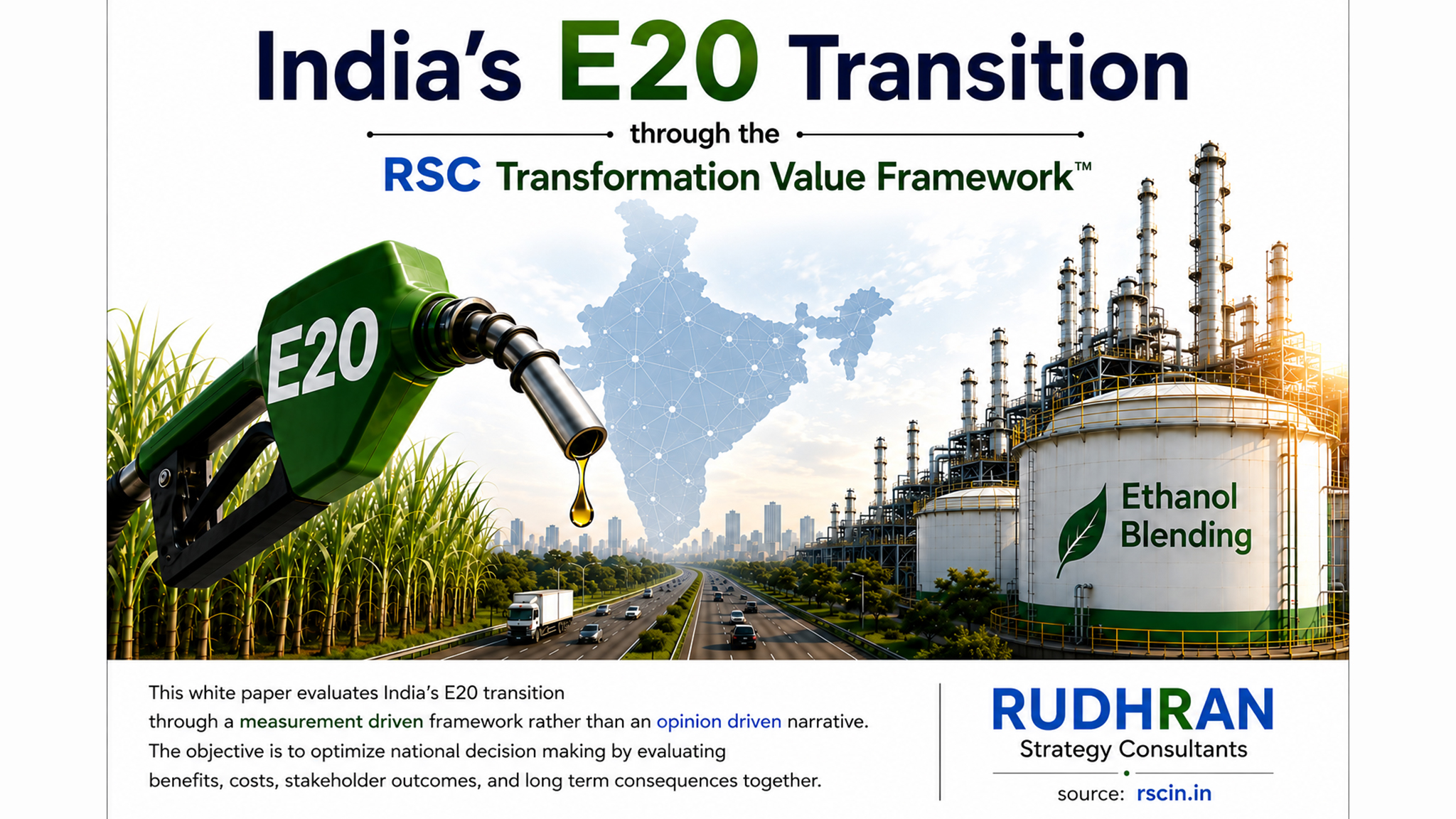
This paper by Rudhran Strategy Consultants (RSC) has been intentionally designed as a measurement-driven analysis rather than an opinion-driven commentary. It neither begins with the assumption that India’s E20 program has succeeded nor with the assumption that it has failed. Instead, every major observation presented throughout this paper is supported by publicly available evidence wherever possible. Where sufficient evidence does not presently exist, the paper explicitly distinguishes reasoned hypotheses from verified findings and identifies the additional information that would enable more robust national decision-making. The objective is therefore not to advocate a particular policy position, but to strengthen the quality of future policy evaluation.
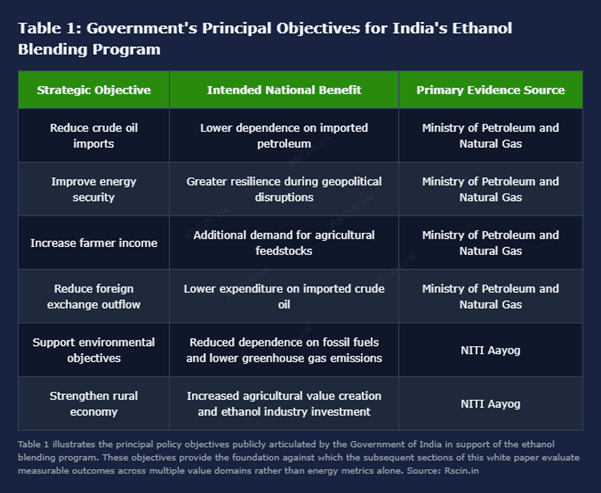
India’s ethanol blending program emerged from a set of legitimate and strategically important national objectives. India remains one of the world’s largest importers of crude oil, exposing the country to significant geopolitical uncertainty, exchange rate volatility, and international supply disruptions. Reducing dependence on imported fossil fuels has therefore remained an important policy objective across successive governments. Ethanol blending was viewed as one of several mechanisms capable of improving energy security while simultaneously creating domestic economic activity through agricultural feedstocks.
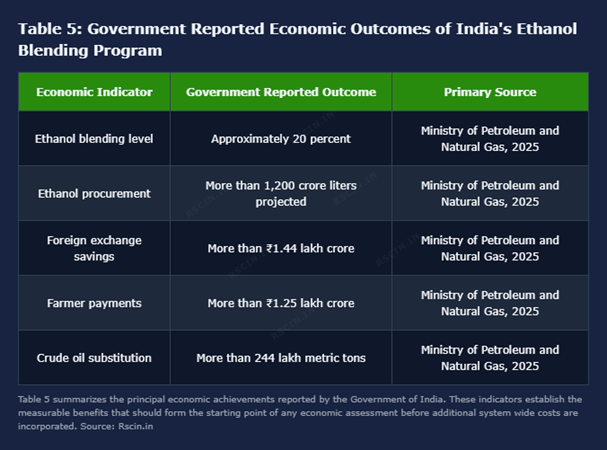
Over the past decade, the program has expanded at a remarkable pace. The original target of achieving 20 percent ethanol blending by 2030 was subsequently advanced, and nationwide implementation was substantially completed ahead of the original schedule. According to the Government of India, ethanol procurement increased from approximately 38 crore liters during Ethanol Supply Year 2013 to 2014 to more than 1,200 crore liters projected for Ethanol Supply Year 2025 to 2026. During the same period, blending levels increased from approximately 1.5 percent to around 20 percent, making India one of the fastest expanding ethanol blending programs globally (Ministry of Petroleum and Natural Gas, 2025; NITI Aayog, 2021).
The government has consistently articulated several strategic benefits arising from this transition. These include reducing crude oil imports, improving national energy security, lowering exposure to global oil price volatility, increasing demand for agricultural produce, strengthening rural incomes, reducing greenhouse gas emissions, and generating substantial foreign exchange savings. Government statements further estimate cumulative foreign exchange savings exceeding ₹1.44 lakh crore together with payments of more than ₹1.25 lakh crore to farmers since the program’s expansion (Ministry of Petroleum and Natural Gas, 2025).
These objectives are neither trivial nor insignificant. Energy security has become an increasingly important national priority following repeated geopolitical disruptions affecting global oil markets. The Russia Ukraine conflict, instability across the Middle East, and continuing uncertainty surrounding international energy supply chains have demonstrated the vulnerability of economies that depend heavily upon imported fossil fuels. Within this broader geopolitical context, diversifying India’s transportation fuel mix represents a strategically understandable policy direction.
At the same time, every large-scale transformation inevitably creates interactions with other national systems that extend beyond its original policy objective. A program designed to reduce crude oil imports may simultaneously influence agricultural land use, public procurement policies, water consumption, logistics infrastructure, consumer mobility costs, industrial investment, and long-term environmental sustainability. Some of these interactions may strengthen the original policy objective, while others may create second order consequences that were not fully anticipated during program design.
For this reason, the central question addressed throughout this white paper is not whether ethanol blending is intrinsically beneficial or intrinsically harmful.
The more important question is whether India has evaluated the complete national consequences of the transition using a sufficiently comprehensive analytical framework before considering future progression towards higher ethanol blends.
This distinction is fundamental.
If the answer is affirmative, the program deserves continued confidence and transparent public support. If important dimensions remain insufficiently measured, then strengthening those measurements becomes an essential prerequisite before further expansion is considered.
The chapters that follow therefore move beyond the traditional debate surrounding E20. Rather than asking whether ethanol blending should be supported or opposed, this paper examines whether India’s transformation has been evaluated across all major value domains that determine national success.
2. Why the National Debate Changed
For nearly a decade, India’s ethanol blending program attracted relatively little public attention. The policy gradually progressed from lower blending levels without generating widespread national debate, while government communications largely emphasized its contribution toward reducing crude oil imports, improving energy security, supporting agricultural incomes, and lowering foreign exchange outflows. During this period, ethanol blending remained primarily an energy policy discussion among policymakers, industry participants, and technical institutions.
The public conversation changed dramatically following the nationwide transition toward E20 petrol.
Unlike earlier blending levels, E20 became immediately visible to millions of vehicle owners because the transition affected an aspect of everyday life that consumers measure instinctively: the distance their vehicles travel for every liter of fuel purchased. While technical discussions surrounding combustion chemistry, emissions, and energy security remained important, the average citizen evaluated the transition through a far simpler question.
“Has my overall cost of mobility increased or decreased?”
This distinction fundamentally changed the national conversation.
Consumers rarely purchase fuel for its chemical composition. They purchase mobility. Consequently, evaluating fuel solely through its retail price per liter provides only a partial picture of its economic value. A lower priced fuel that delivers substantially fewer kilometers per liter may ultimately increase transportation costs. Conversely, a higher priced fuel that maintains superior fuel economy may reduce overall operating expenditure. From a consumer perspective, the relevant metric is therefore not price per liter but cost per kilometer traveled.
This difference between policy metrics and consumer metrics has become one of the defining characteristics of the current debate.
Government agencies have understandably highlighted macroeconomic indicators such as crude displacement, foreign exchange savings, ethanol production capacity, and blending percentages. Consumers, however, have largely evaluated the transition using operational indicators including mileage, drivability, vehicle compatibility, maintenance concerns, resale implications, and overall ownership costs.
Neither perspective is incorrect.
The challenge arises because both groups are measuring different outcomes.
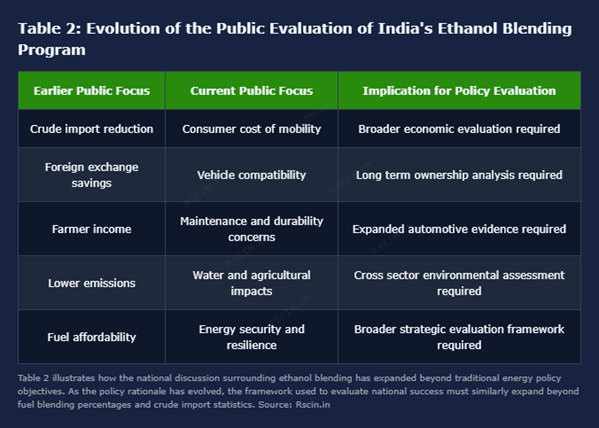
As the national discussion intensified, additional concerns emerged across automotive communities, service centers, transport operators, and social media platforms. Many vehicle owners questioned whether older vehicles originally designed around lower ethanol blends would experience accelerated component wear, reduced fuel economy, material compatibility issues, or increased maintenance costs over extended operating periods. While some of these concerns remain supported primarily by individual experiences rather than comprehensive national datasets, the volume of public discussion itself indicates that consumer confidence has weakened significantly.
Recent reporting surrounding the Automotive Research Association of India’s (ARAI) durability studies further intensified these discussions. Public reports indicated that certain rubber fuel system components in vehicles originally calibrated for lower ethanol blends may experience greater deterioration under E20 exposure, while the same reporting also concluded that newer vehicles specifically designed for E20 generally demonstrated acceptable compatibility under the test conditions evaluated (reported in The Times of India, July 2026, based on ARAI findings). These reports did not establish widespread vehicle failure across India’s fleet. However, they reinforced a broader public perception that compatibility outcomes may differ substantially across vehicle generations.
Another important development involved the evolution of the government’s own public communication regarding ethanol blending.
During the earlier stages of the program, public messaging frequently emphasized reduced crude imports, foreign exchange savings, and lower fuel costs as important outcomes associated with ethanol blending. More recently, senior government officials have increasingly emphasized energy security and resilience during periods of geopolitical uncertainty as the primary strategic justification for maintaining higher ethanol blending levels. Simultaneously, public statements have acknowledged that ethanol is not necessarily less expensive than conventional petrol under prevailing market conditions and that the strategic value of blending extends beyond immediate retail fuel pricing (Ministry of Petroleum and Natural Gas, 2025).
This evolution in policy communication deserves careful attention.
Public policy naturally evolves as economic conditions, commodity prices, and geopolitical realities change. There is nothing inherently inappropriate about governments refining the rationale supporting a long-term national strategy. However, when the principal justification for a major public transformation changes, the analytical framework used to evaluate that transformation should evolve as well.
If the original justification cantered primarily upon affordability, then fuel price becomes an appropriate evaluation metric.
If the principal justification shifts toward strategic resilience and national energy security, then additional variables become equally important. These include long term supply chain resilience, agricultural sustainability, water availability, fiscal costs, consumer burden, infrastructure readiness, and environmental consequences.
In other words, the policy objective determines the measurement framework. This white paper therefore does not attempt to determine whether the government’s revised justification is correct or incorrect. Instead, it asks a more fundamental question:
Has India’s ethanol blending program been evaluated using a sufficiently comprehensive framework that reflects its expanded strategic objectives?
This distinction forms the foundation for the remainder of the paper.
The current public debate has often become polarized between two opposing narratives. One argues that ethanol blending represents a necessary national investment in energy security whose long-term benefits outweigh short term inconveniences. The other portrays the transition as an unnecessary burden imposed upon consumers without adequate scientific validation or transparency in the pretext of increased mobility costs and vehicle maintenance.
Both narratives contain elements of truth. Neither, however, fully captures the complexity of a national transformation that simultaneously affects energy policy, agriculture, environmental sustainability, industrial investment, consumer economics, automotive engineering, logistics infrastructure, and public finance.
A more comprehensive evaluation therefore becomes necessary.
Rather than asking whether E20 should be supported or opposed, policymakers should ask whether the complete system has been measured before future expansion toward higher ethanol blends is considered.
That question ultimately represents the central motivation for this white paper.
3. Why Traditional Policy Evaluation Is Incomplete
Throughout history, governments, enterprises, and public institutions have undertaken ambitious transformation programs with the objective of improving national competitiveness, economic resilience, technological capability, or societal welfare. Some initiatives have modernized infrastructure, others have accelerated industrial development, while many have fundamentally reshaped the way economies produce, distribute, and consume resources. Despite their diversity, these transformations share one common characteristic.
They are almost always evaluated using the metrics that are easiest to measure rather than the outcomes that are most important to society.
Economic growth may be celebrated through Gross Domestic Product (GDP) while income inequality remains largely unexamined. Digital transformation programs may report software implementation success while employee adoption remains poor. Artificial Intelligence initiatives may demonstrate impressive productivity improvements while governance risks, workforce displacement, and cybersecurity vulnerabilities remain insufficiently measured. Electric vehicle adoption may accelerate while electrical grid readiness, charging infrastructure, and mineral supply chains struggle to keep pace.
Each of these examples illustrates the same underlying principle. Large transformations rarely produce benefits within a single system. Instead, they redistribute value across multiple interconnected systems.
Some benefits become immediately visible because they are measured by the organizations implementing the transformation. Other consequences emerge gradually within different sectors of the economy, often remaining invisible because no institution has been assigned responsibility for measuring them.
This observation forms the intellectual foundation of this white paper.
India’s transition toward E20 petrol is not simply an energy policy. It is a national transformation whose consequences extend across energy security, agriculture, public finance, environmental sustainability, industrial investment, logistics, automobile engineering, consumer economics, and long-term resource management. Evaluating such a transformation through crude import reduction alone would therefore be no different from evaluating a digital transformation solely through software deployment, or evaluating healthcare reform solely through hospital construction. Each approach measures one component of a much larger system.
A more comprehensive framework therefore becomes necessary. Rather than asking whether a transformation has achieved its stated objective, decision makers should first ask whether every significant consequence of that transformation has been identified, measured, and incorporated into the final decision-making process.
This paper proposes that every major transformation should be evaluated through three fundamental questions.
Where has value been created?
Where have costs migrated?
Who ultimately captures the value and who ultimately bears the cost?
These three questions may appear deceptively simple. However, together they fundamentally change the way complex transformations are evaluated.
Consider a hypothetical national program that successfully reduces imported crude oil by ten percent. From the perspective of an energy ministry, the program may be considered highly successful. However, what if achieving that reduction simultaneously increases agricultural water consumption, diverts food crops into industrial production, raises consumer transportation costs, requires substantial public subsidies, and creates additional logistics complexity?
The original objective may still have been achieved. The question, however, becomes considerably broader. Has the nation become better off after considering the complete system? This distinction separates measurement from evaluation. Measurement determines whether an objective has been achieved. Evaluation determines whether achieving that objective created greater overall national value.
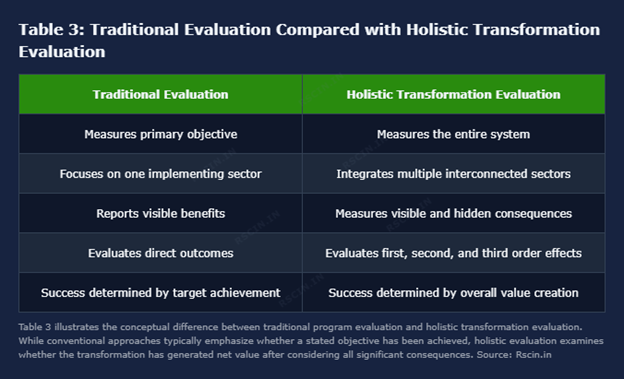
This distinction becomes increasingly important as national transformations grow more complex. Modern public policy rarely affects only one ministry or one economic sector. A decision concerning transportation fuels influences agriculture. Agricultural policy affects water resources. Water availability influences food security. Food systems affect inflation. Inflation influences household purchasing power. Consumer purchasing power affects national productivity.
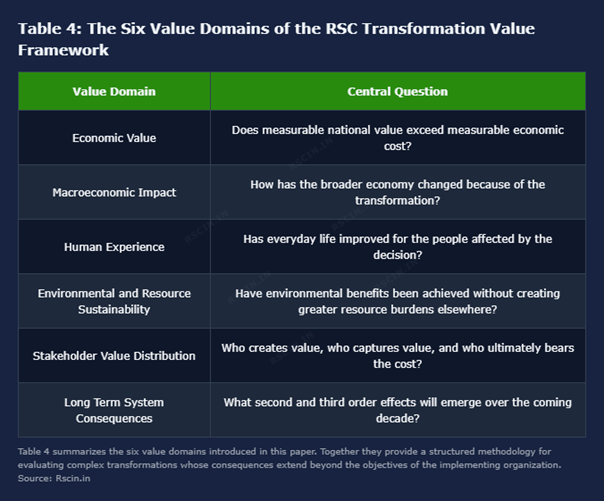
Each decision therefore creates a network of interconnected consequences. Understanding those interactions requires a structured analytical methodology rather than isolated performance indicators. For this reason, this white paper introduces the RSC Transformation Value Framework.
The framework does not attempt to determine whether a transformation is inherently good or inherently bad. Such conclusions often depend upon incomplete information, evolving circumstances, and societal priorities that differ across countries and generations. Instead, the framework seeks to answer a more objective question.
Has the transformation been evaluated across every major value domain that determines long-term national success? The framework therefore evaluates transformations through six interconnected value domains.
- Economic Value: Assessing whether measurable economic benefits continue to exceed measurable economic costs after all significant financial variables have been incorporated into the analysis.
- Macroeconomic Impact: Recognizing that national transformations frequently reshape agricultural systems, trade patterns, inflation, employment, industrial competitiveness, and broader economic resilience.
- Human Experience: This domain recognizes that public policy ultimately exists to improve the quality of life experienced by citizens. Financial success alone cannot fully describe a transformation if everyday ownership costs, consumer confidence, accessibility, transparency, or public trust deteriorate.
- Environmental and Resource Sustainability: Rather than measuring only one environmental objective, this domain examines whether environmental burdens have merely shifted from one resource system to another, including water, land, emissions, biodiversity, and natural capital.
- Stakeholder Value Distribution: Every transformation creates winners and losers. This domain asks whether value has been distributed proportionately across society or whether significant benefits have become concentrated within a relatively small group while costs have been transferred elsewhere.
- Long Term System Consequences: Large transformations often produce second and third order effects that remain invisible during early implementation. This domain therefore examines future implications including resource security, infrastructure readiness, technological evolution, climate resilience, policy flexibility, and long-term national competitiveness.
An important characteristic of this framework is its treatment of evidence. Where publicly verifiable data exist, quantitative analysis should form the basis of evaluation. Where sufficient evidence does not yet exist, reasoned hypotheses should be clearly identified rather than presented as established facts.
Where critical national data remain unavailable, the absence of those measurements should itself become an important policy finding. A decision cannot be fully optimized when essential variables remain unknown.
Consequently, this white paper intentionally distinguishes three categories of evidence throughout its analysis.
Verified findings are supported through publicly available government publications, institutional research, academic literature, or other credible sources. Analytical hypotheses represent logically reasoned conclusions derived from the available evidence but requiring additional validation through future research. Data gaps identify important variables that are presently unavailable in the public domain but whose measurement would materially strengthen future policy decisions. This distinction reflects an important principle of responsible policy analysis.
Uncertainty should not be concealed.
It should be measured.
The chapters that follow therefore apply the RSC Transformation Value Framework to India’s ethanol blending program. The objective is not to determine whether E20 should be supported or opposed. The objective is to evaluate whether the complete transformation has been measured across every major value domain before future policy decisions are made.
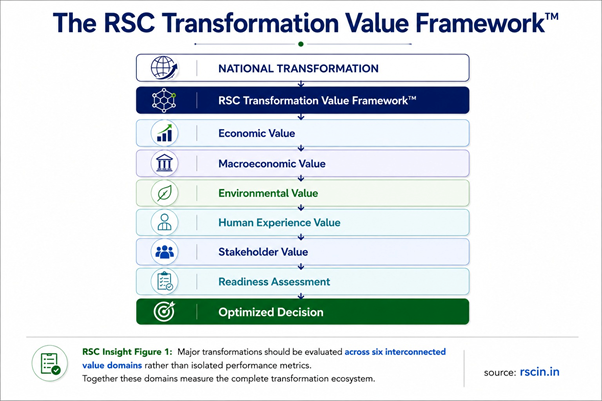
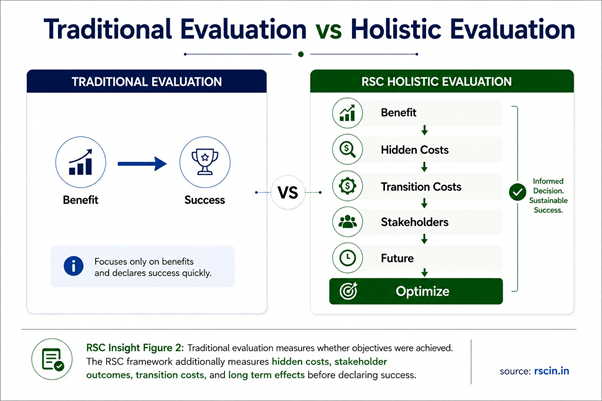
Although India serves as the case study throughout this paper, the methodology itself extends far beyond ethanol blending. The same framework can be applied to Artificial Intelligence adoption, healthcare reform, digital transformation, manufacturing incentives, infrastructure development, environmental policy, and virtually any complex public or enterprise transformation where value creation, cost migration, and stakeholder outcomes extend across multiple interconnected systems.
The broader proposition is therefore simple. A transformation should never be judged solely by the benefits it creates. It should also be evaluated by the costs it transfers, the stakeholders who ultimately capture its value, and the long-term consequences it leaves behind.
4. Value Domain One: Economic Value Analysis
Economic justification formed the foundation of India’s ethanol blending program from its earliest stages. The underlying proposition appeared both logical and strategically attractive. By replacing a portion of imported petrol with domestically produced ethanol, India could reduce crude oil imports, retain foreign exchange within the national economy, create additional demand for agricultural produce, and gradually improve long term energy security. Considered independently, each of these objectives represents a legitimate national economic priority.
The Government of India has reported substantial progress toward these objectives. According to the Ministry of Petroleum and Natural Gas, ethanol procurement increased from approximately 38 crore liters during Ethanol Supply Year 2013 to 2014 to more than 1,200 crore liters projected for Ethanol Supply Year 2025 to 2026. During the same period, ethanol blending increased from approximately 1.5 percent to around 20 percent. The government further estimates cumulative foreign exchange savings exceeding ₹1.44 lakh crore, payments of more than ₹1.25 lakh crore to farmers, and crude oil substitution of more than 244 lakh metric tons since the expansion of the program (Ministry of Petroleum and Natural Gas, 2025).
These achievements should be recognized because they represent measurable outcomes supported by official data. However, economic evaluation should not conclude at this stage.
Traditional program evaluation often measures the benefits directly associated with the implementing ministry while assuming that the remaining parts of the economic system remain unaffected. In reality, every major transformation redistributes economic value across multiple sectors. Some costs become immediately visible within government budgets, while others migrate toward consumers, taxpayers, agriculture, logistics providers, or entirely different ministries. A complete economic evaluation therefore requires measuring both visible benefits and migrated costs.
These reported achievements raise an important analytical question. Are these figures measuring gross economic benefits or net national economic value? The distinction is fundamental.
Gross benefits measure the direct gains produced by a policy. Net national value measures what remains after accounting for all significant costs required to achieve those gains. Consider a simple business analogy.
A manufacturing company may proudly announce that annual revenue increased by twenty percent. Investors, however, would never evaluate the business using revenue alone. They would immediately ask whether raw material costs increased, operating margins declined, capital expenditure expanded, financing costs rose, or profitability deteriorated despite higher sales.
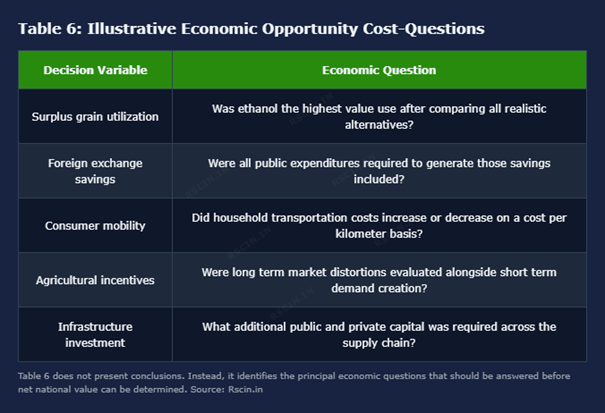
Public policy deserves the same analytical discipline. If India reports foreign exchange savings arising from reduced crude imports, the corresponding economic analysis should also measure the public expenditure, subsidies, opportunity costs, infrastructure investments, and consumer impacts required to generate those savings. Only then can policymakers determine whether the transformation has created net economic value.
One example illustrates why this distinction matters.
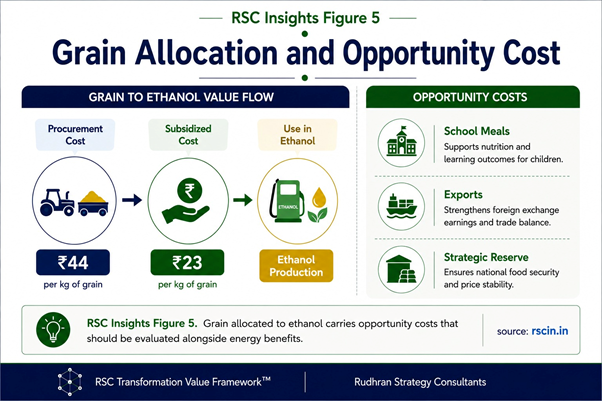
During 2024 and 2025, the Government of India substantially increased the allocation of Food Corporation of India rice for ethanol production. Public reporting indicates that approximately 5.2 million metric tons of rice were allocated for ethanol production during this period, compared with less than 3,000 tons reportedly used during the preceding year, representing an increase of more than 1,700 times in scale (Reuters, June 2025).
This figure should not be interpreted as evidence that the decision itself was inappropriate. Government grain stocks during this period substantially exceeded statutory buffer requirements, providing policymakers with legitimate flexibility regarding surplus utilization. The more important economic question lies elsewhere.
Was ethanol production the highest value use of that surplus?
Alternative uses could theoretically have included expanded nutrition programs, strategic reserve enhancement, humanitarian exports, commercial exports, livestock feed, industrial applications, or ethanol production. Each option carries different economic, social, and strategic implications.
The purpose of this white paper is not to determine which option was politically preferable. The purpose is to determine whether all economically relevant alternatives were evaluated using the same decision framework.
Another important development has emerged during the evolution of the public debate. Recent public statements by senior government officials have acknowledged that ethanol is not necessarily less expensive than conventional petrol under prevailing market conditions. Instead, increasing emphasis has been placed upon energy security, resilience during geopolitical disruptions, and reduced exposure to crude oil price volatility as the primary economic justification for higher ethanol blending (Ministry of Petroleum and Natural Gas, 2025).
This shift in emphasis has significant implications for economic evaluation. If ethanol blending is no longer justified primarily as a lower cost fuel, then affordability alone should no longer be considered the principal measure of success.
Instead, policymakers should evaluate whether the additional fiscal costs associated with ethanol production are justified by measurable improvements in national resilience, supply security, and reduced geopolitical vulnerability. The evaluation criteria have therefore become broader than fuel pricing alone. At the same time, this broader justification introduces an equally important responsibility.
Every additional economic cost incurred in pursuit of greater resilience should be measured with the same rigor as the resilience benefits themselves. This includes direct fiscal expenditure, consumer transportation costs, feedstock procurement, agricultural subsidies, infrastructure investment, logistics adaptation, inventory management, and opportunity costs associated with alternative resource utilization.
One area where current public analysis remains incomplete is the distinction between fuel price and mobility cost.
Consumers do not purchase fuel as an end in itself. They purchase transportation. Consequently, evaluating affordability through the retail price per liter alone may produce incomplete conclusions. The economically relevant metric for households and businesses is cost per kilometer traveled.
A blended fuel that costs less per liter but delivers proportionately lower fuel economy may ultimately increase transportation costs over the lifetime of vehicle ownership. Conversely, a fuel with a higher retail price may still reduce total mobility costs if operating efficiency improves. Future sections of this paper therefore examine consumer mobility separately from national energy economics because both represent distinct dimensions of economic value. The broader conclusion of this value domain is intentionally restrained.
The Government of India has presented substantial evidence demonstrating measurable economic benefits arising from ethanol blending. Those benefits should form an essential component of any objective assessment. However, a complete economic evaluation requires expanding the analysis beyond reported benefits to include the full spectrum of measurable costs, migrated expenditures, opportunity costs, and consumer impacts. Only after both sides of the national economic ledger are measured together can policymakers confidently determine whether the transformation has generated net economic value for the nation as a whole.
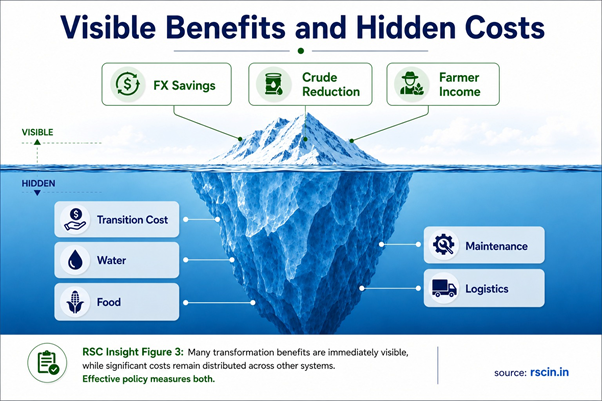
The remaining value domains therefore expand this analysis beyond economics alone, recognizing that national transformations ultimately succeed or fail through their combined impact across the economy, society, the environment, and the lived experience of the people they are intended to serve.
4.1 Imported Ethanol and the Net Energy Independence Equation
One of the principal economic objectives of India’s Ethanol Blended Petrol Program is to reduce dependence on imported crude oil while strengthening long term national energy security. This objective remains strategically important and has been consistently articulated throughout India’s biofuel policy. However, a broader systems perspective suggests that the overall effectiveness of this objective should be evaluated across the complete energy supply ecosystem rather than through crude oil imports alone. (NITI Aayog, 2021).
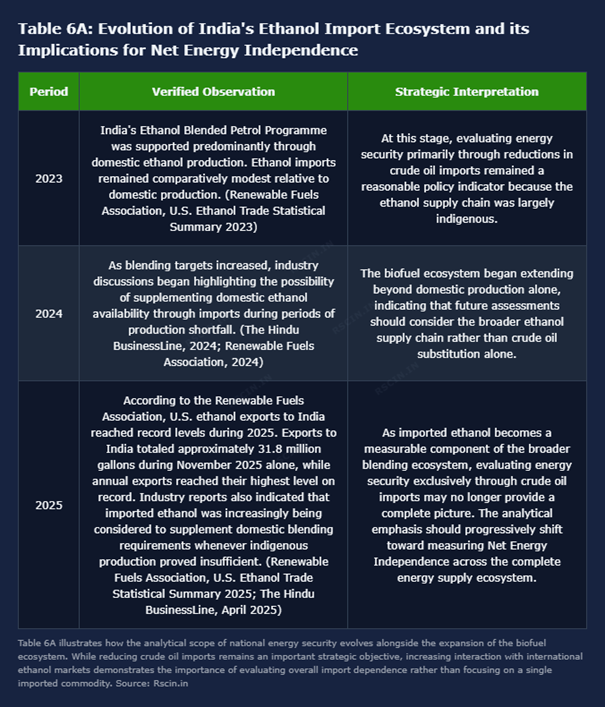
Recent international trade statistics indicate that U.S. ethanol exports to India increased significantly during 2025. According to the Renewable Fuels Association’s 2025 U.S. Ethanol Trade Statistical Summary, India emerged as one of the fastest growing destinations for American ethanol, including exports of approximately 31.8 million gallons during November 2025 alone as part of a record year for U.S. ethanol shipments. (Renewable Fuels Association, U.S. Ethanol Trade Statistical Summary 2025).
At the same time, industry reporting has suggested that imported ethanol may increasingly supplement domestic availability in order to support India’s expanding blending program during periods when indigenous production is insufficient to satisfy demand. If such imports become an operational component of the blending ecosystem, an important analytical question emerges. (The Hindu BusinessLine, 2025).
From the perspective of the RSC Transformation Value Framework, reducing crude oil imports represents only one dimension of national energy independence. A comprehensive assessment should additionally evaluate imported ethanol, imported agricultural feedstocks where applicable, imported production technologies, imported processing equipment, and other strategic inputs necessary to sustain the long-term biofuel ecosystem. Reducing dependence upon one imported commodity while simultaneously increasing dependence upon another does not necessarily diminish the value of the transformation. It does, however, change the manner in which national energy independence should be measured.
Accordingly, this white paper proposes that future evaluations move beyond conventional crude oil substitution and instead measure Net Energy Independence. Such an approach would assess crude oil imports avoided alongside ethanol imports, imported production inputs, fiscal subsidies, domestic production capacity, and the overall strategic resilience of India’s energy supply chain. This broader perspective provides policymakers with a more complete understanding of whether the transformation is reducing overall import dependence or merely redistributing it across different components of the energy ecosystem.
Future public reporting could further strengthen this evaluation through an annual National Energy Independence Ledger summarizing crude oil imports avoided, domestic ethanol production, imported ethanol volumes, imported feedstocks where applicable, government subsidies, and the resulting net contribution toward India’s long term energy security. Such reporting would substantially improve transparency while enabling policymakers, researchers, and citizens to evaluate national energy resilience through a complete systems perspective rather than a single commodity.
The observations presented above should not be interpreted as evidence that India’s ethanol blending strategy is ineffective or inconsistent with its stated objectives. Rather, they demonstrate that as the biofuel ecosystem matures, the traditional metric of crude oil import substitution alone becomes insufficient to measure the complete outcome of the transformation.
Future policy evaluations would therefore benefit from measuring Net Energy Independence, incorporating crude oil imports, imported ethanol, imported feedstocks where applicable, strategic
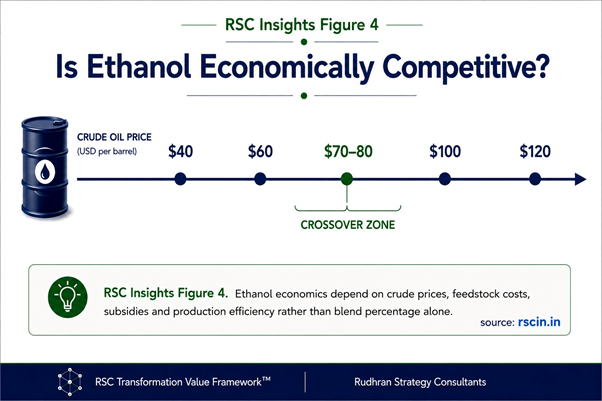
production inputs, domestic production capacity, fiscal support mechanisms, and overall supply chain resilience. Such an approach aligns with the RSC Transformation Value Framework by evaluating the complete system rather than a single component within it.
5. Value Domain Two: Macroeconomic Impact Analysis
The previous section examined the direct economic rationale supporting India’s ethanol blending program. That analysis primarily focused on measurable outcomes associated with energy economics, including crude oil substitution, foreign exchange savings, government expenditure, and the broader financial implications of producing ethanol as a transportation fuel. While these indicators remain essential, they represent only the first layer of economic evaluation. Large national transformations rarely remain confined to the sector that initiated them. Instead, they gradually reshape the broader economy by altering production incentives, influencing trade flows, redistributing investment, and changing the allocation of scarce national resources.
This broader perspective represents the distinction between economic analysis and macroeconomic analysis. Economic analysis asks whether a particular program generates measurable financial value. Macroeconomic analysis asks how that same program changes the structure and behavior of the wider economy. As ethanol blending has expanded across India, its influence has extended beyond petroleum into agriculture, food procurement, commodity markets, logistics, industrial investment, and rural development. Consequently, the success of the program cannot be evaluated solely through energy statistics. It must also be evaluated through the broader economic system that now supports it.
One of the most visible examples of this interaction is the relationship between ethanol production and agricultural feedstocks. India’s ethanol industry today draws upon multiple sources including sugarcane derivatives, maize, and rice. This diversification has strengthened the country’s ability to increase ethanol production while reducing dependence upon a single agricultural commodity. At the same time, the increasing reliance on food and feed crops introduces a new macroeconomic question. As transportation fuel demand grows over time, how will agricultural production adapt to satisfy both food security requirements and industrial fuel demand?
This question becomes particularly important because transportation fuel demand behaves very differently from agricultural production. Fuel demand generally follows long-term economic growth and population expansion, making it relatively predictable and structurally increasing. Agricultural production, however, remains influenced by rainfall, groundwater availability, climatic variability, pest outbreaks, changing cropping patterns, and international commodity prices. A temporary agricultural surplus may comfortably support ethanol production during one period, while a drought or adverse climatic event may substantially alter the same equation within only a few growing seasons. Understanding this distinction is essential because it determines whether today’s surplus can reliably support tomorrow’s structural fuel demand.
The interaction between agriculture and fuel production has already begun influencing commodity markets. Recent reporting indicates that increasing ethanol demand has contributed to greater maize cultivation while simultaneously raising concerns regarding the availability of maize for livestock feed. Reuters also reported that India has increasingly transitioned from being a net exporter of maize toward importing maize and related feed products in response to changing domestic demand patterns (Reuters, September 2024).
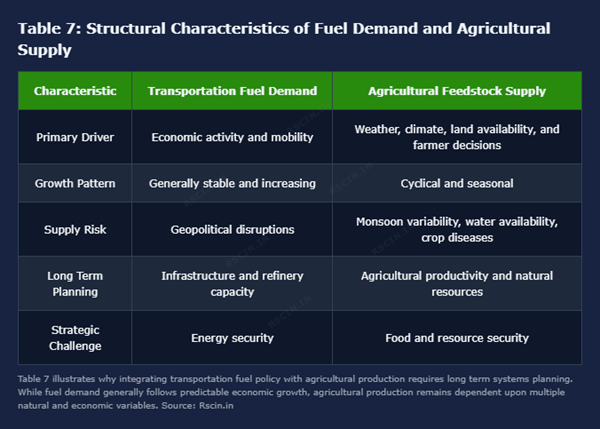
Separately, reporting has suggested that expanding maize cultivation may reduce acreage available for certain oilseed crops, potentially increasing India’s dependence on imported edible oils (Reuters, August 2025). These developments do not establish that ethanol blending has become economically undesirable. They do, however, demonstrate that the consequences of fuel policy extend well beyond the petroleum sector.
A similar observation emerges from the use of Food Corporation of India (FCI) grain stocks for ethanol production. During 2024 and 2025, the allocation of public rice stocks for ethanol increased substantially, reflecting the government’s assessment that available inventories exceeded statutory buffer requirements (Reuters, June 2025). From an energy perspective, utilizing surplus grain to reduce crude imports may appear economically rational. From a macroeconomic perspective, however, a broader question arises. Every tone of grain allocated toward one objective is simultaneously unavailable for alternative economic purposes.
Those alternatives need not imply that the government’s decision was incorrect. Surplus grain could have remained in storage, been exported, supported additional nutrition programs, strengthened strategic reserves, supplied industrial applications, or been diverted toward ethanol production. Each alternative carries different fiscal costs, foreign exchange implications, and social outcomes. A robust macroeconomic evaluation therefore requires comparing these competing uses rather than evaluating ethanol production in isolation.
This principle becomes even more significant when examined over longer planning horizons. If India’s transportation fuel demand continues increasing while ethanol blending remains at E20 or expands toward higher blends, agricultural demand for ethanol feedstocks may continue growing even if the blending percentage itself remains unchanged. Should future policies introduce higher mainstream blends such as E27 or E30, while flex fuel vehicles gradually increase demand for E85 or E100, the pressure upon feedstock supply chains could become considerably more complex. Such scenarios do not necessarily imply that shortages will occur. They simply illustrate that long-term agricultural planning should accompany long-term energy planning.
The challenge therefore extends beyond agriculture into national resource allocation. Governments routinely balance competing priorities when allocating scarce public resources. Water, agricultural land, logistics infrastructure, public finance, and strategic grain reserves all serve multiple national objectives simultaneously. A policy designed to strengthen one objective may inadvertently increase pressure upon another if these interactions are not evaluated collectively.
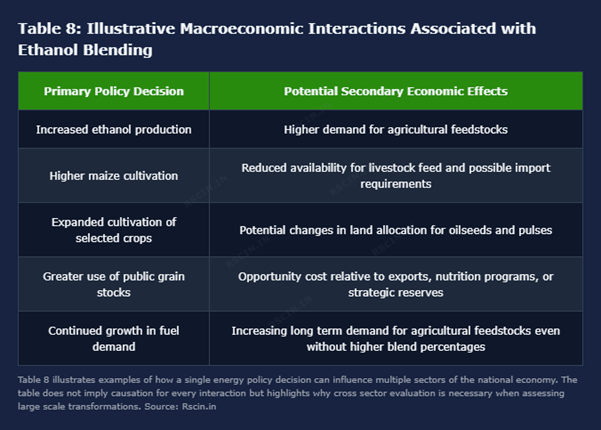
The broader lesson emerging from this analysis extends well beyond ethanol blending. Modern public policy increasingly operates within interconnected systems where energy, agriculture, trade, environmental resources, and consumer welfare cannot be evaluated independently. Success within one ministry’s performance indicators does not automatically translate into optimal outcomes for the national economy as a whole. Consequently, future policy evaluation should move beyond measuring direct outputs and instead examine how those outputs influence adjacent sectors over time.
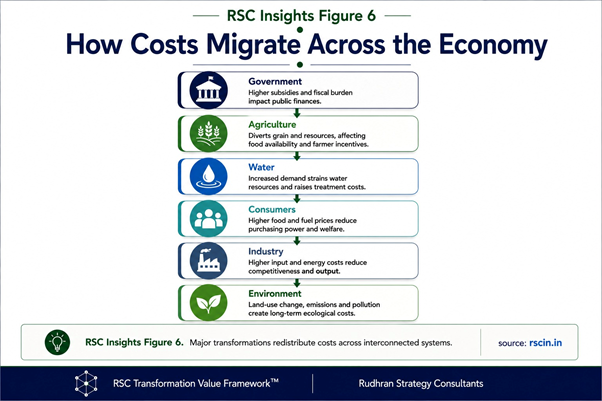
For this reason, the RSC Transformation Value Framework proposes that macroeconomic analysis should not merely quantify economic activity generated by a transformation. It should also evaluate how that transformation redistributes production incentives, reshapes trade patterns, alters resource allocation, and influences the resilience of the broader economy. These interactions ultimately determine whether national value has genuinely been created or whether benefits observed within one sector have been accompanied by unmeasured costs elsewhere.
Having established the broader economic interactions surrounding ethanol blending, the analysis now turns toward one of the most critical resources underlying every agricultural and industrial transformation. Water, land, emissions, and natural resources represent constraints that cannot be expanded indefinitely. Understanding whether environmental gains have been achieved without transferring pressure to these finite resources forms the next value domain of this white paper.
6. Value Domain Three: Environmental and Resource Sustainability Analysis
Economic development and environmental stewardship have often been presented as competing objectives. In reality, sustainable national development requires balancing both. A transformation that strengthens economic resilience while permanently degrading critical natural resources cannot be considered sustainable over the long term. Conversely, environmental protection that significantly weakens economic security may also become difficult to sustain politically and socially. Successful public policy therefore seeks an equilibrium where economic progress, environmental responsibility, and resource conservation reinforce rather than undermine one another.
India’s ethanol blending program was introduced partly within this broader sustainability context. Replacing a portion of fossil fuel consumption with renewable biofuels has the potential to reduce dependence on imported petroleum and contribute toward national climate objectives. These anticipated benefits have been reflected in several government publications, including estimates of cumulative greenhouse gas reductions associated with ethanol blending (Ministry of Petroleum and Natural Gas, 2025). From this perspective, ethanol represents more than an alternative transportation fuel. It also forms part of India’s long-term energy transition strategy.
However, environmental sustainability cannot be evaluated through carbon emissions alone.
Every major transformation redistributes environmental pressures in much the same way that it redistributes economic value. A policy that reduces dependence on one natural resource may simultaneously increase demand for another. Consequently, evaluating environmental success requires examining the complete resource system rather than a single environmental indicator.
The first resource requiring examination is water.
Agriculture already accounts for the overwhelming majority of freshwater consumption in India. As ethanol production increasingly utilizes agricultural feedstocks such as sugarcane, rice, and maize, questions naturally arise regarding the long-term relationship between transportation fuel policy and national water security. This relationship has become particularly important because several of the crops used in ethanol production are also among the more water intensive agricultural commodities cultivated in India.
The National Institution for Transforming India (NITI Aayog) itself acknowledged this issue in its Roadmap for Ethanol Blending in India. The report estimated that producing one liter of ethanol from sugar-based feedstocks carries a water footprint of approximately 2,860 liters when agricultural cultivation is included within the calculation (NITI Aayog, 2021). More recent scenario analyses published by NITI Aayog indicate that water requirements vary significantly across feedstocks, with certain pathways requiring substantially greater quantities depending upon cultivation practices, irrigation intensity, and regional conditions (NITI Aayog, 2026).
These figures are frequently misunderstood.
They do not imply that an ethanol distillery directly consumes nearly three thousand liters of industrial process water to manufacture one liter of ethanol. Rather, they represent the broader agricultural
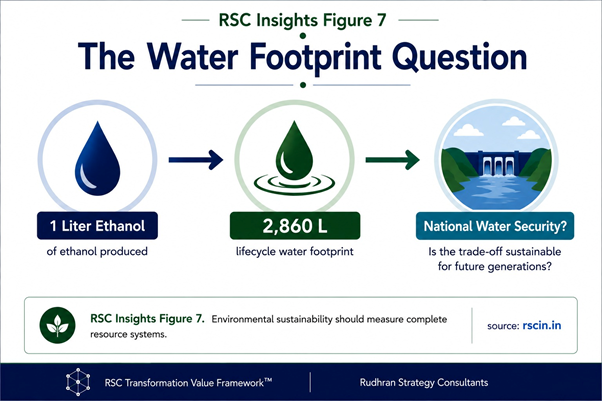
water footprint associated with cultivating the feedstock itself. This distinction is important because it prevents the discussion from becoming technically inaccurate while preserving the central policy question.
The discussion surrounding water becomes even more significant when considered alongside India’s broader resource outlook. The Central Water Commission has estimated that annual per capita water availability declined to approximately 1,486 cubic meters during 2021, placing India within the internationally recognized category of water stressed nations. Official projections further indicate continued reductions over the coming decades if current demographic and resource trends persist (Ministry of Jal Shakti, 2024).
These national statistics do not establish that ethanol blending is responsible for India’s water challenges. They do, however, reinforce the importance of evaluating future feedstock strategies within the broader context of national water security.
A similar systems perspective applies to environmental emissions.
Public discussions surrounding ethanol frequently simplify the debate by suggesting that biofuels are either environmentally superior or environmentally inferior to conventional petrol. The scientific evidence presents a more nuanced picture. Ethanol blending has been associated with reductions in certain regulated pollutants and lower dependence upon fossil carbon. At the same time, research has identified potential increases in specific unregulated emissions such as acetaldehyde under certain operating conditions, while overall environmental outcomes remain dependent upon feedstock selection, cultivation practices, combustion characteristics, and lifecycle assessment boundaries (NITI Aayog, 2021; Down To Earth, 2026).
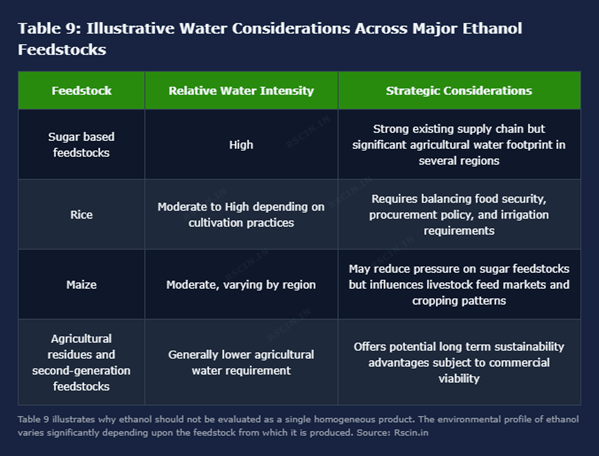
Consequently, environmental evaluation should not focus exclusively upon tailpipe emissions.
Lifecycle assessment provides a more comprehensive perspective because it considers agricultural production, fertilizer use, irrigation, transportation, industrial processing, fuel distribution, combustion, and eventual environmental impacts together. Two liters of ethanol may appear chemically identical at the fuel pump while carrying substantially different environmental footprints depending upon the feedstock, production technology, and regional agricultural conditions.
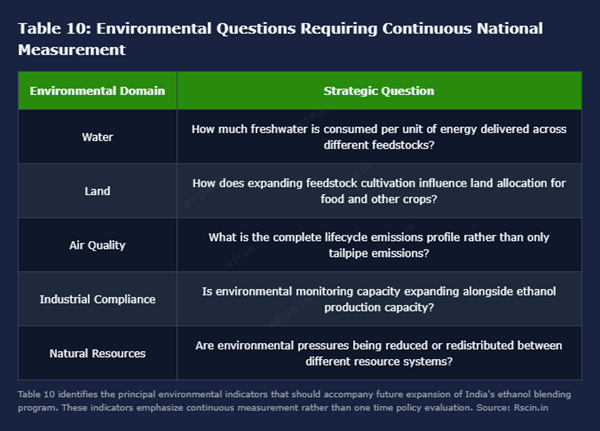
Another important dimension concerns environmental governance.
As ethanol production capacity expands, regulatory oversight must expand at a comparable pace. India’s environmental regulatory framework already requires environmental clearances, pollution control approvals, and compliance monitoring for distilleries. Nevertheless, individual enforcement cases have demonstrated that environmental performance ultimately depends not only upon regulatory standards but also upon monitoring capacity, inspection frequency, compliance transparency, and timely corrective action.
The widely reported environmental proceedings involving the Zira distillery in Punjab illustrate this distinction. The case should not be interpreted as representative of the ethanol industry as a whole. Rather, it demonstrates why rapid industrial expansion must be accompanied by equally robust environmental governance, continuous monitoring, and transparent public reporting. As production capacity increases nationwide, environmental resilience depends as much upon institutional capability as upon engineering design (National Green Tribunal proceedings; Central Pollution Control Board reports).
The broader conclusion emerging from this value domain is consistent with the methodology established earlier in this paper.
Environmental sustainability cannot be evaluated through a single indicator, regardless of whether that indicator is carbon emissions, fossil fuel reduction, or renewable fuel production. Sustainable national policy requires understanding how environmental pressures migrate across interconnected resource systems. Water, land, agriculture, industrial activity, and atmospheric emissions should therefore be evaluated collectively rather than independently.
For this reason, future policy decisions regarding higher ethanol blends should be supported by continuously updated resource assessments rather than static environmental assumptions established during earlier phases of implementation. Such an approach would strengthen both environmental governance and public confidence by ensuring that future decisions remain responsive to changing climatic conditions, agricultural realities, technological advancements, and emerging scientific evidence.
Having examined the interaction between ethanol blending and India’s environmental resources, the analysis now turns to the dimension that ultimately determines whether public policy fulfils its broader social purpose. National transformations may strengthen economic indicators and environmental objectives, yet still fail to improve the everyday experience of the people they are intended to serve. Evaluating that dimension requires shifting the focus from national statistics to the lived experience of citizens, consumers, and vehicle owners.
7. Value Domain Four: Human Experience Analysis
Public policy ultimately exists to improve the quality of life experienced by the people it serves. Economic growth, infrastructure development, industrial expansion, environmental sustainability, and technological advancement are all important national objectives. However, these objectives represent means rather than ends. Their ultimate purpose is to enhance the everyday lives of citizens by improving affordability, accessibility, reliability, safety, convenience, and long-term prosperity.
This distinction of a policy serving the citizen’s best interest becomes particularly relevant when evaluating transportation fuels.
Governments naturally evaluate transportation policy through national indicators such as energy security, foreign exchange savings, crude oil substitution, emissions reduction, and agricultural development. Citizens, however, evaluate transportation through a fundamentally different lens. Their primary concern is whether their daily mobility has become more affordable, more reliable, and more predictable. They experience public policy through vehicle ownership, fuel expenditure, maintenance costs, commuting time, and confidence that the products they purchase will continue performing as expected throughout their useful lives.
The difference between these two perspectives explains much of the current national discussion surrounding India’s E20 transition.
From a citizen’s perspective, transportation fuel is not purchased for its chemical composition. It is purchased to accomplish everyday activities including commuting to work, transporting family members, operating businesses, supporting logistics, and enabling social mobility. Consequently, consumers rarely evaluate fuel through liters consumed. They evaluate it by giving maximum priority to kilometers traveled and monthly transportation expenditure, and marginally towards frequency of maintenance, and total cost of vehicle ownership.
This distinction fundamentally changes the analytical framework.
A policy may generate measurable macroeconomic benefits while simultaneously increasing everyday mobility costs for a particular segment of society. Conversely, a policy may impose short-term adaptation costs while producing substantial long term national benefits. Neither outcome should be assumed. Both require objective measurement.
One concept proposed in this paper is therefore particularly important.
Governments should evaluate transportation policy through the concept of “cost of mobility” rather than simply “cost of fuel.”
The price displayed on a fuel dispenser represents only one component of mobility. Consumers are equally influenced by fuel efficiency, maintenance expenditure, replacement parts, service intervals, vehicle compatibility, downtime, resale value, and long-term reliability. Measuring only the retail price of petrol therefore provides an incomplete understanding of the economic experience of vehicle ownership.
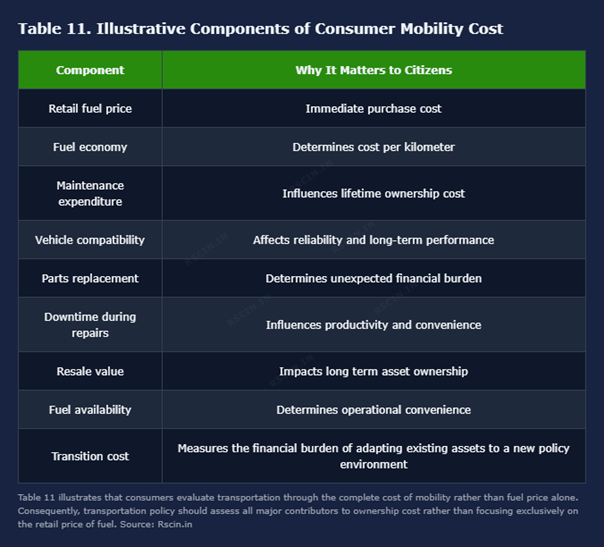
Recent public discussions illustrate why this broader perspective has become increasingly important. Vehicle owners across different segments have reported varying experiences regarding fuel economy, drivability, maintenance, and compatibility following the transition toward E20. While individual experiences cannot substitute for statistically representative national studies, they nevertheless indicate that consumer perceptions have become an important policy variable in their own right.
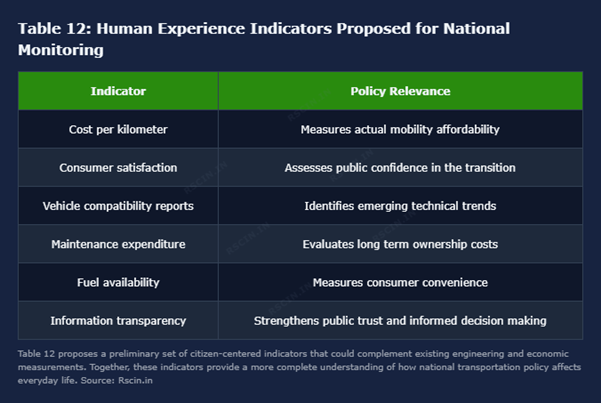
Public confidence should never be dismissed as merely anecdotal. Neither should it be accepted uncritically. Instead, it should become a measurable policy indicator.
This paper therefore proposes that governments undertaking large scale public transformations should establish structured citizen feedback mechanisms alongside technical testing programs. Just as automobile manufacturers conduct durability testing under controlled engineering conditions, governments can complement those studies with longitudinal consumer observation programs covering different geographic regions, climatic conditions, vehicle ages, engine technologies, usage patterns, and annual driving distances.
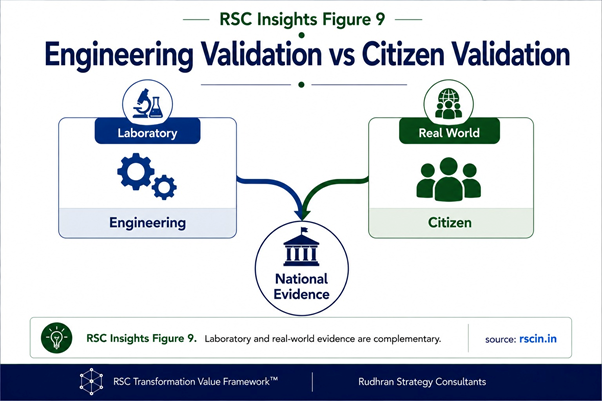
Such an approach would generate two complementary forms of evidence. Engineering studies would continue measuring technical performance under standardized conditions. Citizen observation programs would measure how those technical outcomes translate into real world ownership experiences over extended periods.
Engineering validation and real-world consumer behavior do not always coincide. Ethanol’s hygroscopic characteristics and the possibility of phase separation during prolonged storage have been discussed within technical literature, particularly for vehicles that remain unused for extended periods. Whether these characteristics translate into meaningful consumer issues depends upon actual ownership behavior, including refueling frequency, vehicle utilization patterns, storage duration, climatic conditions, and maintenance practices. These variables differ considerably across India’s diverse vehicle population. Consequently, future policy evaluations could benefit from incorporating large scale observational studies that examine how ordinary consumer behavior interacts with fuel characteristics under real world operating conditions.
An important distinction should be recognized between engineering certification and national ownership experience. Organizations such as ARAI perform vehicle validation under highly controlled and repeatable laboratory conditions using standardized driving cycles, calibrated test equipment, and consistent environmental parameters. These procedures are essential because they ensure that competing vehicle technologies can be evaluated objectively under identical conditions. Such testing, however, serves a fundamentally different purpose from measuring the experience of millions of vehicle owners operating under India’s diverse climatic, geographic, traffic, and maintenance conditions.
Consequently, laboratory findings should be interpreted as engineering reference values rather than direct representations of nationwide consumer experience. Real world vehicle performance is influenced by numerous variables including ambient temperature, humidity, traffic congestion, road quality, vehicle age, maintenance history, driving style, fuel storage practices, payload, and operating environment. It is therefore entirely possible for engineering certification results and citizen ownership experiences to differ without either observation being technically incorrect. Responsible public policy should recognize the complementary value of both forms of evidence.
This distinction becomes particularly important when evaluating changes in fuel economy following the introduction of higher ethanol blends. While controlled laboratory studies have reported relatively modest reductions in fuel economy under standardized test conditions, automotive journalists, consumer communities, and vehicle owners have reported substantially wider variations during everyday operation. These observations should neither be accepted as definitive national evidence nor dismissed as anecdotal opinion. Instead, they justify the establishment of statistically representative longitudinal studies that measure real world vehicle performance across different regions, climates, traffic conditions, vehicle categories, ownership patterns, and driving behaviors. Such evidence would enable policymakers to compare engineering validation with nationwide operational experience before future blending levels are expanded.
A second aspect of consumer experience concerns transition cost. Public policy often measures the expenditure incurred by governments and institutions to implement a transformation. Citizens, however, experience an additional category of expenditure associated with adapting to that transformation. In the context of ethanol blending, technical publications have acknowledged that certain components used within older fuel systems, including selected elastomers, plastics, rubber seals, and fuel lines, may exhibit reduced durability under prolonged exposure to higher ethanol blends compared with vehicles specifically engineered for E20 compatibility. For owners of legacy vehicles, any preventive modification or corrective replacement of these components represents an additional ownership cost extending beyond routine vehicle maintenance.
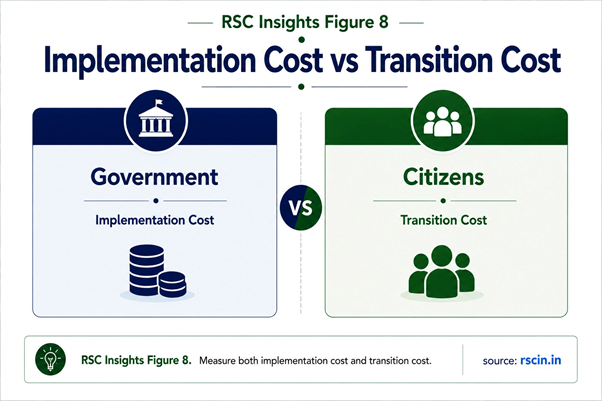
This observation should not be interpreted as evidence that all legacy vehicles will require immediate modification or experience premature component failure. Rather, it illustrates why transition costs deserve independent measurement within public policy evaluation. A country in which vehicles are commonly retained for ten to twenty years naturally contains a large population of owners whose purchasing decisions were made under earlier engineering assumptions. Understanding how these citizens experience the transition becomes an important component of evaluating the overall quality of the transformation itself.
Together, these approaches would provide policymakers with a substantially richer evidence base than either method could provide independently.
Consumer behavior represents another important variable that cannot be fully replicated through engineering certification alone. Ethanol possesses hygroscopic characteristics that require careful management throughout storage and distribution. Technical literature has long recognized that fuel quality may be influenced by storage duration, water contamination, climatic conditions, and fuel handling practices. The extent to which these characteristics affect ordinary vehicle owners depends not only upon engineering design but also upon everyday consumer behavior, including refueling frequency, vehicle utilization patterns, storage intervals, and maintenance practices. These behaviors vary considerably across India’s diverse vehicle population.
As ethanol blending continues expanding, the integrity of the fuel supply chain becomes an equally important component of public confidence. Transportation systems, storage depots, retail dispensing infrastructure, water contamination monitoring, and quality assurance procedures all influence the condition of fuel delivered to consumers. Future policy evaluations would therefore benefit from greater public transparency regarding quality assurance protocols, inspection frequency, water management practices, and operational monitoring across the fuel distribution network. Such transparency should not be viewed merely as an industrial compliance exercise. Given that transportation fuel directly affects national mobility, public expenditure, and everyday consumer experience, transparent governance of the supply chain represents an important element of public accountability.
Transparency becomes particularly important when policies influence products used daily by hundreds of millions of people.
In several countries, fuel pumps clearly identify fuel composition, compatibility requirements, and recommended vehicle applications. Such disclosures enable consumers to make informed decisions while strengthening confidence that public institutions are communicating openly regarding product characteristics. As future fuel blends potentially diversify beyond E20, transparent labeling and standardized consumer guidance may become increasingly important for minimizing confusion and maintaining public trust.
One issue deserves particular attention as India considers the future evolution of ethanol blending.
The diversity of India’s vehicle fleet continues to increase. Alongside millions of legacy vehicles remain in service, manufacturers are introducing vehicles specifically engineered for E20 compatibility, while flex fuel technologies capable of operating across wider ethanol ranges are gradually entering the market. Simultaneously, India has witnessed rapid growth in premium performance vehicles and motorcycles whose engineering requirements differ significantly from mass market commuter vehicles. The Government of India has also liberalized regulations permitting the import of vintage vehicles that are at least fifty years old, further increasing the diversity of the national fleet.
This diversity presents an important planning challenge.
A single fuel composition may not represent the optimal solution for every category of vehicle operating within the country. Conversely, offering numerous fuel blends without careful planning may create significant logistical complexity across fuel distribution networks.
The objective should therefore not be maximizing the number of available blends.
The objective should be identifying the optimum number of blends that collectively maximize national benefit while minimizing infrastructure complexity, consumer confusion, and operational cost.
Determining that optimum requires evidence rather than assumption.
Controlled national studies involving representative samples of passenger vehicles, commercial vehicles, motorcycles, legacy engines, flex fuel vehicles, premium automobiles, varying climatic conditions, and different driving environments could provide policymakers with the quantitative evidence necessary to optimize future fuel strategy. These metrics vary by country and warrant an indigenous, controlled-group test executions. The protocols of ethanol blending in other nations will not translate to have similar testing outcomes in India.
Such studies would allow future decisions regarding E20, E25, E27, E30, E85, E100 or other fuel compositions to emerge from measured national experience rather than theoretical projections alone. This recommendation extends beyond ethanol blending itself. It illustrates a broader principle applicable to every major transformation.
The experience of the people affected by a policy should not merely be acknowledged. It should be measured with the same rigor as the economic and technical objectives that originally justified the policy. Only when governments evaluate both national performance and everyday human experience together can transformation be assessed in a manner that genuinely reflects its impact upon society.
The broader significance of this value domain extends well beyond transportation fuels. Every major transformation creates two distinct categories of expenditure. The first is the cost of implementation incurred by governments, institutions, and industries to execute the transformation. The second is the cost of transition incurred by citizens, consumers, employees, or businesses as they adapt to that transformation. Both forms of expenditure ultimately contribute to the true cost of national change, yet the latter frequently receives far less analytical attention because it is dispersed across millions of individual experiences rather than recorded within institutional budgets.
Sound governance therefore requires measuring both categories of cost before declaring a transformation successful. Economic indicators may demonstrate national progress while citizens continue absorbing transition costs that remain largely invisible within conventional policy evaluation. Recognizing and measuring these costs does not diminish the value of the transformation itself. Instead, it enables governments to design implementation strategies that reduce unnecessary burdens while preserving the broader public benefits the policy seeks to achieve. Only when implementation costs and transition costs are evaluated together can the complete human experience of a national transformation be understood.
8. Value Domain Five: Stakeholder Value Distribution Analysis
The preceding value domains evaluated India’s ethanol blending program through economic performance, macroeconomic interactions, environmental sustainability, and human experience. Together, these analyses provide a comprehensive understanding of how the transformation has influenced different components of the national system. They do not, however, answer one of the most important questions associated with any large public transformation.
Who ultimately captures the value created by the ethanol blend transformation?
This question deserves independent examination because value creation and value distribution are fundamentally different concepts. A national policy may create substantial economic value while distributing that value unevenly across society. Likewise, a policy may require one stakeholder group to bear disproportionately higher costs in order for another stakeholder group to realize the majority of the benefits. Neither outcome is inherently inappropriate. Infrastructure projects, environmental regulations, taxation reforms, and industrial policies frequently create winners and losers as resources are reallocated to achieve broader national objectives. The responsibility of public policy is therefore not to guarantee that every stakeholder benefits equally. Rather, it is to ensure that the overall distribution of benefits and costs remains transparent, proportionate, and justifiable in relation to the objectives being pursued.
This distinction represents one of the central principles of the RSC Transformation Value Framework. Traditional program evaluation typically measures whether a policy has achieved its intended objective. Stakeholder Value Distribution extends the analysis by asking whether the value created by that objective has been distributed in a manner consistent with the broader public interest. Consequently, this value domain does not seek to identify whether particular stakeholders have benefited. Instead, it evaluates whether the relationship between benefits received, costs incurred, and risks assumed remains balanced across the national ecosystem.
The Government of India has identified several stakeholder groups expected to benefit from ethanol blending. These include the nation through improved energy security and reduced foreign exchange outflows, farmers through additional demand for agricultural feedstocks, consumers through a more resilient transportation fuel supply, and industry through investments in ethanol production and associated infrastructure. Each of these anticipated benefits represents a legitimate policy objective and should therefore form the starting point of any stakeholder assessment.
At the same time, the preceding value domains demonstrate that every transformation also generates costs that extend beyond the implementing sector. Consumers may incur transition costs associated with adapting legacy vehicles. Agricultural markets may experience changes in cropping patterns and commodity demand. Water resources may experience additional pressure depending upon feedstock composition. Government finances may absorb subsidies, procurement costs, or infrastructure investments that are not immediately visible within energy statistics. These observations do not diminish the legitimacy of the program’s objectives. They simply recognize that value creation and cost allocation rarely occur within the same stakeholder group.
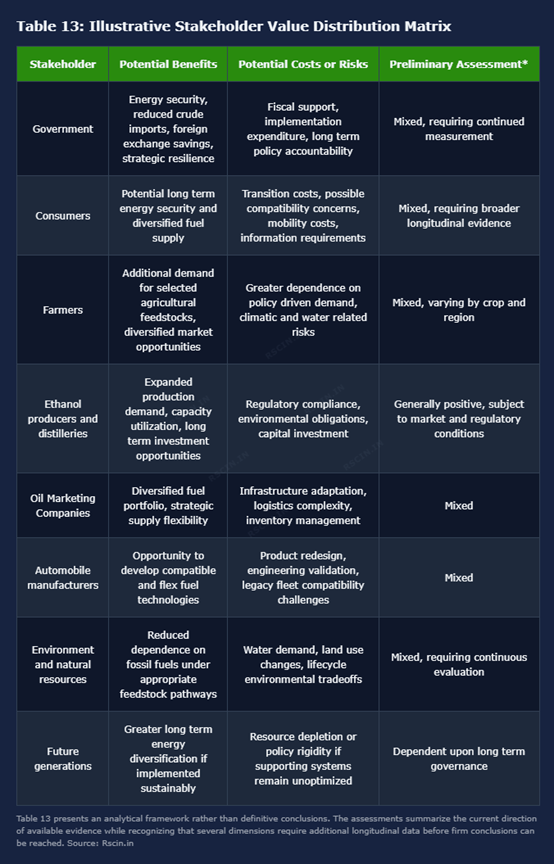
The matrix illustrates an important characteristic of complex transformations. No stakeholder experiences only benefits or only costs.
Instead, each stakeholder participates in a different combination of opportunities, obligations, risks, and long-term consequences. Consequently, evaluating only one stakeholder group inevitably produces an incomplete understanding of the transformation itself.
The matrix also reveals another important observation. Benefits and costs frequently migrate across institutional boundaries.
A fiscal expenditure incurred by government may generate economic opportunity for industry. Agricultural incentives may strengthen rural incomes while simultaneously increasing demand for finite natural resources. Consumer transition costs may arise from engineering decisions that ultimately improve long term national resilience. These interactions are not evidence of policy failure. Rather, they illustrate why holistic evaluation becomes essential before declaring a transformation successful.
One stakeholder group – the ethanol production industry – deserves particular analytical attention because it has received comparatively limited discussion within the public domain.
The ethanol production industry occupies a central position within the value chain connecting agricultural feedstocks, fuel production, and national energy policy. As blending percentages increase, demand for ethanol naturally increases, creating opportunities for capacity expansion, technological investment, and industrial growth. Such outcomes are consistent with the objectives of industrial development and should not be viewed negatively in themselves.
The more important analytical question concerns proportionality.
To what extent does the additional economic value generated by ethanol blending remain distributed across the broader national ecosystem, and to what extent does it become concentrated within particular segments of the value chain?
Answering this question requires evidence rather than assumption.
Comprehensive analysis would require publicly available information regarding industry profitability, capital investment, procurement mechanisms, subsidy structures, capacity utilization, regulatory compliance, and market concentration. While portions of these data are available through government publications and financial reporting, a fully integrated national assessment has not yet been published in the public domain. Consequently, this paper deliberately refrains from attributing disproportionate benefit to any stakeholder without sufficient evidence.
The absence of comprehensive evidence, however, should not discourage measurement. On the contrary, it strengthens the case for greater transparency because its involves both the nation’s economical interest and has impacts on every fuel-utilizing citizen. Given that ethanol blending directly influences national energy security, public expenditure, agricultural procurement, and the mobility costs borne by hundreds of millions of citizens, greater transparency across the ethanol value chain should be viewed not merely as an industrial reporting obligation, but as an essential component of public accountability.
An instructive example of the importance of scientific transparency emerged during the national discussion surrounding E20 petrol. Public reports cited research conducted by IIT Kanpur indicating that E20 did not produce significant adverse effects on vehicle engines or fuel economy under the conditions evaluated by the researchers. At the same time, other publicly reported discussions referenced laboratory observations by ARAI indicating measurable differences in fuel economy under standardized testing conditions, while separate media reports highlighted that detailed technical reports requested through the Right to Information process had not been publicly released. Collectively, these developments shifted public discussion away from the scientific evidence itself and toward questions concerning transparency, methodology, and reproducibility.
From the perspective of the RSC Transformation Value Framework, this situation illustrates an important distinction. Scientific findings, media summaries of those findings, and policy justification represent three different layers of evidence. A scientific study evaluates a defined hypothesis under specified conditions. Media reporting communicates selected conclusions to the public. National policy, however, requires a broader evidentiary foundation encompassing engineering validation, statistically representative field observation, stakeholder impacts, environmental sustainability, implementation readiness, and long-term operational experience. Conflating these three layers may unintentionally create public misunderstanding even when each participant acts in good faith.
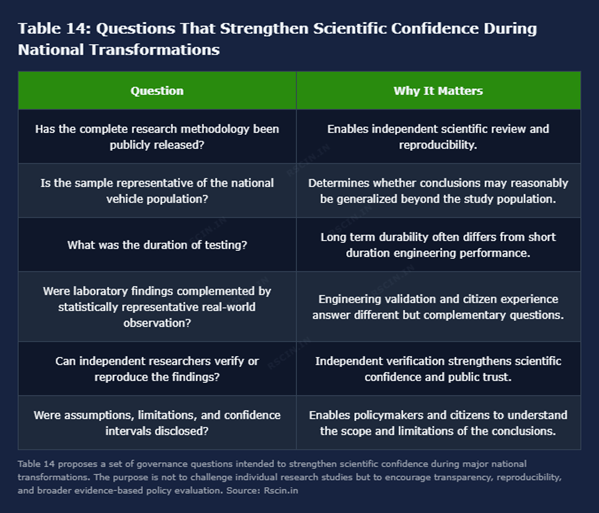
The purpose of raising these questions is not to dispute the scientific capability of any institution, nor to diminish the value of laboratory research. Organizations such as IIT Kanpur and ARAI play an essential role in advancing engineering knowledge and supporting evidence-based policymaking. Rather, the broader recommendation emerging from this white paper is that publication of methodologies, representative datasets where appropriate, statistical analyses, and technical reports can substantially strengthen public confidence by enabling independent scientific scrutiny. Such openness should be viewed not as a challenge to public institutions but as a natural characteristic of robust scientific governance.
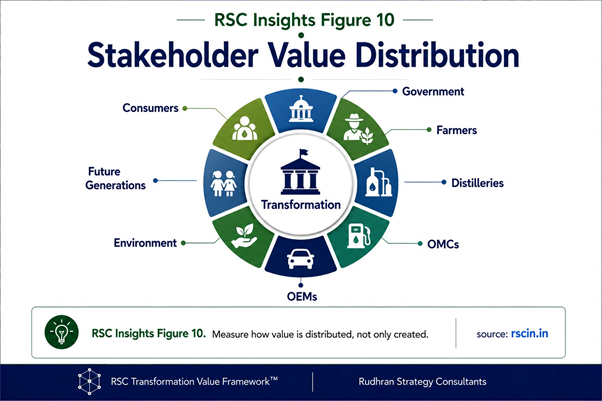
Large national transformations inevitably attract public attention, media scrutiny, and diverse stakeholder perspectives. Under such circumstances, transparency becomes more than a communication exercise. It becomes an important component of transformation governance itself. Policy should therefore be evaluated not through headlines alone, but through the quality, transparency, and reproducibility of the evidence upon which it rests.
Future policy evaluations would benefit from periodic publication of stakeholder level value distribution analyses that quantify how economic benefits, fiscal expenditure, transition costs, environmental obligations, and strategic gains are distributed across the principal participants in the ethanol ecosystem. Such analyses would allow policymakers, industry, and citizens to evaluate not only whether value has been created, but also whether that value has been distributed in a manner consistent with the program’s broader national objectives.
This value domain therefore reaches a conclusion that extends beyond ethanol blending itself. It implies that:
- Every major transformation redistributes value
- Some stakeholders create value
- Some capture value
- Some finance the transition
- Others bear the cost of adapting to it
- Successful governance requires understanding all four
Only after value creation, value distribution, cost migration, and stakeholder outcomes are evaluated together, can decision makers determine whether a transformation has generated equitable national benefit, rather than simply measurable sectoral success.
9. Value Domain Six: Transformation Readiness and Long-Term System Consequences Analysis
National transformations should not be evaluated solely by the outcomes they have already produced. Equally important is determining whether the institutions responsible for implementing the transformation possess the operational, technological, regulatory, and societal readiness required to sustain and expand it over time. A policy may successfully achieve its initial objectives while simultaneously creating future constraints that become apparent only after implementation begins. Consequently, responsible governance requires evaluating not only present performance but also future preparedness.
This principle is particularly relevant for India’s ethanol blending program. The nationwide implementation of E20 represents a significant milestone within the country’s broader energy transition. However, public discussions have increasingly expanded beyond E20 toward the possibility of higher ethanol blends including E25, E27, E30, E85, and E100. These discussions naturally raise a fundamental policy question.
Should future blending levels be determined primarily by production capability and energy objectives, or should they emerge from a broader scientific evaluation of national readiness?
This paper proposes the latter.
Every progression beyond an existing transformation should be supported by evidence demonstrating that the surrounding ecosystem has matured sufficiently to absorb the next stage of implementation. Production capacity alone cannot determine readiness. Infrastructure, consumers, manufacturers, regulators, logistics networks, environmental resources, and supporting industries must evolve together. Otherwise, implementation may outpace the ecosystem upon which long term success ultimately depends.
The concept of Transformation Readiness therefore extends beyond engineering. It represents the collective preparedness of every major stakeholder participating within the transformation.
One of the most significant operational questions concerns fuel distribution infrastructure.
Introducing additional fuel blends does not simply require producing more ethanol. It also requires an integrated logistics network capable of transporting, storing, forecasting, and dispensing multiple fuel compositions across more than one hundred thousand retail fuel stations distributed throughout India. Each additional blend potentially increases inventory complexity, storage requirements, transportation planning, quality assurance procedures, forecasting uncertainty, and operational costs.
These challenges should not be interpreted as arguments against consumer choice.
Rather, they illustrate why consumer choice itself must be designed scientifically.
Offering every conceivable fuel blend may maximize theoretical flexibility while simultaneously imposing substantial logistical inefficiencies. Conversely, offering only a single blend may simplify distribution while reducing compatibility across an increasingly diverse national vehicle fleet.
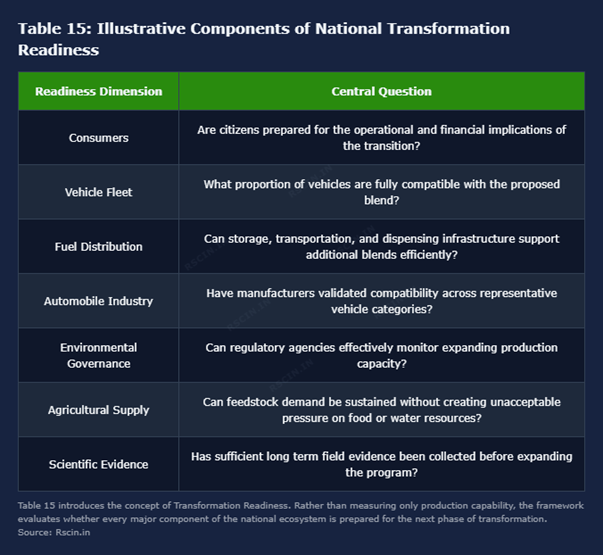
The appropriate objective therefore lies between these two extremes.
The national fuel distribution system should seek to identify the optimum number of fuel blends that collectively maximize public benefit while minimizing operational complexity.
Determining that optimum requires evidence rather than assumption.
India’s vehicle population today represents one of the most diverse transportation ecosystems in the world. Legacy vehicles designed before higher ethanol blends remain in service alongside modern E20 compatible vehicles. Flex fuel vehicles capable of operating across wider ethanol ranges are gradually entering the market. Premium performance automobiles often possess engineering characteristics that differ significantly from high volume commuter vehicles. In parallel, regulatory changes permitting the import of vintage vehicles are likely to increase the diversity of specialized vehicles requiring lower ethanol blends. A scientifically optimized fuel strategy should therefore reflect this diversity rather than assume that every vehicle category will converge toward identical operating requirements.
This observation suggests that future policy decisions should move beyond evaluating fuel composition alone and instead evaluate the interaction between vehicle diversity, consumer demand, infrastructure capability, and operational efficiency.
Recent demonstrations involving flex fuel motorcycles provide an instructive illustration of this principle. Independent testing has shown that although higher ethanol blends may carry a lower retail price per liter, the resulting cost per kilometer depends upon changes in fuel efficiency rather than fuel price alone. In one widely viewed demonstration conducted using a flex fuel motorcycle capable of operating across multiple ethanol blends, the measured operating cost remained lower with E20 than with E85 despite the latter carrying a lower retail fuel price. While individual demonstrations cannot substitute for statistically representative national research, they nevertheless reinforce an important analytical principle.
Consumers optimize mobility rather than fuel composition.
Consequently, future fuel strategy should be evaluated through cost per kilometer, total ownership cost, vehicle compatibility, and operational convenience rather than retail fuel price alone.
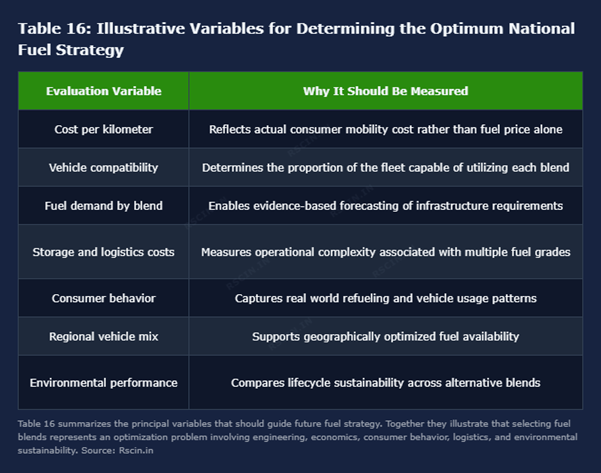
This paper therefore proposes that future progression beyond E20 should be supported by a structured national research program rather than incremental policy expansion alone.
Such a program could include representative testing across at least fifty thousand vehicles encompassing passenger cars, motorcycles, commercial vehicles, flex fuel platforms, legacy vehicles, premium automobiles, and vintage vehicles operating under different climatic conditions, traffic environments, annual driving distances, and ownership patterns. Engineering durability studies should be complemented by longitudinal consumer observation programs measuring cost of mobility, maintenance expenditure, transition costs, ownership satisfaction, and operational reliability over multiple years.
Equally important, the findings should remain publicly available because transparency leave little room for conflicting biases and expedites the articulation of right policies that benefit a nation’s economy while protecting the interest of its citizens.
Open publication of compatibility studies, consumer observations, infrastructure readiness assessments, environmental measurements, and operational data would strengthen public confidence while allowing independent researchers, automobile manufacturers, and policymakers to validate future decisions through transparent evidence.
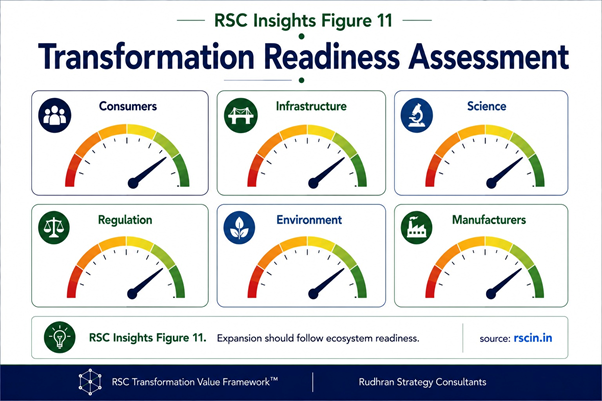
The broader significance of this recommendation extends beyond ethanol blending. Large national transformations should not progress simply because additional implementation becomes technically possible. They should progress because objective evidence demonstrates that the national ecosystem has become sufficiently prepared for the next stage of change.
This distinction separates implementation from optimization. Implementation asks whether the next stage can be executed. Optimization asks whether the next stage should be executed.
The difference between these two questions may ultimately determine the long-term success of any national transformation. For this reason, the final recommendation emerging from this value domain is intentionally broader than transportation fuels.
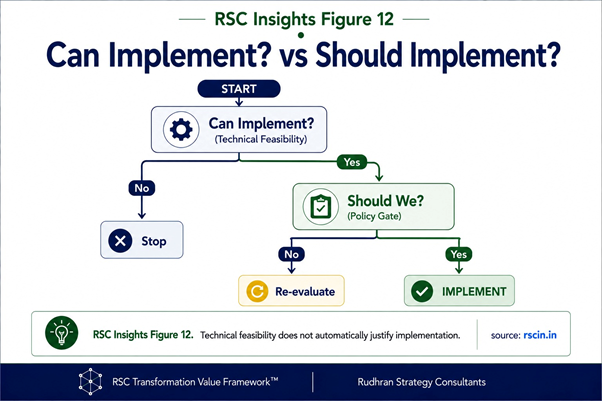
Future national transformations should incorporate formal Transformation Readiness Assessments before major policy expansion occurs. Such assessments should integrate engineering evidence, consumer behavior, infrastructure capability, environmental sustainability, economic analysis, and stakeholder readiness into a single decision framework. Doing so would enable future policy decisions to emerge from comprehensive national measurement rather than from isolated implementation metrics alone.
Only after readiness has been demonstrated across the complete transformation ecosystem should large-scale progression toward the next stage of implementation be considered.
10. Toward a New Framework for National Transformations
Every generation of policymakers is confronted with decisions that permanently reshape the trajectory of a nation. Some involve energy, others healthcare, education, digital governance, industrial policy, artificial intelligence, transportation, environmental protection, or national security. Although these transformations differ in their technical complexity, they often share one common characteristic. They are implemented within interconnected systems where decisions affecting one sector inevitably influence numerous others. Consequently, the quality of the transformation depends not only upon the quality of the decision itself but also upon the methodology used to evaluate that decision before, during, and after implementation.
India’s transition toward E20 petrol provides an instructive case study of this broader principle. Throughout this white paper, the analysis has intentionally avoided asking whether ethanol blending should be supported or opposed. Instead, it has examined whether the transformation has been evaluated across every major value domain capable of influencing its long-term success. This distinction is important because the objective of responsible policy analysis is not to defend or criticize a particular initiative. Its purpose is to strengthen the quality of future decision making.
The analyses presented across the preceding chapters suggest that modern national transformations can no longer be evaluated through isolated performance indicators. Note the influence of a domino-effect below:
- Energy policy influences agriculture
- Agriculture influences water security
- Water availability influences food systems
- Food systems affect inflation, public expenditure, and household purchasing power
- Consumer behavior influences engineering outcomes, while engineering decisions influence industrial investment, logistics infrastructure, and environmental governance
These interactions demonstrate that every significant transformation functions as an integrated system rather than a collection of independent policy decisions.
Recognizing this systems perspective fundamentally changes how transformation should be evaluated. Instead of measuring only the visible benefits produced by the implementing ministry, governments should also identify where costs migrate throughout the broader economy. They should determine which stakeholder groups capture the greatest proportion of the value created, which groups bear the greatest proportion of the transition burden, and whether those outcomes remain proportionate to the national objectives originally sought.
Such analyses do not complicate decision making unnecessarily. Rather, they reduce the likelihood that important consequences remain invisible until public dissatisfaction or operational challenges emerge after implementation.
One of the most important observations emerging from this paper concerns the distinction between implementation and optimization. Governments frequently evaluate whether a transformation can be implemented successfully from an administrative, financial, or engineering perspective. While this assessment remains essential, it represents only the first stage of effective governance. Equally important is determining whether the proposed transformation represents the optimal configuration after considering all major stakeholder groups, alternative implementation pathways, resource constraints, consumer behavior, environmental consequences, and long-term national priorities.
Implementation therefore answers the question, “Can this transformation be executed?”
Optimization answers the question, “Is this the most appropriate way to execute it?”
The distinction may appear subtle, yet it carries profound implications for public policy. Many implementation challenges arise not because the underlying objective lacks merit but because the surrounding ecosystem has not yet matured sufficiently to support the next stage of transformation. Readiness therefore becomes a measurable prerequisite rather than an assumption.
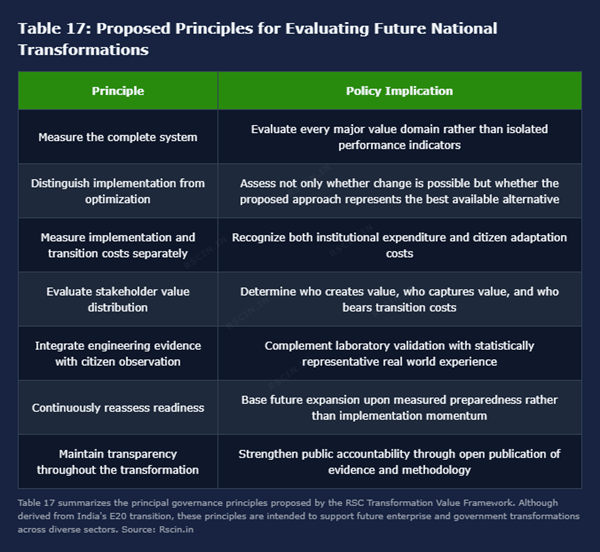
The framework proposed in this paper also recognizes an important characteristic of evidence itself. Not every policy question can be answered immediately through complete datasets. Governments frequently make decisions under conditions of uncertainty where portions of the required evidence remain unavailable. Such circumstances should not prevent action when national priorities require timely intervention. They do, however, require transparency regarding the distinction between verified evidence, analytical hypotheses, and remaining data gaps. A decision supported by openly acknowledged uncertainty is often more credible than one presented with unwarranted certainty.
This observation reinforces another important principle developed throughout the paper.
Engineering validation and citizen validation represent complementary forms of evidence rather than competing ones.
Laboratory testing establishes whether a technology performs under controlled and repeatable conditions. Citizen observation demonstrates how that same technology performs within the complexity of everyday life. Both forms of evidence are necessary because governments ultimately implement policy within society rather than within laboratories. Future transformations should therefore integrate engineering excellence with longitudinal observation of real-world outcomes so that implementation remains responsive to changing conditions rather than static assumptions.
The same principle applies to governance.
Public confidence is strengthened not merely through successful implementation but through transparent measurement. Citizens are more likely to support difficult national transformations when they understand the objectives being pursued, the evidence supporting those objectives, the tradeoffs involved, the uncertainties that remain, and the mechanisms through which future adjustments will be made. Transparency should therefore be viewed not as a communication exercise but as an integral component of effective governance.
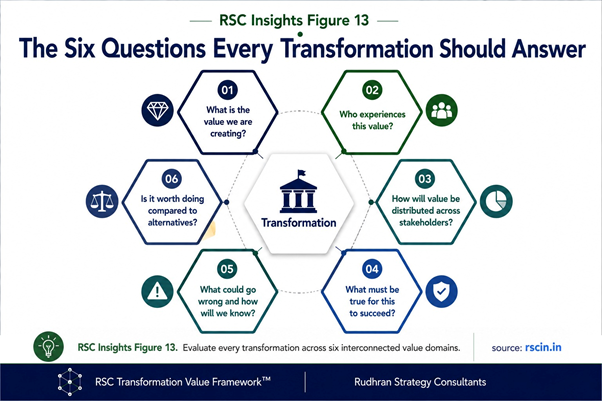
The broader contribution of this white paper therefore extends beyond transportation fuels.
The RSC Transformation Value Framework proposes a structured methodology through which governments, enterprises, regulators, multilateral institutions, and corporate leaders may evaluate any complex transformation whose consequences extend across multiple interconnected systems. Whether applied to artificial intelligence, healthcare reform, digital governance, energy transition, industrial policy, infrastructure development, or climate adaptation, the underlying principles remain unchanged. Every transformation should be evaluated across the complete ecosystem it influences rather than solely through the objectives that initiated it.
Ultimately, the success of a national transformation should not be measured only by the benefits it creates. It should also be measured by the costs it avoids, the burdens it minimizes, the transparency with which it is governed, the confidence it inspires among citizens, and the resilience it leaves for future generations. Only then can transformation be considered not merely implemented, but genuinely optimized.
11. Executive Recommendations
The purpose of this white paper has not been to determine whether ethanol blending should continue or be discontinued. Rather, it has been to evaluate whether the transformation has been measured across the complete ecosystem it influences and whether opportunities exist to further strengthen future decision making. The recommendations presented below therefore seek to improve the quality of implementation rather than advocate a particular political or commercial outcome. Together, they represent a measurement driven pathway through which future fuel policy may continue evolving while strengthening public confidence, scientific rigor, and long-term national resilience.
Recommendation 1: Establish a National Transformation Review Commission
The Government of India may consider establishing an independent multidisciplinary review commission to periodically evaluate major national transformations whose effects extend across multiple sectors of the economy. Such a commission should include experts in engineering, economics, agriculture, environmental science, public policy, behavioral science, logistics, statistics, and consumer affairs. Its objective would not be to replace implementing ministries but to provide an integrated assessment of transformation outcomes across the complete national ecosystem.
Recommendation 2: Introduce Longitudinal National Field Studies
Future expansion beyond E20 should be supported by statistically representative longitudinal studies involving approximately fifty thousand vehicles encompassing passenger cars, commercial vehicles, motorcycles, flex fuel platforms, legacy vehicles, premium automobiles, agricultural equipment, and diverse climatic regions. Laboratory validation should continue serving as the engineering benchmark, while longitudinal field observation should measure the lived experience of citizens under real world operating conditions over multiple years.
Recommendation 3: Maintain Multiple Fuel Grades During the Transition
India’s vehicle fleet represents one of the most diverse transportation ecosystems in the world. Legacy vehicles, modern E20 compatible vehicles, flex fuel platforms, premium performance automobiles, commercial fleets, and vintage vehicles each possess different engineering characteristics and operational requirements. The evidence presented throughout this paper suggests that maintaining a carefully planned combination of lower and higher ethanol blends during the transition period may better accommodate this diversity than immediate convergence toward a single nationwide composition. Future optimization studies should determine the scientifically appropriate number and composition of fuel grades after evaluating consumer demand, infrastructure capability, operational efficiency, long term logistics, and national energy objectives.
The evidence reviewed throughout this paper also suggests that lower ethanol blends, including E10, should remain nationally available during the transition period, particularly for legacy vehicles whose original engineering specifications preceded higher ethanol blends. Maintaining such availability recognizes the diversity of India’s existing vehicle fleet while reducing unnecessary transition costs borne by citizens. Consideration may also be given to ensuring that consumers selecting lower ethanol blends for legitimate vehicle compatibility reasons are not subjected to disproportionate price premiums relative to the standard fuel composition. Such an approach preserves consumer choice while allowing future optimization studies to determine the most appropriate long term national fuel strategy.
The objective of fuel policy should not be to maximize the adoption of any single blend in isolation. Rather, it should seek to optimize national benefit by balancing energy security, environmental sustainability, consumer affordability, vehicle compatibility, infrastructure readiness, and operational efficiency. Until comprehensive national evidence establishes the optimum long term fuel strategy, maintaining scientifically justified consumer choice represents a prudent and balanced approach that strengthens both public confidence and the quality of the overall transformation.
Recommendation 4: Publish Comprehensive Transformation Dashboards
Major national transformations should be accompanied by publicly accessible dashboards presenting engineering findings, environmental measurements, agricultural impacts, fiscal expenditure, consumer observations, infrastructure readiness, and stakeholder outcomes through standardized performance indicators. Such transparency would strengthen public confidence while enabling independent researchers and industry experts to contribute additional analysis and recommendations.
Recommendation 5: Measure Implementation Cost and Transition Cost Separately
One of the principal observations emerging from this paper is that every major transformation creates two categories of expenditure. Governments and institutions incur implementation costs associated with executing the transformation, while citizens, businesses, and consumers incur transition costs as they adapt to it. Future policy evaluation should measure both categories independently so that the complete economic impact of national change becomes visible before long term conclusions are reached.
Recommendation 6: Publish Annual Stakeholder Value Distribution Reports
Governments routinely publish economic statistics, environmental indicators, and fiscal data. An equally valuable addition would be periodic Stakeholder Value Distribution Reports evaluating how benefits, costs, subsidies, transition burdens, environmental obligations, and strategic gains are distributed across the principal participants within the transformation ecosystem. Such reporting would significantly improve transparency while strengthening evidence based public discussion.
Recommendation 7: Adopt a Net Energy Independence Framework
India’s energy security objectives have traditionally been evaluated through metrics such as reductions in crude oil imports, increased domestic biofuel production, and higher ethanol blending percentages. While these indicators remain strategically important, the analyses presented throughout this white paper suggest that future policy evaluation would benefit from a broader systems perspective.
The Government of India may therefore consider adopting a Net Energy Independence Framework that evaluates the complete energy supply ecosystem rather than individual commodities in isolation. Such a framework would measure crude oil imports avoided alongside domestic ethanol production, imported ethanol volumes, imported feedstocks where applicable, strategic production inputs, government subsidies, supply chain resilience, and the overall contribution of the biofuel ecosystem toward long term national energy security.
As India’s energy transition continues to evolve, measuring only crude oil substitution may become progressively less representative of the complete transformation. A Net Energy Independence Framework would enable policymakers to evaluate whether overall strategic dependence is genuinely declining or whether dependence is gradually shifting across different components of the energy supply chain.
Such an approach is fully consistent with the RSC Transformation Value Framework, which proposes that major transformations should be evaluated through the complete systems they influence rather than through the individual objectives they were originally designed to achieve.
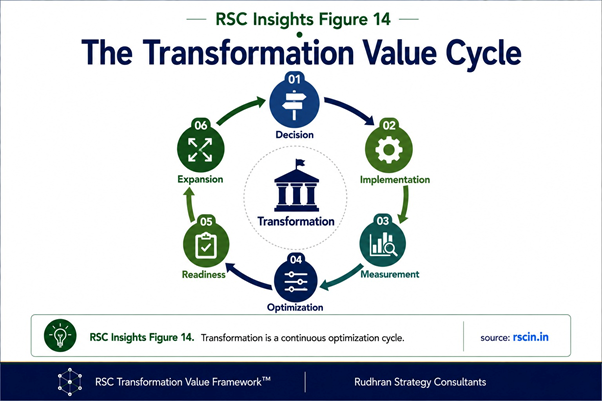
Recommendation 8: Apply the Transformation Value Framework to Future Biofuel Expansion
India has already initiated discussions regarding the future introduction of isobutanol blended diesel. Unlike petrol, diesel supports a substantial proportion of the nation’s freight transportation, commercial logistics, agriculture, construction, mining, and public transportation sectors. Consequently, the economic implications of diesel blending extend far beyond passenger mobility.
Current engineering evidence suggests that isobutanol possesses several technical characteristics that compare favorably with ethanol, including higher energy density, lower hygroscopicity, and improved storage behavior. These characteristics justify continued scientific investigation. At the same time, publicly available evidence remains insufficient to determine its long-term effects on nationwide fuel economy, commercial fleet performance, total cost of ownership, infrastructure readiness, or citizen experience under Indian operating conditions.
The evidence presented throughout this white paper therefore suggests that future biofuel expansion should proceed through formal Transformation Readiness Assessments before nationwide implementation is considered. Such assessments should integrate engineering validation, statistically representative field studies, logistics infrastructure, supply chain governance, environmental sustainability, stakeholder value distribution, and long-term consumer observation. The objective is not to delay innovation but to ensure that innovation progresses at a pace consistent with the readiness of the national ecosystem expected to support it.
Recommendation 9: Adopt Measurement Driven Governance
Perhaps the most important recommendation emerging from this paper extends beyond ethanol blending itself. National transformations should increasingly be evaluated through evidence that measures both intended outcomes and unintended consequences across interconnected systems. Doing so enables governments to identify emerging risks earlier, optimize implementation continuously, strengthen stakeholder confidence, and improve the resilience of future policy decisions.
The RSC Transformation Value Framework is proposed as one possible methodology through which governments, enterprises, regulators, and multilateral institutions may conduct such evaluations. Although developed through the case study of India’s E20 transition, the framework is intended to support decision making across a broad spectrum of national and enterprise transformations where technical, economic, environmental, and societal systems interact simultaneously.
12. Strategic Conclusion
India’s E20 transition represents one of the country’s most significant energy policy initiatives in recent decades. Its objectives are both understandable and strategically important. Reducing dependence on imported crude oil, strengthening national energy security, supporting domestic agriculture, encouraging renewable fuels, and improving long term environmental sustainability are legitimate national priorities that deserve continued attention. Throughout this white paper, these objectives have been acknowledged as the foundation upon which the transformation was initiated.
At the same time, the analysis presented across the preceding chapters demonstrates that the success of a national transformation cannot be evaluated solely through the achievement of its original objectives. Every major policy decision creates interactions across multiple interconnected systems, redistributing benefits, costs, responsibilities, risks, and opportunities throughout the broader economy. Consequently, evaluating only the intended outcomes provides an incomplete understanding of the transformation itself.
India’s E20 program illustrates this principle clearly. Energy security influences agriculture. Agricultural policy influences water resources, food systems, and public expenditure. Transportation fuels influence engineering, consumer behavior, logistics, environmental governance, and household affordability. Infrastructure investment influences industrial growth, while industrial growth influences stakeholder value distribution and long-term national competitiveness. Each of these interactions contributes to the overall outcome of the transformation, regardless of whether it was part of the original implementation objective.
This observation forms the central conclusion of the paper.
Successful transformations should not be evaluated through isolated performance indicators. They should be evaluated through the complete ecosystem they influence.
That principle gave rise to the RSC Transformation Value Framework presented throughout this white paper. Rather than asking whether a transformation has succeeded according to a single objective, the framework evaluates six interconnected value domains comprising economic value, macroeconomic impact, environmental and resource sustainability, human experience, stakeholder value distribution, and transformation readiness. Together, these domains provide a more comprehensive understanding of how large-scale transformations influence governments, enterprises, industries, citizens, and future generations simultaneously.
Several additional principles emerged naturally during the course of this analysis.
The first is the distinction between implementation cost and transition cost. Governments and institutions incur expenditure while implementing major transformations. Citizens, businesses, and consumers incur separate costs while adapting to those transformations. Both forms of expenditure contribute to the true cost of national change and should therefore be measured independently before long term conclusions are drawn.
The second principle concerns the distinction between engineering validation and citizen validation. Controlled laboratory testing establishes whether technologies perform under standardized conditions. Real world observation determines how those same technologies perform across the diversity and complexity of everyday life. Responsible governance benefits from integrating both forms of evidence rather than relying exclusively upon either one.
The third principle concerns transformation readiness. Future stages of national change should not progress solely because additional implementation has become technically possible. They should progress because objective evidence demonstrates that the surrounding ecosystem has become sufficiently prepared to support the next phase of transformation. Implementation determines whether change can occur. Readiness determines whether change should expand.
Collectively, these principles suggest a broader evolution in public policy evaluation.
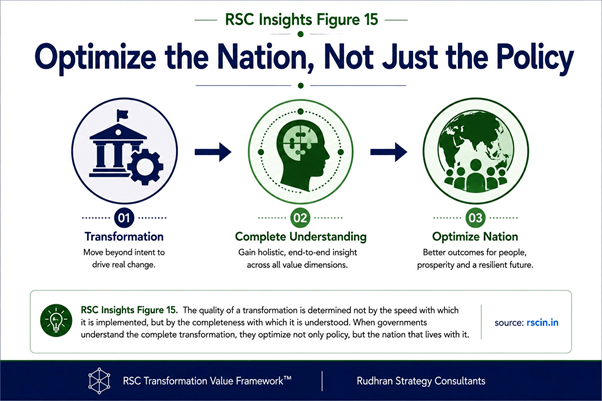
National success should increasingly be measured not only by the benefits that governments create, but also by the costs they avoid, the burdens they minimize, the transparency with which they govern, the confidence they build among citizens, and the resilience they preserve for future generations.
For India’s ethanol program, this perspective leads to a balanced conclusion.
The evidence reviewed throughout this paper supports continued investment in scientific innovation, renewable fuels, and national energy security. At the same time, it also supports strengthening longitudinal field research, preserving scientifically justified consumer choice during the transition, improving public transparency, continuously evaluating stakeholder outcomes, expanding transformation readiness assessments before introducing higher blend mandates, and measuring both implementation costs and transition costs with equal rigor.
These recommendations should not be interpreted as opposition to ethanol blending. Nor should they be interpreted as unconditional endorsement of the current implementation pathway.
Rather, they represent an invitation to strengthen the scientific methodology through which future decisions are evaluated.
Ultimately, the quality of a transformation is determined not by the speed with which it is implemented, but by the completeness with which it is understood.
When governments measure only the visible benefits of transformation, hidden costs often migrate into other systems unnoticed until they emerge as public dissatisfaction, economic inefficiency, or environmental pressure. When governments measure the complete ecosystem, those same transformations become opportunities for continuous optimization rather than sources of unintended consequence.
That is the central message of this white paper. Measurement should precede optimization. Optimization should precede expansion.
Only then can transformation deliver benefits that are not only measurable, but also equitable, resilient, and enduring for the nation it seeks to serve.
Appendix
A: Methodology
This white paper was developed using the RSC Transformation Value Framework, a measurement driven methodology designed to evaluate complex enterprise and national transformations that extend across multiple interconnected systems. Rather than evaluating policy through a single objective or performance indicator, the framework examines the interaction between six value domains comprising economic value, macroeconomic impact, environmental and resource sustainability, human experience, stakeholder value distribution, and transformation readiness.
The analyses presented throughout this paper integrate publicly available government publications, peer reviewed research, industry reports, engineering studies, regulatory documents, news publications, and publicly available statistical information. Where comprehensive datasets were unavailable, the paper explicitly distinguishes between verified evidence, analytical hypotheses, and identified data gaps. Such hypotheses are presented to encourage further scientific investigation rather than as definitive conclusions.
The objective of the methodology is not to advocate predetermined policy positions. Instead, it seeks to improve the quality of decision making by ensuring that measurable benefits, measurable costs, stakeholder outcomes, and long-term consequences are evaluated simultaneously before future policy expansion occurs.
B: Key Analytical Principles
Throughout this white paper, the following analytical principles were applied consistently.
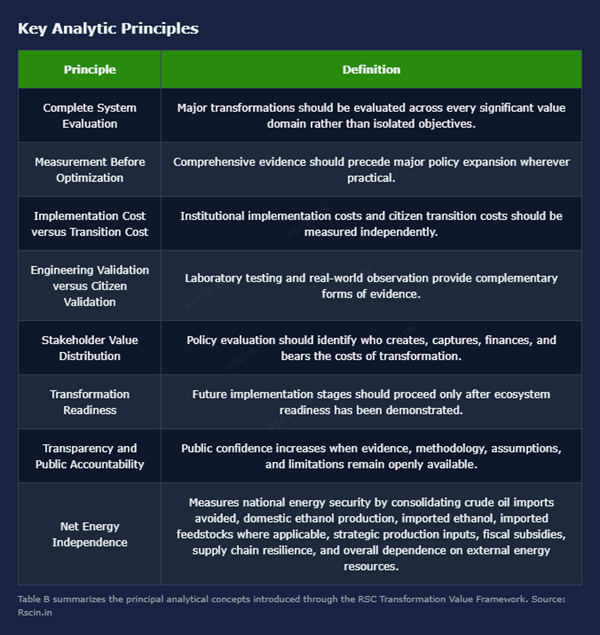
RSC Observation: Throughout this white paper, several proposed measurements evaluate individual dimensions of the E20 transformation, including economic performance, stakeholder value distribution, environmental sustainability, citizen experience, and transformation readiness. The proposed Net Energy Independence Index (NEII) differs from these metrics by acting as an integrative national indicator that consolidates multiple dimensions into a single strategic measure of India’s long term energy resilience. As future energy transitions introduce additional fuels such as isobutanol, sustainable aviation fuel, hydrogen, or other biofuels, the NEII can evolve into a standardized framework.
C: Areas Requiring Future Research
Although substantial public information exists regarding India’s ethanol blending program, several important analytical areas would benefit from continued research and greater public transparency.
These include:
- Longitudinal real world vehicle performance across representative national samples
- Long term maintenance and ownership cost studies for legacy vehicles
- Regional fuel economy variation under different climatic and traffic conditions
- Stakeholder value distribution across the complete ethanol value chain
- Periodic lifecycle environmental assessments across different feedstocks
- Water resource forecasting under future ethanol demand scenarios
- Consumer behavior and mobility pattern analyses
- National optimization studies for determining future fuel grade strategy
- Long term readiness assessments before introducing higher ethanol blends or alternative biofuels such as isobutanol
These recommendations should not be interpreted as evidence that existing policy is incorrect. Rather, they identify opportunities through which future policy decisions may be supported by increasingly comprehensive evidence.
Recent public discussions surrounding E20 have further demonstrated the importance of distinguishing between engineering research findings, media summaries of those findings, and the publicly available evidence supporting national policy. Future national transformations would benefit from the routine publication of detailed methodologies, statistical analyses, representative datasets where appropriate, and peer reviewed technical reports. Independent scientific verification should be viewed not as opposition to policy, but as a normal and constructive component of evidence-based governance.
Appendix D: Glossary
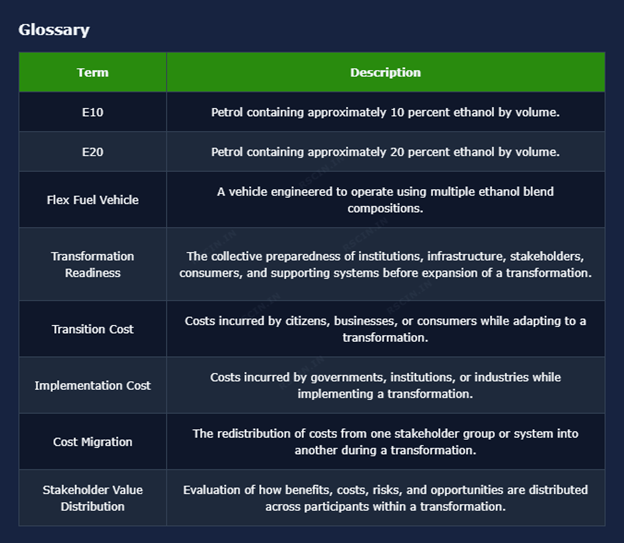
E: References
The analyses presented throughout this white paper draw upon publicly available publications including, but not limited to, the following categories of sources.
Government Publications
- NITI Aayog
- Ministry of Petroleum and Natural Gas
- Ministry of Road Transport and Highways
- Ministry of Jal Shakti
- Central Water Commission
- Automotive Research Association of India
- Central Pollution Control Board
- Petroleum Planning and Analysis Cell
Peer Reviewed Research
- Energy
- Fuel
- Renewable and Sustainable Energy Reviews
- Applied Energy
- Energy Policy
- Transportation Research publications
- Society of Automotive Engineers publications
Industry and Institutional Reports
- Society of Indian Automobile Manufacturers
- Renewable Fuels Association
- Federation of Automobile Dealers Associations
- Oil Marketing Companies
- Automobile manufacturers
- International Energy Agency
- World Bank
- Organization for Economic Cooperation and Development
Business and Technical Publications
- The Economic Times
- Moneycontrol
- Business Standard
- Autocar India
- Down To Earth
- Reuters
- Bloomberg
- Hindustan Times
- The Hindu
- Financial Express
- Hindu Business Line
Note: Individual citations are provided throughout the white paper in parentheses immediately following the relevant discussion. The above list summarizes the principal source categories supporting the overall analysis.
Appendix F: About the RSC Transformation Value Framework
The RSC Transformation Value Framework was developed to address a recurring limitation observed in the evaluation of complex enterprise and national transformations. Organizations frequently measure success by determining whether the original objectives of a transformation have been achieved. While such evaluation remains necessary, it often provides only a partial understanding of the broader consequences that emerge as transformations influence interconnected economic, technological, environmental, operational, and societal systems.
Modern transformations rarely occur within isolated environments. A decision affecting one sector frequently generates measurable consequences across numerous others. Artificial intelligence influences workforce capability, governance, cybersecurity, regulation, and customer experience. Energy policy influences agriculture, environmental sustainability, industrial investment, logistics, and household affordability. Digital transformation affects organizational culture, employee capability, operational efficiency, and long-term competitiveness. Similar interactions exist across healthcare, infrastructure, manufacturing, education, sustainability, financial services, and public administration.
Recognizing this interconnected nature of transformation, the RSC Transformation Value Framework proposes that major decisions should be evaluated through multiple complementary value domains rather than isolated performance indicators. The framework therefore examines six interconnected dimensions comprising economic value, macroeconomic impact, environmental and resource sustainability, human experience, stakeholder value distribution, and transformation readiness. Together, these value domains provide a structured methodology for understanding how benefits, costs, opportunities, risks, and long-term consequences propagate throughout the broader ecosystem influenced by a transformation.
Several analytical principles further support the framework.
The first distinguishes implementation cost from transition cost. Governments, enterprises, and institutions incur expenditure while implementing transformation. Citizens, employees, customers, suppliers, and businesses incur separate costs while adapting to it. Evaluating both categories independently enables decision makers to understand the complete cost of change rather than only the expenditure recorded within organizational budgets.
The second distinguishes engineering validation from citizen validation. Controlled laboratory testing, pilot implementations, simulations, and engineering analyses establish whether a technology performs under standardized conditions. Real world observation determines how that same technology performs within the complexity of everyday operational environments. Both forms of evidence are complementary and together provide a more complete understanding of transformation outcomes.
The third principle recognizes that value created by a transformation and value captured from that transformation are not necessarily distributed equally. Stakeholder Value Distribution therefore evaluates how benefits, costs, responsibilities, risks, and opportunities migrate across different participants within the ecosystem rather than remaining concentrated within the implementing organization alone.
Finally, the framework introduces the concept of Transformation Readiness. Rather than evaluating whether future implementation is technically possible, the framework asks whether the surrounding ecosystem has become sufficiently prepared to support the next stage of transformation responsibly. Readiness therefore extends beyond technology itself to include governance, infrastructure, stakeholder preparedness, environmental sustainability, consumer behavior, regulatory capability, and long-term resilience.
Although this white paper applies the framework to India’s E20 transition, the methodology is intentionally sector independent. It is designed to support evaluation of enterprise strategy, artificial intelligence adoption, digital transformation, healthcare modernization, sustainability initiatives, infrastructure development, manufacturing transformation, regulatory reform, national policy, and other complex programs whose consequences extend across multiple interconnected systems.
The RSC Transformation Value Framework should therefore be viewed not as a fixed model, but as an evolving analytical methodology. Future applications, empirical research, industry case studies, and collaborative engagement with enterprises, governments, regulators, and academic institutions will continue refining the framework while expanding its practical applicability across diverse transformation contexts.
Ultimately, the framework rests upon one central principle. The purpose of transformation is not merely to achieve change. It is to ensure that change creates the greatest possible value while minimizing unintended consequences across the complete ecosystem it influences.
That principle remains equally relevant whether the transformation involves an enterprise, an industry, or an entire nation.