

Identifying and Building the Missing Layer Between Data and Decision Making for Efficient Governance
Download the PDF version of this white paper: “Governance Truth Making Government Information Systems Failure-Proof”
1. Executive Summary
Governments today generate more information than at any point in history, yet the executives responsible for acting on that information, chief ministers, cabinet secretaries, agency heads, continue to make consequential decisions on data that is incomplete, delayed, or quietly filtered by the time it reaches them. This is rarely a failure of technology. It is a failure of structure, and it is measurable, recurring, and well documented across sectors and countries that have nothing else in common.
This paper examines that failure through eight cases, drawn from aerospace, health administration, global finance, tax and welfare policy, criminal justice technology, aviation, and digital government infrastructure. Two space shuttle disasters, a financial crisis that required an act of the United States Congress to formally investigate, a wrongful conviction scandal now regarded as the largest in modern UK legal history, an automated welfare debt scheme that brought down an entire national cabinet, and a decade long government technology program that spent over ten billion pounds while its own benefit went largely unmeasured, all share a single underlying pattern. In each case, the technology in use performed exactly as built. In each case, the information needed to prevent serious harm existed somewhere inside the organization, sometimes for years, and did not reach the people with the authority to act on it in time.
Two further cases, Estonia’s X-Road data exchange infrastructure and the United States Aviation Safety Reporting System, demonstrate that this outcome is not inevitable. Both were deliberately designed around a small number of structural principles, guaranteeing the integrity of information at its source in one case, and separating verification from enforcement in the other, and both have produced measurable, sustained benefit over decades.
From this evidence, this paper develops the RSC Governance Truth Framework, organized around six integrity domains, source integrity, escalation integrity, verification independence, accountability traceability, human oversight calibration, and systemic learning. Applied consistently across every case examined, these six domains explain, with unusual precision, why some large scale government and institutional transformations succeed while others produce the kind of failure that later requires a formal public inquiry to explain.
The paper concludes with seven specific recommendations for any government considering how to close this gap, spanning executive sponsorship, independence of verification, automatic escalation, protection for good faith reporting, and measured public transparency. None of these recommendations depend on adopting a particular technology platform. All of them depend on a government’s willingness to build a distinct, structurally protected function whose sole responsibility is guaranteeing that the information reaching its most senior decision makers reflects what is actually true.
The central argument of this paper can be stated in a single sentence. More data, delivered faster, through more advanced systems, does not by itself produce better decisions, and every case examined in this paper shows what happens when that assumption goes unexamined for too long.
2. Why Traditional Governance Modernization Is Incomplete
Governments evaluating technology led transformation programs consistently gravitate toward the metrics that are easiest to report, rather than the outcomes that actually determine success. A portal is launched. A budget is utilized. A system goes live. Each of these is a real, verifiable event, and each one is also, on its own, silent about the question that matters most to an executive, which is whether the information now flowing through that system reaches the person responsible for acting on it, accurately and in time.
This is not a hypothetical concern. It is one of the most consistent patterns across major public sector technology failures over the past two decades.
Case Study: The NHS National Program for IT (United Kingdom, 2002 to 2011)
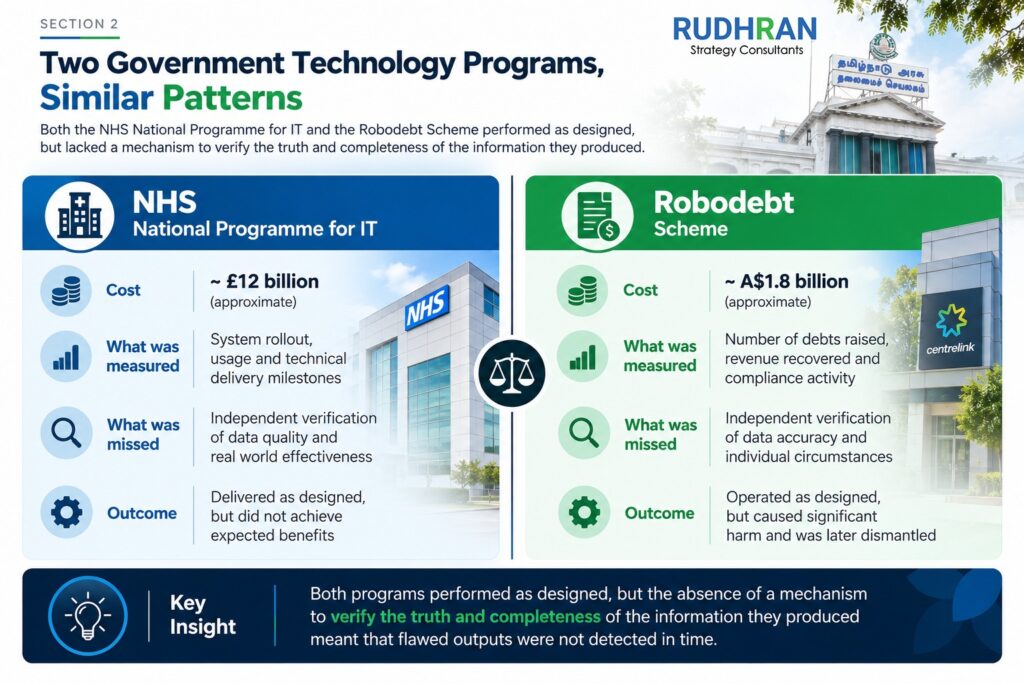
The United Kingdom’s National Program for IT was, at launch, the largest civilian information technology program in the world, intended to give every NHS patient a single electronic health record accessible across the entire health service (Public Accounts Committee, 2013, Commonwealth Fund, 2011). Progress was tracked, for most of the program’s life, through contract milestones, rollout counts, and expenditure against budget, precisely the metrics a large procurement organization is built to measure. By the time the program was formally dismantled in September 2011, total expenditure had reached an estimated 10 to 12.7 billion pounds, against which the government’s own assessment found roughly 2.6 to 3.7 billion pounds in realized benefit (Panorama Consulting, 2024, Public Accounts Committee, 2013). Parliament’s Public Accounts Committee, reviewing the outcome, concluded that clinical benefit had gone essentially unmeasured until it was too late to correct course, and separately noted that the program’s core patient record component, the part most directly tied to whether clinicians actually received better information, was the element that had failed most completely (Public Accounts Committee, 2013).
The lesson is not that the technology failed. Large portions of the underlying software were delivered. The lesson is that the program was managed and reported against deployment metrics, while the metric that should have mattered most, whether the record reaching a doctor at the point of care was complete, current, and trusted, was never made the primary measure of progress until an external review forced the question.
Case Study: The Robodebt Scheme (Australia, 2015 to 2020)
A sharper illustration of the same failure, this time centered on information integrity rather than deployment, is Australia’s Robodebt scheme. The system used automated income averaging to identify and issue debt notices to welfare recipients, ultimately raising an estimated 1.76 billion Australian dollars in debts against roughly 433,000 people, a substantial share of which were later found to have been unlawfully assessed (Royal Commission Final Report, 2023, as summarized by the Prime Minister’s Office and the Law Society Journal). What makes this case directly relevant to a governance truth framework is not the automation itself, but what happened to the information about its flaws.
Internal legal advice sought by one department as early as November 2014 found that the scheme’s core method did not accord with legislation. The Royal Commission’s final report found no evidence that this advice was ever communicated to the implementing department at the time (Law Society Journal, 2023). By 2017, an independent tribunal had issued a series of rulings, ultimately 424 separate cases, finding the income averaging method wrong, and the report found the responsible agencies’ response was, in essence, to continue operating as though the rulings had not occurred (Department of Social Services Ministers transcript, 2023). The scheme’s own departmental secretary later told the Royal Commission that he had signed a letter to the Commonwealth Ombudsman asserting the scheme’s legality without having reviewed the legal or policy advice on which that assertion depended (summary of Royal Commission findings, 2023). The scheme ended only when a Federal Court ruling in 2019 found it unlawful.
This is, structurally, a pure governance truth failure. The technology performed exactly as designed. The legal and human cost of that design was known, in writing, inside the system for years, and never reached the political executives with sufficient force to trigger a review, because no mechanism existed whose job was specifically to ensure that it did.
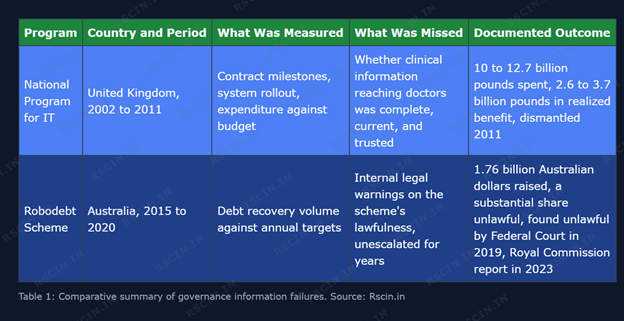
Across both cases, the technology available at the time was not the determining factor in the outcome. What determined the outcome was whether the organization had built a specific, accountable function whose sole purpose was verifying that the information reaching decision makers was complete, current, and true, as distinct from a function whose purpose was simply building or operating the system that generated that information. Neither the NHS program nor the Robodebt scheme had such a function in place, watching clinical adoption in one case and legal risk in the other.
This distinction, between building systems that move information and building a function that guarantees the truth of that information, is the foundation the remainder of this paper builds on. Section 6 returns to this same distinction from the opposite direction, examining governance transformations where information integrity was treated as the primary design goal from the outset, and the outcomes that followed as a result.
3. The Information Problem at the Top – with Global Evidence
The pattern identified in Section 2 is not limited to government technology programs, and it is not limited to any single country. The same failure mode, information that existed somewhere inside a large organization but did not travel upward with enough force to change a decision, appears repeatedly across sectors as different as space exploration and global finance. Establishing this breadth matters, because it demonstrates that the problem this paper addresses is structural to large hierarchies in general, not a defect specific to any one government or political system.
Case Study: The Space Shuttle Challenger (United States, 1986)
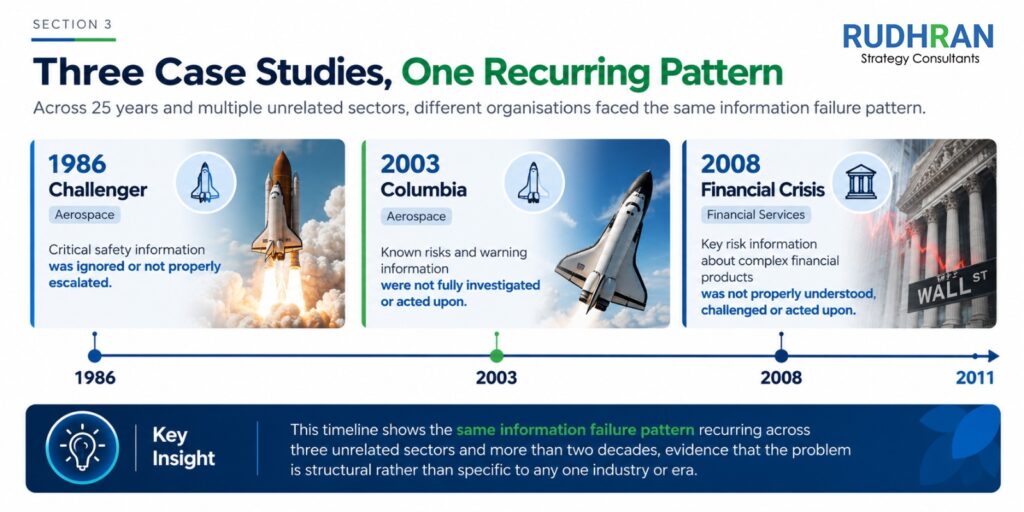
On January 28, 1986, the Space Shuttle Challenger broke apart 73 seconds after launch, killing all seven crew members, when a rubber O-ring seal on one of the solid rocket boosters failed in unusually cold conditions (Rogers Commission Report, 1986, as summarized in multiple contemporary and academic accounts). The failure was not a surprise to everyone inside NASA. Engineers at contractor Morton Thiokol had documented O-ring erosion on prior flights, and on the night before launch, engineers formally recommended against launching. given the forecast cold temperatures. That recommendation was overruled (Rogers Commission Report, 1986, sociologist Diane Vaughan’s account, 1996). Sociologist Diane Vaughan, studying the disaster afterward, coined the term normalization of deviance to describe what had happened inside NASA over the preceding years. Each successful flight completed despite a known O-ring anomaly made the next anomaly seem more acceptable, until a genuine warning sign had been redefined, inside the organization’s own culture, as routine variation rather than a hazard requiring escalation (Vaughan, 1996, as summarized in Dysmemic Pressure research paper, 2025).
The information that could have prevented the disaster existed in writing, inside the organization, years before the launch. It did not fail to exist. It failed to be treated as urgent by the time it reached the people with the authority to stop the launch.
Case Study: The Space Shuttle Columbia (United States, 2003)
Seventeen years later, NASA lost a second shuttle and crew to a structurally similar failure. During Columbia’s launch on January 16, 2003, a piece of foam insulation broke free from the external fuel tank and struck the leading edge of the shuttle’s wing. Engineers raised concerns about the strike within days of launch and requested satellite imagery, three separate times, to assess whether the wing had been damaged. That imagery was never obtained (Columbia Accident Investigation Board Final Report, 2003, as reported by Al Jazeera, 2003). The Columbia Accident Investigation Board later found that NASA managers had missed at least eight separate opportunities to address the concern, and that when engineers requested imaging, managers reportedly responded by asking who was requesting the images rather than assessing the request on its merits (Columbia Accident Investigation Board Final Report, 2003, Volume 1, as summarized by Human Factors 101 research archive).
The Board’s central conclusion was explicit on this point. It found that NASA’s organizational culture had played as much a role in the loss of Columbia as the physical foam strike itself, and that the agency’s structure did not provide effective checks and balances, lacked an independent safety program, and had not developed the characteristics of a learning organization (Columbia Accident Investigation Board Final Report, 2003). Foam debris had, in fact, struck shuttles on 79 of 113 flights between 1981 and 2003 without causing a loss of vehicle, and that long run of survived incidents appears to have taught the organization the wrong lesson, treating repeated near misses as proof of safety rather than as an accumulating warning (Human Factors 101 research archive, summarizing Board findings).
Two disasters, seventeen years apart, inside the same agency, following the same underlying pattern. The second investigation board explicitly noted the echo of the first.
Case Study: The 2008 Global Financial Crisis (United States and global markets)
The same pattern appears outside engineering and government entirely. The Financial Crisis Inquiry Commission, a ten-member panel appointed by the United States Congress, spent eighteen months reviewing millions of documents and interviewing more than 700 witnesses before concluding, in January 2011, that the 2008 financial crisis had been avoidable (Financial Crisis Inquiry Commission Final Report, 2011). The Commission’s own language was direct. It found that the crisis resulted from human action and inaction, not from market forces behaving unpredictably, and that the leaders of major financial institutions and the public officials responsible for overseeing them had ignored warnings and failed to question, understand, and manage risks that were already visible within their own institutions (Financial Crisis Inquiry Commission Final Report, 2011, as reported by NPR, 2011). The Commission specifically identified dramatic failures of corporate governance and risk management inside systemically important financial institutions as a key cause of the crisis, meaning the failure was not an absence of data about risk, but a failure of that data to change behavior at the level where decisions were actually made (Financial Crisis Inquiry Commission Final Report, 2011).
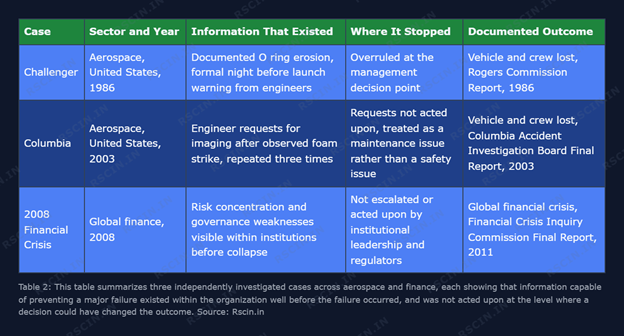
In each of these three cases, drawn from two industries and two countries, the organization possessed the information needed to prevent the outcome. In each case, that information existed at a working level and did not travel upward with the force needed to reach the decision makers who could act on it, or reached them but was not treated with the urgency the underlying risk warranted. This is the precise mechanism the remainder of this paper is concerned with. It is not a technology gap. It is a structural gap in how large organizations, public or private, verify that the information reaching their top decision makers reflects the true state of the system they are responsible for.
The next section examines why the current generation of digital and AI led government modernization initiatives, however well designed, does not by itself close this specific gap.
4. Why Technology Investment Alone Does Not Close the Information Gap
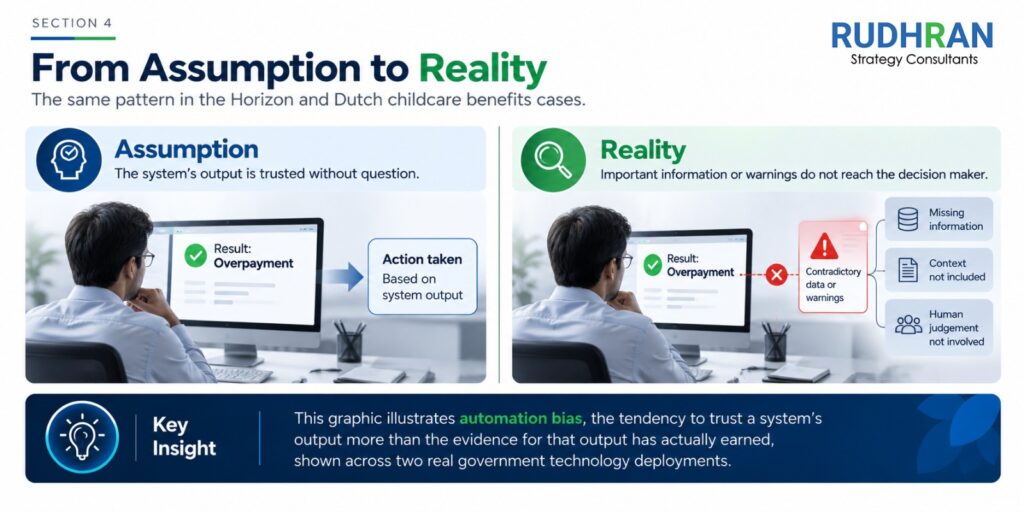
If the information integrity gap identified in the previous two sections were simply a matter of insufficient technology, it should be closing rapidly, given how much governments worldwide have invested in digital systems, automation, and increasingly, artificial intelligence, over the past two decades. It has not closed. In several documented cases, adding more sophisticated technology to a government process made the underlying integrity problem worse rather than better, for a specific and repeatable reason. Technology is very good at moving information faster and processing larger volumes of it. It does nothing, by itself, to verify that the information is true, and it does nothing to guarantee that a warning generated deep inside the system reaches someone with the authority to act on it. Worse, a well-built system tends to be trusted more than a human clerk would be, a pattern human factors researchers call automation bias, the tendency to treat a computer-generated output as more reliable than it has actually been shown to be. When that trust is combined with an absence of independent verification, the technology does not close the integrity gap. It gives the gap a more convincing disguise.
Case Study: The Post Office Horizon Scandal (United Kingdom, 1999 to 2015)
Starting in 1999, the UK Post Office deployed an accounting system called Horizon, built by Fujitsu, across its national network of branches. Horizon calculated how much cash and stock should be present in each branch, based on recorded transactions, and branch managers, known as sub postmasters, were required to reconcile their physical cash against the system’s figures each day (Criminal Cases Review Commission, ccrc.gov.uk). Between 1999 and 2015, the Post Office prosecuted approximately 736 to over 900 sub postmasters for theft, fraud, and false accounting, based substantially on Horizon’s own output, with a number of them imprisoned (The Register, 2025, citing the statutory public inquiry led by Sir Wyn Williams, TechMonitor, 2024). At least 13 deaths by suicide have been linked to the wrongful prosecutions (The Register, 2025).
The inquiry established that bugs in Horizon had been known internally at Fujitsu from close to the start of its deployment. Fujitsu’s own European co-chief executive told the public inquiry in January 2024 that the company had been aware of at least 29 distinct bugs in the system for nearly two decades, and that the Post Office had been made aware of the vast majority of them (ITV News, 2024). The inquiry’s first published volume went further, finding that a number of senior Post Office employees knew, or at minimum should have known, that Horizon was capable of error, yet the organization maintained throughout the system’s lifetime what the inquiry chairman described as the fiction that its data was always accurate (The Register, 2025, quoting the inquiry report). Witness statements referencing the known bugs were reportedly edited before being submitted in court, an action Fujitsu’s own executive later called shameful and appalling under questioning (ITV News, 2024).
Horizon was, by any measure, a substantial and largely functional piece of government facing technology. The organization deploying it experienced years of internal signals that its core output could not always be trusted, and no mechanism existed whose function was to independently verify that output before it was used as the sole basis for a criminal prosecution. The result was, at the time of writing, the largest single series of wrongful convictions in UK legal history, ultimately requiring the UK Parliament to pass unprecedented legislation overturning convictions in bulk rather than case by case (Criminal Cases Review Commission, ccrc.gov.uk).
Case Study: The Dutch Childcare Benefits Scandal (Netherlands, 2013 to 2019)
A more recent case shows the same pattern occurring with more advanced, algorithmically driven technology. Between 2013 and 2019, the Dutch tax authority used a data driven system to flag families for investigation over suspected childcare benefit fraud. A parliamentary inquiry, publishing its findings in December 2020, found that an estimated 10,000 families had been wrongly accused of fraud and ordered to repay benefits, in many cases tens of thousands of euros, with consequences including bankruptcy and family breakdown (Dutch News, 2021, CNBC, 2021). The inquiry and subsequent reporting found that some families had been flagged for investigation in part because they held dual nationality, a pattern widely described afterward as a form of discriminatory profiling built into the system’s own criteria (The Vibes, 2021).
The consequences reached the highest level of government. On January 15, 2021, Prime Minister Mark Rutte and his entire cabinet resigned, with Rutte telling reporters that if the whole system had failed, only joint responsibility could be borne (Dutch News, 2021). In his resignation statement, Rutte specifically identified the underlying failure as an information problem, stating that signs something was not going well needed to surface far faster and lead to action far faster, and that information provision within government needed to be, in his words, fundamentally overhauled (The Cable, 2021, quoting Rutte’s resignation statement).
This case is a direct rebuttal to the assumption that more advanced technology closes the integrity gap on its own. The system involved was more sophisticated than a simple accounting tool. It used data patterns to make judgments about individual families. That added sophistication did not produce better oversight. It produced a system whose internal logic was harder for anyone outside it, including the ministers ultimately held responsible, to question or verify in time to prevent years of harm.
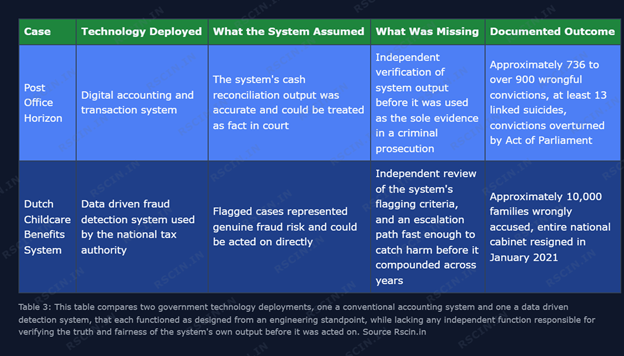
Neither case involved a technology failure in the ordinary sense. Horizon processed transactions. The Dutch system flagged cases according to its programmed criteria. In both cases, the technology did exactly what it was built to do, and the harm occurred precisely because no independent function existed to check whether what the technology was built to do was actually correct, or whether the humans responsible for acting on its output had any real ability to question it. This is the central argument of this paper stated in its sharpest form. Digital transformation and artificial intelligence adoption change how fast information moves and how much of it can be processed. They do not, by themselves, change whether that information is true, or whether a warning buried inside the system reaches the person who can act on it in time. That requires a distinct, deliberately designed function, which is the subject of the section that follows.
5. A Framework for Governance Information Integrity
The cases examined so far, across aerospace, health administration, financial regulation, and two different national tax and welfare systems, do not share an industry, a country, or even an era. What they share is a small, repeatable set of structural gaps, each of which allowed accurate information to exist somewhere inside a system while never reaching a decision maker complete, verified, and in time to act. Isolated case studies are useful for establishing that a problem is real. They are not, by themselves, useful for building something. What is needed is a structure that lets any government, in any department, ask the same diagnostic question about its own information flows, before a failure occurs rather than after a commission is convened to explain one.
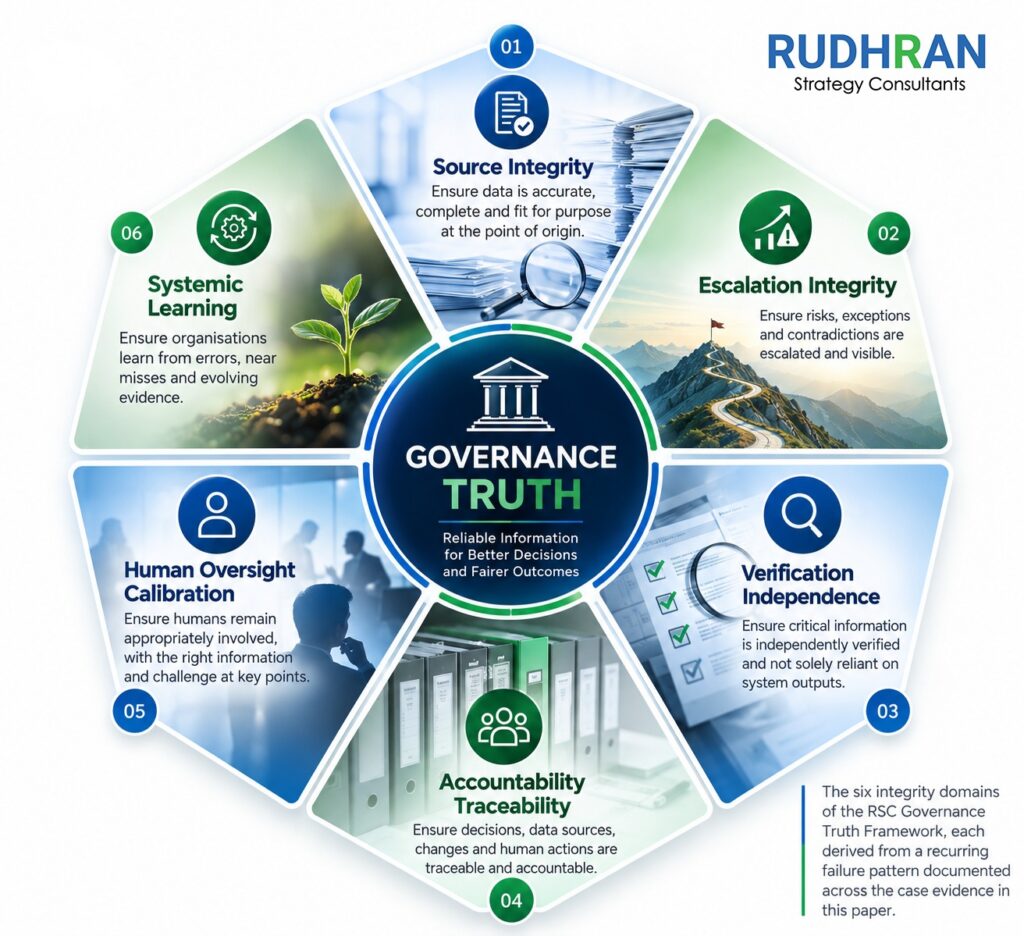
This section introduces the RSC Governance Truth Framework, developed specifically for that purpose. The framework organizes the recurring failure points identified across Sections 2 through 4 into six integrity domains. A government information system that is strong across all six domains is, based on the evidence reviewed in this paper, structurally resistant to the kind of failure described in every case study so far. A system that is weak in even one domain carries the same underlying vulnerability that produced the Horizon prosecutions, the Robodebt scheme, or the Dutch childcare benefits collapse, regardless of how modern its underlying technology is.
Consistent with the evidentiary discipline this paper has followed throughout, each domain below is stated as a diagnostic principle grounded in the case evidence already presented, rather than as an untested theoretical construct. Where this paper extends beyond what the case evidence directly proves, that extension is stated plainly as an analytical hypothesis rather than an established fact, in keeping with the broader RSC research standard of separating verified findings from reasoned extrapolation.
The Six Integrity Domains
1. Source Integrity: This domain asks whether the raw information entering a governance system is accurate at its point of origin, before any human or algorithm acts on it. The Post Office Horizon case is the clearest failure of this domain in the cases reviewed, where the underlying system itself generated inaccurate figures for years, and those figures were nonetheless treated as ground truth (The Register, 2025).
2. Escalation Integrity: This domain asks whether critical information travels upward through an organization automatically, rather than depending on a specific individual choosing to forward it. Every failure case in this paper contains an escalation integrity gap. Robodebt’s internal legal warning from 2014 never reached the responsible department. The Columbia engineers’ repeated requests for imaging never resulted in the imaging being obtained. In both cases, the information existed, and its upward movement depended on a discretionary human step that did not occur.
3. Verification Independence. This domain asks whether the party generating or benefiting from a piece of information is also the party responsible for judging its accuracy. The 2008 financial crisis inquiry found that institutions were, in effect, grading their own risk, with insufficient independent challenge from boards or regulators (Financial Crisis Inquiry Commission, 2011). The Dutch tax authority’s fraud detection criteria were similarly never subjected to meaningful independent review before being acted upon at scale.
4. Accountability Traceability: This domain asks whether a durable, tamper resistant record exists connecting a specific decision to the specific information that was available to the decision maker at the time. Its absence made it possible, in the Horizon case, for witness statements referencing known bugs to be edited before submission to court, a fact only established years later through a statutory public inquiry (ITV News, 2024).
5. Human Oversight Calibration: This domain addresses a subtler failure, the tendency for humans to trust a system’s output more than the evidence for that output actually warrants, a pattern documented in human factors research as automation bias. The Horizon case is again instructive here, since sub postmasters were effectively required to disprove a system’s output rather than the system’s output being independently proven correct (The Register, 2021).
6. Systemic Learning: This domain asks whether an organization treats repeated near misses as accumulating evidence of risk, or normalizes them as proof of safety. The Columbia Accident Investigation Board’s finding that foam strikes had occurred on 79 of 113 shuttle flights without previously causing a loss of vehicle, and that this record had taught NASA the wrong lesson, is the clearest documented instance of this failure in the cases reviewed (Columbia Accident Investigation Board Final Report, 2003).
Applying the Framework Across the Case Evidence
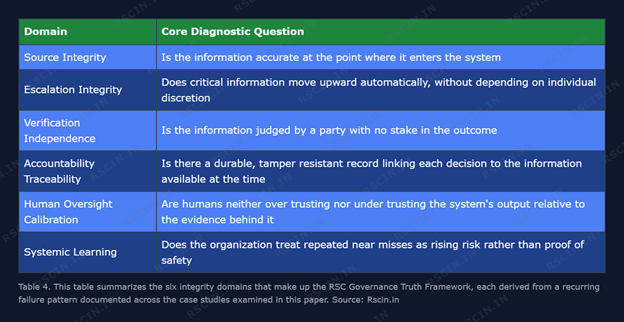
The analytical value of a framework of this kind depends on whether it can be applied consistently across genuinely different cases, rather than being tailored after the fact to fit any single example. Table 4 applies all six domains to every major case examined so far in this paper, marking which domains were structurally absent or compromised in each documented failure.
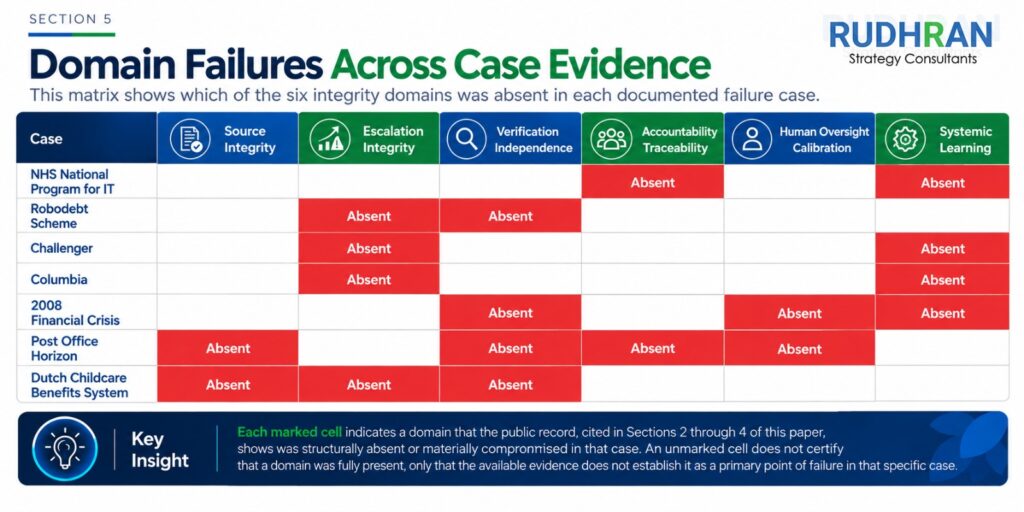
Two patterns in this table are worth naming directly. Escalation Integrity and Verification Independence are the two most frequently absent domains across the full case set, appearing as a documented failure point in five and four of the seven cases respectively. This is consistent with the central argument of this paper. Technology investment, examined in the prior section, tends to strengthen how information is stored and processed, which touches Source Integrity and Accountability Traceability. It does far less, by default, to guarantee that a warning reaches the right desk without depending on a person choosing to send it, or that the party grading a risk is not the same party responsible for having caused it.
Toward an Instrument, Not Only a Diagnosis
A framework that only diagnoses failure after the fact has real value, in the same way a case study has value, but it stops short of what a government actually needs, which is a working mechanism that closes these gaps before a failure occurs. Escalation Integrity and Verification Independence, having emerged as the most consistently absent domains across the case evidence, point toward a specific design principle. A governance information system needs a function, independent of the department or official generating a piece of information, whose sole role is to classify the severity of a given risk, and whose classification cannot be altered by the party under review.
That same function needs to pair any identified risk with a mandatory acknowledgment step, and that acknowledgment needs to travel automatically to the appropriate level of oversight based on its severity, rather than depending on the original recipient’s discretion to forward it. This paper refers to this instrument, at the level of general principle, as an executive notification mechanism. Its detailed design, including how severity tiers are set and how escalation paths are structured for a specific government’s departmental architecture, is a matter for direct engagement rather than public discussion, and is addressed only in general policy terms later in this paper.
The next section turns from diagnosis to demonstration, examining governance transformations where several of these six domains were deliberately built in from the outset, and the outcomes that followed as a result.
6. Governance Transformations That Built Integrity in From the Start
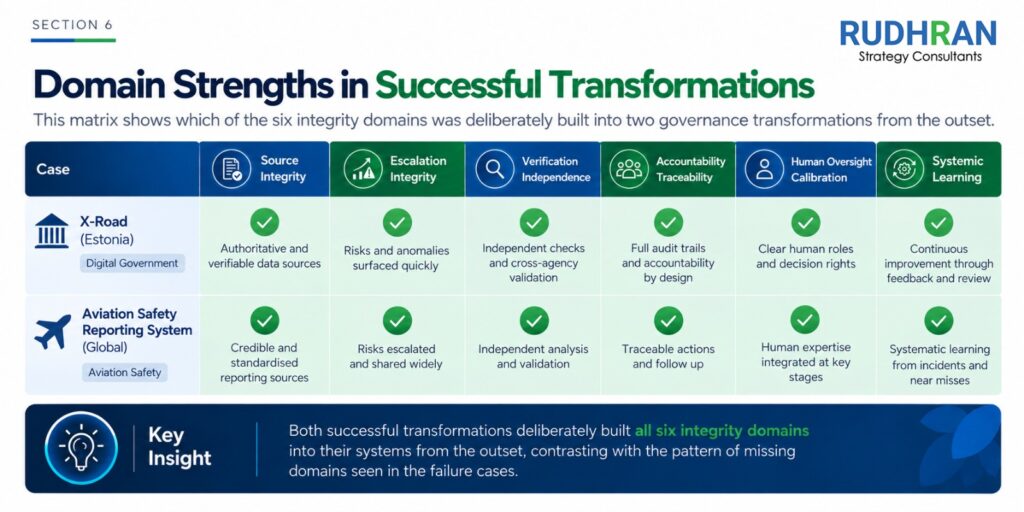
Every case examined so far in this paper has been a failure. That was a deliberate choice, consistent with the emphasis you asked for earlier, since failures tend to expose a system’s true structure more clearly than successes do. It is equally important, though, to show that the six integrity domains introduced in Section 5 are not only useful for explaining disasters after the fact. They also describe what a government information system looks like when it works. This section examines two cases, drawn from different sectors entirely, where one or more of the six domains were deliberately built into a system from the outset, rather than added after a failure forced the question, and the outcomes that followed as a result.
Case Study: Estonia’s X-Road (2001 to present)
X-Road is the data exchange layer underlying most of Estonia’s digital government services, connecting an estimated 450 to over 900 public and private organizations (e-Estonia platform documentation, GovInsider, 2024). Rather than treating system deployment as the measure of success, X-Road was built around a specific design rule known as the ask once principle, meaning a citizen’s data, once submitted to any part of government, does not need to be resupplied or reverified through a separate channel, because the underlying data exchange guarantees its integrity across every connected system (e-Estonia platform documentation). This is a direct, structural implementation of Source Integrity, the first domain in the framework above, built into the system’s architecture rather than added as an oversight process afterward.
The measured outcomes reflect that design choice. Independent estimates place the aggregate working time saved by X-Road at somewhere between roughly 800 and over 3,000 years annually, with fiscal savings estimated at approximately 2 percent of Estonia’s GDP each year (e-Estonia platform documentation, citing World Bank and academic sources). Independent digital government rankings have specifically noted that Estonia’s global standing is strongest on infrastructure that is universal and mandatory, precisely the category concerned with whether data moving through government can be trusted without separate verification at every step (P2P Foundation Wiki, summarizing UCL Institute for Innovation and Public Purpose analysis, 2018).
Case Study: The Aviation Safety Reporting System (United States, 1976 to present)
A second case, drawn from an entirely different sector, demonstrates a different pair of domains built in from the start, Escalation Integrity and Verification Independence, the two domains identified in Section 5 as the most frequently absent across every failure case in this paper. The Aviation Safety Reporting System, known as ASRS, was created following the investigation into the crash of TWA Flight 514 in December 1974, after the National Transportation Safety Board recommended a national mechanism for identifying unsafe operating conditions before they caused accidents (SAE Technical Paper, Corrie, 1997). ASRS began operations in April 1976, and by design, it is administered not by the Federal Aviation Administration, the body with enforcement authority over pilots and airlines, but by NASA, an agency with no enforcement power and no institutional stake in the outcome of any individual report (Wikipedia, Aviation Safety Reporting System, AVweb, ASRS Safe Protections).
This single design choice, placing verification in the hands of a party independent of the party being scrutinized, is a direct structural implementation of Verification Independence. It is paired with an equally deliberate implementation of Escalation Integrity. Any pilot, air traffic controller, mechanic, or dispatcher can file a report on a safety concern, including their own error, and the report is stripped of identifying information once NASA’s analysts are satisfied with its content, after which NASA independently issues alerts to airlines, air traffic authorities, manufacturers, or airport authorities if the issue is judged significant, regardless of whether the original reporter takes any further action (Wikipedia, Aviation Safety Reporting System, Boldmethod, 2024). The escalation of a genuine safety concern does not depend on the reporter’s continued involvement or on any single individual choosing to pursue it further. Reports filed within ten days of an incident additionally carry limited immunity from enforcement action for the reporter, a design feature specifically intended to remove the disincentive to report an error that the Horizon and Robodebt cases show can otherwise cause a system’s true state to remain hidden (AVweb, ASRS Safe Protections, Boldmethod, 2024).
The scale of the result is substantial. Annual reports to ASRS grew from around 3,000 to over 32,000 within roughly two decades of the program’s founding (SAE Technical Paper, Corrie, 1997), and the program has received more than 1.5 million reports over its lifetime (Boldmethod, 2024). The model has since been adopted, in modified form, by the rail, medical, firefighting, and offshore petroleum industries, specifically because its core structure, independent verification paired with guaranteed escalation, has proven transferable across sectors with very different technologies and risks (Wikipedia, Aviation Safety Reporting System).
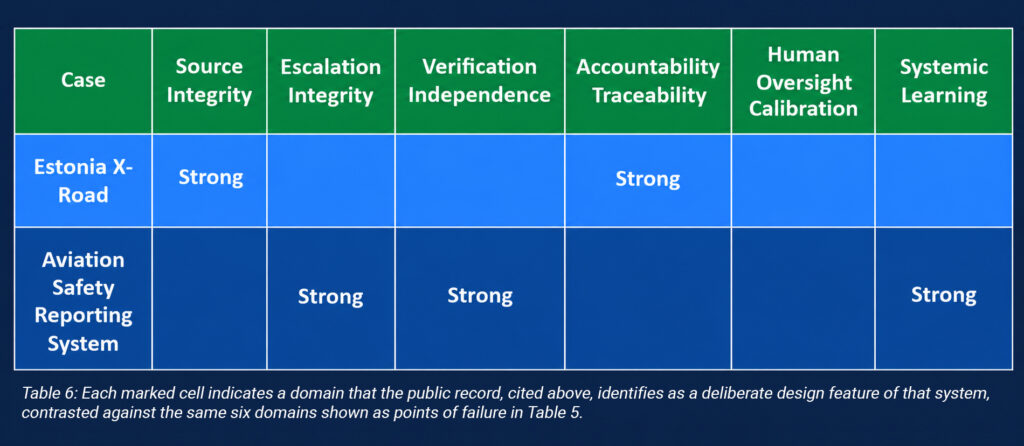
Reading Tables 5 and 6 together
Placed side by side with the earlier failure analysis in Section 5, the pattern becomes direct rather than theoretical. Escalation Integrity was absent in five of the seven failure cases in this paper, and it is one of the two domains deliberately engineered into ASRS from its founding in 1976. Verification Independence was absent in four of the seven failure cases, and it is the other domain ASRS was specifically built around, through the choice of NASA rather than the FAA as its administrator. Source Integrity was absent in two of the failure cases and is the domain X-Road was explicitly designed to guarantee through its ask once architecture.
None of this is coincidence. It is the same six domains, described in the same terms, producing measurably different outcomes depending on whether they were designed in from the start or left to chance. This is the strongest evidence available that the framework in Section 5 is not simply a way to explain disasters after they happen, but a specification for what a government information system needs to include if it wants to avoid becoming the next case study in a paper like this one.
The next section turns to what this means structurally for a government considering building such a system, in general policy terms rather than as a specific technical blueprint.
7. What a Governance Information Integrity Function Requires Structurally
The six domains in Section 5, and the two contrasting sets of outcomes in Section 6, establish what a governance information integrity function needs to achieve. They do not, on their own, establish where such a function should sit inside a government, or who should be accountable for its success. This is not a minor implementation detail. A function of this kind touches nearly every department in a government, since information failures, as shown throughout this paper, rarely respect departmental boundaries. Where the function sits, and who sponsors it, determines whether it can actually see across those boundaries or whether it becomes, in practice, just one more department’s initiative that other departments can quietly decline to fully cooperate with.
The Cross Department Problem
A governance information integrity function, by its nature, needs visibility into police, revenue, finance, municipal administration, and citizen facing services simultaneously, because an information failure in any one of these can compound with a failure in another before either is caught. No single department has the standing to compel the others to share data, participate in reviews, or accept independent verification of their own reporting. Only an authority positioned above all of them, typically the office of the head of government, carries that standing. This is a structural observation, not a political one. It follows from the basic mechanics of organizational authority in any large government, regardless of country or party in power.
Case Study: Singapore’s Smart Nation and Digital Government Group (2014 to present)
Singapore’s experience with its own digital government program is a useful, non-controversial illustration of this exact structural lesson. The Smart Nation initiative was launched in late 2014, and its early years were coordinated through a Smart Nation Program Office operating within the Prime Minister’s Office alongside separate digital government functions housed in the Ministry of Finance and the Ministry of Communications and Information (Singapore Government Technology Agency, official release, March 2017). By 2017, the government concluded that this distributed arrangement was not sufficient, and restructured all three functions into a single Smart Nation and Digital Government Group, placed directly and formally under the Prime Minister’s Office, with the Government Technology Agency reporting into it as the implementing arm (Singapore Government Technology Agency, official release, March 2017, Prime Minister’s Office Singapore, official release, March 2017).
Deputy Prime Minister Teo Chee Hean, explaining the restructuring at the time, made the underlying logic explicit. The purpose of consolidating the function directly under the Prime Minister’s Office was specifically to strengthen the government’s ability to coordinate across agencies and maintain a tight link between planning and execution, something the earlier, more distributed structure had not adequately provided (Prime Minister’s Office Singapore, official release, March 2017, as reported by OpenGov Asia, 2017). The lesson is direct. Even a government widely regarded as highly effective at digital administration found that a cross-agency information initiative required consolidation under the head of government’s own office before it could function as intended. A structure that seemed reasonable at launch in 2014 was found, within three years, to be insufficiently authoritative to do its job, and was corrected accordingly.
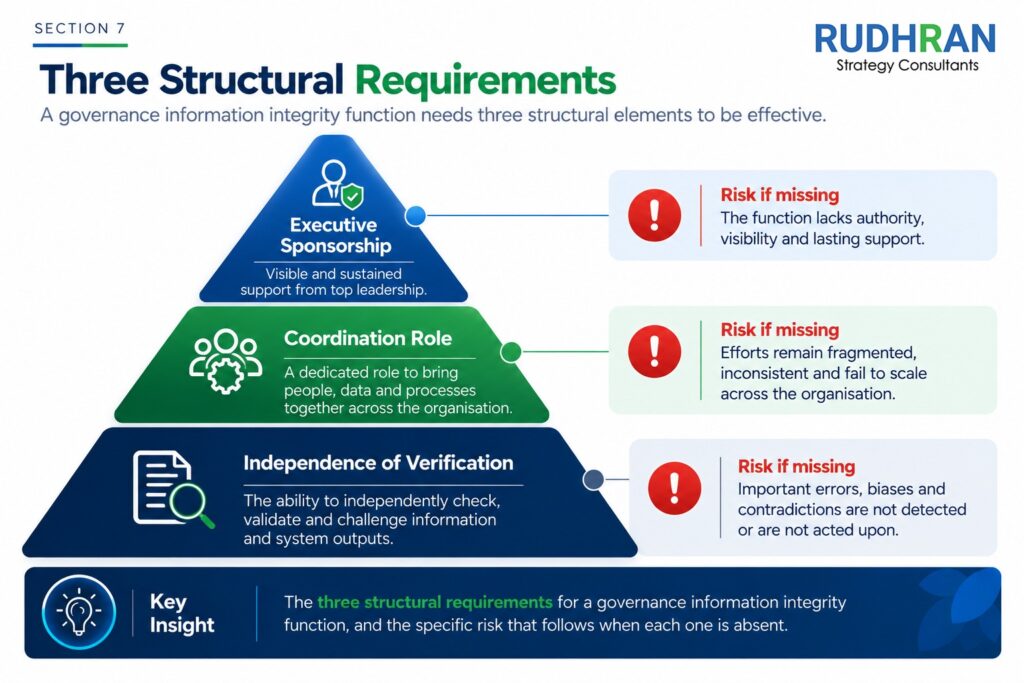
The Three Structural Requirements
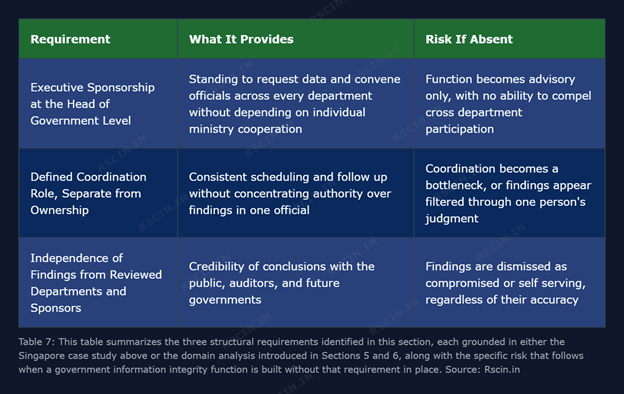
Drawing on this case, together with the domain analysis in Sections 5 and 6, three structural requirements emerge for any governance information integrity function, independent of the country or department structure it is applied to.
The first is executive sponsorship at the level of the head of government. This is not a ceremonial requirement. It is the mechanism by which a cross-department function acquires the standing to request data, convene officials, and receive escalated findings without depending on the goodwill of any single ministry, mirroring exactly what Singapore’s 2017 restructuring was designed to achieve.
The second is a clearly defined coordination role, distinct from ownership of the function itself. A designated liaison, typically a senior official trusted across departments, manages scheduling, tracks participation, and escalates non-cooperation, without being given authority over the function’s findings. This distinction protects the function from becoming dependent on, or filtered through, a single official’s judgment, which Section 5 identified as a Verification Independence risk in its own right.
The third is a guarantee that findings remain independent of the departments being reviewed and of the function’s own sponsors. This requirement follows directly from the Aviation Safety Reporting System case in Section 6, where placing verification authority in a party with no enforcement stake in the outcome was the single design choice most responsible for the system’s credibility and longevity.
Closing this section
None of these three requirements are unique to any one country, department structure, or political system. They follow from the same underlying logic that produced every case examined in this paper so far, that information integrity is a function of structure and incentive, not of the sophistication of the technology involved. A government considering a function of this kind should treat these three requirements as a precondition for success, not as one option among several equally viable structures.
The next section turns from structural requirements to specific, general recommendations, addressed to any government considering closing the information integrity gap this paper has documented.
8. Recommendations
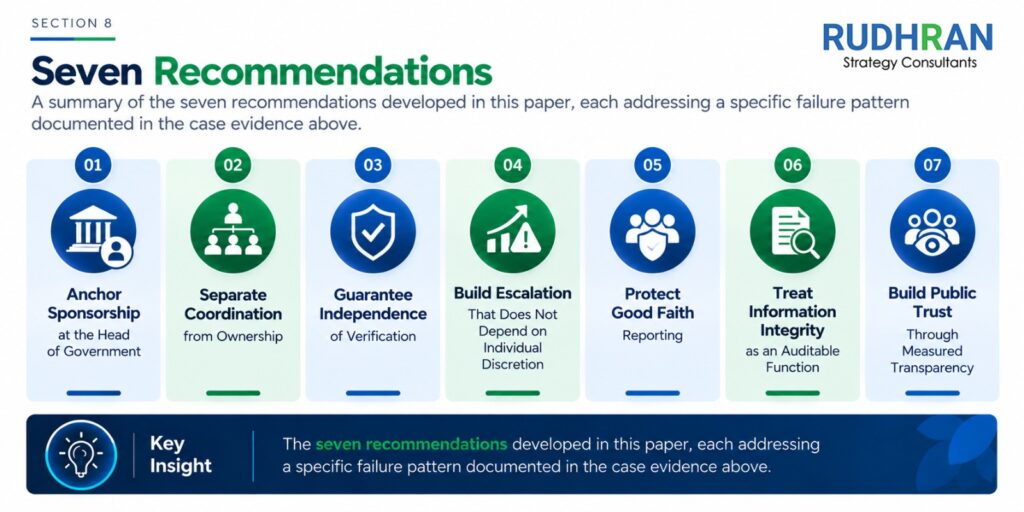
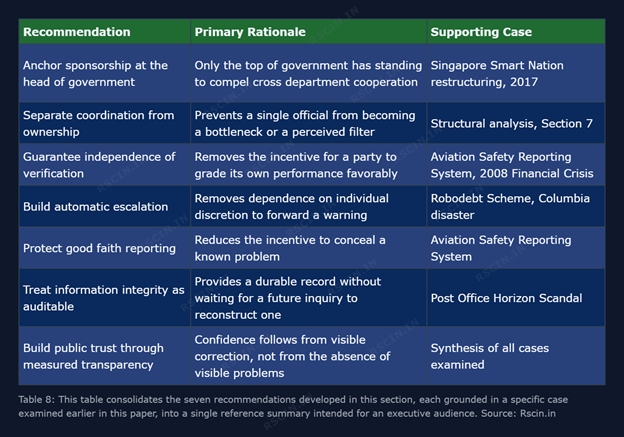
The analysis in this paper points toward a consistent set of recommendations for any government considering how to close the information integrity gap described throughout. These recommendations are stated at the level of principle rather than technical specification, consistent with the purpose of this paper, which is to establish the case for building such a function, not to provide the detailed architecture of any single implementation.
Recommendation One: Anchor Sponsorship at the Head of Government
Any function intended to verify information integrity across multiple departments needs sponsorship from the office of the head of government, not from any individual ministry. Singapore’s 2017 restructuring of its Smart Nation program, examined in Section 7, demonstrates that even a government with a strong digital administration record found a distributed structure insufficient and consolidated authority under the Prime Minister’s Office once cross agency coordination proved to be the binding constraint on progress.
Recommendation Two: Separate Coordination from Ownership
A designated coordinating official can manage scheduling, participation, and escalation of non-cooperation, but should not be given authority over the substance of any findings. This separation, discussed in Section 7, protects the function from becoming a single point of failure or a perceived filter on inconvenient conclusions, a risk that is organizational rather than personal, and applies regardless of how trustworthy any individual official is.
Recommendation Three: Guarantee Independence of Verification
Wherever possible, the party responsible for judging whether information is accurate should not be the party whose performance that information reflects. The Aviation Safety Reporting System, examined in Section 6, achieved its credibility specifically because verification sat with an agency, NASA, that held no enforcement power over the individuals filing reports. The 2008 financial crisis, by contrast, involved institutions substantially grading their own risk, a pattern the official inquiry identified as a central cause of the crisis going undetected until it was too late to prevent.
Recommendation Four: Build Escalation That Does Not Depend on Individual Discretion
Every failure case in this paper, from Robodebt to the Columbia disaster, shared a common feature, a warning that existed somewhere in the organization and did not travel upward because a specific individual did not forward it. A governance information system should be designed so that a finding above a defined severity threshold is escalated automatically, rather than relying on any one person’s judgment about whether to raise it further.
Recommendation Five: Protect Good Faith Reporting
The Aviation Safety Reporting System offers limited immunity from enforcement action to individuals who report an error within a set window of time, a design choice specifically intended to remove the disincentive to disclose a mistake. A government information integrity function should build in equivalent protection for officials who raise genuine concerns in good faith, since the alternative, demonstrated across nearly every failure case in this paper, is a system where the people closest to a problem have the strongest incentive to stay silent about it.
Recommendation Six: Treat Information Integrity as an Auditable Function
A durable, tamper resistant record connecting each significant decision to the information available at the time should be treated as a standing requirement, not an afterthought produced only when an inquiry is later convened. The Post Office Horizon case, examined in Section 4, showed how the absence of such a record allowed evidence of known system faults to be edited out of court submissions for years before the truth surfaced through a dedicated public inquiry. Building the record from the outset removes the need for such an inquiry to reconstruct it after the fact.
Recommendation Seven: Build Public Trust Through Measured Transparency
Public confidence in a government information system tends to follow from visible evidence that problems are identified and addressed, not from the absence of visible problems. A government considering a function of this kind should evaluate what a citizen facing transparency layer could reasonably show, at a level and pace appropriate to that government’s own risk tolerance, since the specific design of such a layer carries its own considerations that fall outside the scope of a general recommendation.
A Note on Scope
These seven recommendations describe what a government information integrity function should achieve and why. They intentionally stop short of prescribing how any specific government should design escalation thresholds, select verification technology, or structure a transparency mechanism for its own departments, since those choices depend on a government’s specific administrative structure, risk tolerance, and existing systems, and are properly the subject of direct engagement between a government and whichever body it selects to help design that function.
9. Conclusion, From Dashboards to Decision Integrity
This paper began with a simple observation. Governments and large organizations generate more information today than at any point in history, and the executives responsible for acting on that information continue to make consequential decisions on data that is incomplete, delayed, or filtered by the time it reaches them. The cases examined across this paper, drawn from aerospace, health administration, global finance, tax and welfare policy, aviation, and digital government infrastructure, show that this is not a problem of insufficient technology. NASA had access to the best engineering talent in the world when Challenger and Columbia were lost. The financial institutions at the center of the 2008 crisis had access to more risk modeling capability than any generation of bankers before them. The Post Office had a functioning, deployed accounting system running for over a decade before its flaws produced the largest wrongful conviction scandal in modern UK legal history. In every failure case in this paper, the technology worked as built. The information that could have prevented harm existed somewhere inside the organization. What was missing, in every case, was a function whose specific job was to verify that the information was true and to ensure it reached someone with the authority to act on it, independent of whether any individual chose to raise it.
The contrast provided by Estonia’s X-Road and the Aviation Safety Reporting System shows that this gap is not inevitable. Both systems were built around a small number of deliberate design choices, guaranteeing data integrity at the point of exchange in one case, and separating verification from enforcement in the other, and both have produced measurable, sustained results over decades rather than years. The six integrity domains developed in Section 5, source integrity, escalation integrity, verification independence, accountability traceability, human oversight calibration, and systemic learning, are not an abstract academic contribution. They are a direct distillation of what was present in the cases that succeeded and absent in the cases that failed, and Table 5 and Table 6 together show that this pattern holds consistently across every case this paper examined, not selectively in a few convenient examples.
The recommendations in Section 8 follow directly from this evidence. Executive sponsorship at the level of the head of government, a coordination function kept separate from ownership of findings, independence of verification from the parties being reviewed, automatic rather than discretionary escalation, protection for good faith reporting, a durable and auditable record of decisions, and measured public transparency are not seven unrelated best practices. They are seven specific corrections to the seven specific failure patterns documented across this paper’s case studies. A government that adopts even a subset of them addresses a known, previously fatal vulnerability. A government that adopts none of them retains the same structural exposure that produced every disaster examined here.
The broader argument of this paper extends beyond any single technology choice a government might make. Digital transformation and artificial intelligence adoption remain valuable and worth pursuing, and nothing in this paper argues against continued investment in either. What this paper argues is that neither, on its own, resolves the question that ultimately determines whether a government succeeds or fails at a critical moment, which is whether the person with the authority to act has been given the truth, completely and in time. A dashboard that displays information faster does not answer that question. A model that processes larger volumes of data does not answer that question. Only a deliberately built function, accountable for the integrity of the information itself, answers that question, and until that function exists, the same pattern documented in Challenger, Columbia, the 2008 financial crisis, the National Program for IT, Robodebt, the Post Office Horizon scandal, and the Dutch childcare benefits system will continue to recur, in new institutions, with new technology, producing outcomes that will look, in hindsight, exactly as avoidable as each of these did.
The question this paper poses to any government considering its own transformation program is therefore not whether to invest in better technology. It is whether that government is prepared to build the one function that no amount of technology can substitute for, an independent, structurally protected guarantee that what reaches the top of the organization reflects what is actually true at the bottom of it. Every case in this paper suggests that governments which answer that question early avoid becoming a case study for the governments that answer it late.
10. Appendix
A1. Methodology
This paper was developed using a research and analysis process built around three disciplines, each chosen specifically to protect the integrity of the paper’s own conclusions, consistent with the standard this paper argues every governance system should apply to itself.
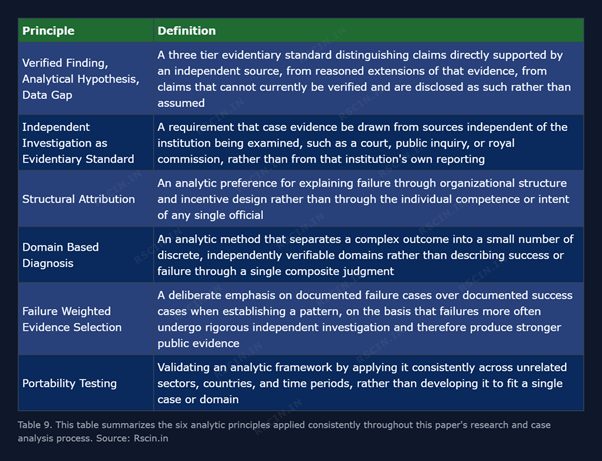
Case selection: Every case study in this paper was drawn from a source that had already undergone independent investigation, either a formal public inquiry, a royal commission, a parliamentary committee, a court ruling, or peer reviewed academic research. No case in this paper relies solely on the self reporting of the institution involved in the failure or success being described. This standard was applied deliberately, because an institution’s own account of its performance is, by definition, the account most likely to be shaped by the same information integrity gaps this paper is concerned with. Cases were also selected to span multiple sectors, aerospace, health administration, global finance, welfare policy, criminal justice technology, aviation, and digital government infrastructure, and multiple countries, specifically to test whether the six integrity domains developed in Section 5 held consistently across genuinely unrelated contexts, rather than being shaped to fit a single convenient example.
Evidentiary discipline: Throughout this paper, three categories of claim are kept distinct. A verified finding is a claim directly supported by an official inquiry, court ruling, government publication, or peer reviewed source. An analytical hypothesis is a reasoned conclusion drawn from the available evidence that extends beyond what any single source directly proves, and is identified as such wherever it appears, most notably in the extension of specific case findings into general principles in Sections 5 through 8. A data gap is an instance where a claim relevant to the analysis could not be verified from publicly available sources at the time of writing, and is noted rather than silently assumed. This discipline is the same standard RSC has applied in prior published research, and it is applied here with particular care given that the subject of this paper is information integrity itself.
Derivation of the framework: The six integrity domains presented in Section 5 were not developed as a theoretical model applied afterward to the case evidence. They were derived inductively, meaning the case studies were analyzed first, the specific point of failure or success in each was identified in the language of that case’s own investigating body, and the six domains emerged as the smallest set of categories capable of describing every documented failure and success without overlap or omission. Table 5 and Table 6 in the main body of this paper are the direct output of that process, applying the same six categories consistently across every case rather than selecting different explanations for different cases.
Significance for government decision making: The RSC Governance Truth Framework is intended to function as a diagnostic instrument a government can apply to its own information systems before a failure occurs, rather than a description available only in hindsight. Its core influence on government decision making lies in shifting the unit of evaluation away from whether a system was deployed, funded, or technologically current, and toward whether the six specific conditions shown in this paper to precede both failure and success are actually present. A government able to answer that question honestly about its own departments has a materially stronger basis for avoiding the outcomes documented in this paper than a government relying on deployment metrics or technology investment alone.
A2. Key Analytic Principles
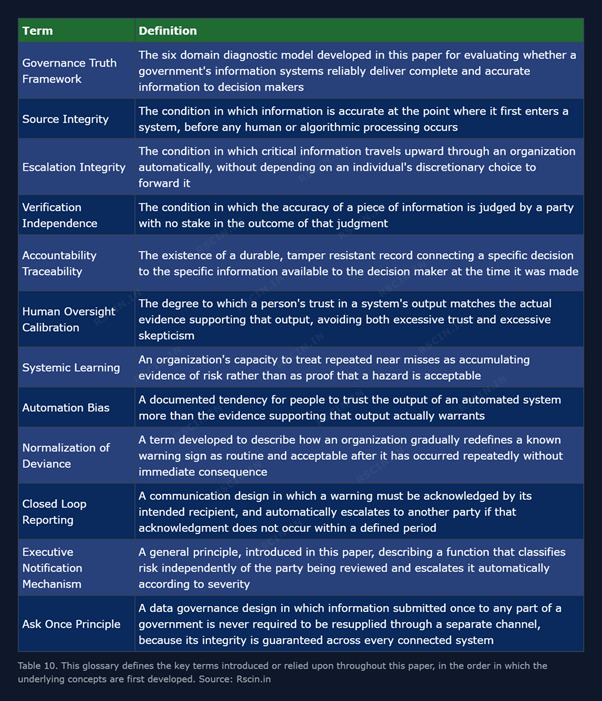
A3. Glossary
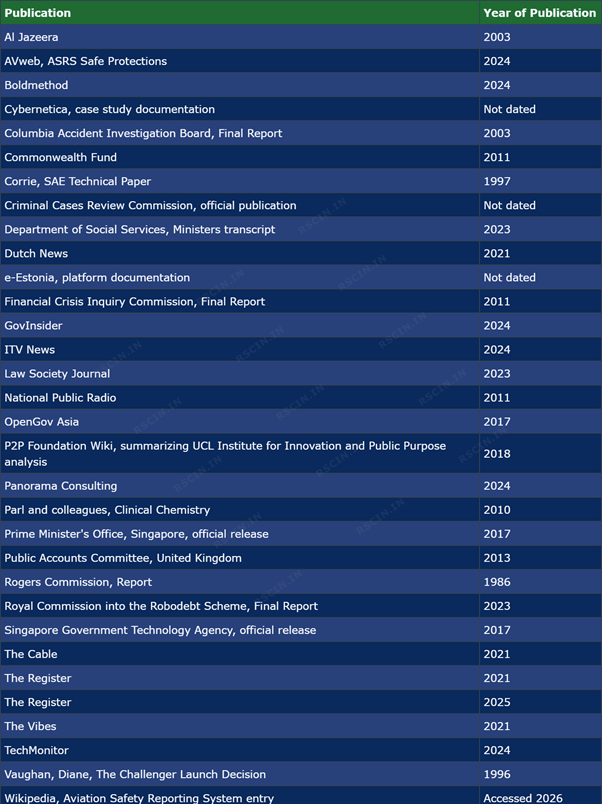
A4. References
A5. About the RSC Governance Truth Framework
The RSC Governance Truth Framework was developed to answer a question that most government transformation programs never explicitly ask, whether the information reaching a decision maker at any given moment reflects the true state of the system that decision maker is responsible for. Most evaluation methods applied to government technology and reform programs measure inputs and outputs, funds spent, systems deployed, services digitized. This framework measures something different, the structural conditions that determine whether the information those systems produce can actually be trusted by the person acting on it.
Its significance lies in three properties that distinguish it from a conventional evaluation checklist. First, it is portable. The same six domains were shown, across the case evidence in this paper, to explain outcomes in aerospace engineering, financial regulation, welfare administration, criminal justice technology, aviation safety, and digital government infrastructure, without modification. A framework that requires reinterpretation for every new context has limited practical value to an executive facing a genuinely new problem. This one did not require that reinterpretation across seven unrelated cases.
Second, it is diagnostic before it is corrective. A government can apply the six domains to its own systems today, identify which domains are weak, and act before a failure occurs, rather than waiting for an inquiry to explain a failure after the fact. This is the single most important difference between this framework and the standard model of government accountability, which is almost entirely retrospective. The Rogers Commission, the Columbia Accident Investigation Board, the Financial Crisis Inquiry Commission, and the Robodebt Royal Commission were all convened after catastrophic harm had already occurred. The value of a diagnostic framework is precisely that it does not require that harm to occur first.
Third, it future proofs against the specific failure mode this paper identifies as most persistent, the false assumption that better technology alone resolves an information integrity problem. As artificial intelligence and automated decision systems become more deeply embedded in government administration, the risk documented in the Dutch childcare benefits case, that a more sophisticated system can produce a less examined outcome, becomes more significant, not less. A framework built around structural conditions, rather than around the capability of any specific technology, remains relevant regardless of which generation of tools a government adopts next. The six domains would apply with equal force to a fully AI driven government decision system as they do to the paper based and early digital systems examined in several of the cases in this paper.
Taken together, these three properties are what justify the framework’s claim to robustness. It has been tested, in this paper, against seven independently investigated cases spanning four decades and multiple continents, and it has not required alteration to explain any of them. That consistency, rather than any single case in isolation, is the foundation of its claim to being a reliable instrument for government decision making rather than a persuasive narrative built around convenient examples.
Ultimately, the framework rests upon one central principle. The purpose of transformation is not merely to achieve change. It is to ensure that change creates the greatest possible value while minimizing unintended consequences across the complete ecosystem it influences.
That principle remains equally relevant whether the transformation involves an enterprise, an industry, or an entire nation.
A6. About Rudhran Strategy Consultants
Rudhran Strategy Consultants (RSC) is an independent boutique management consulting firm specializing in business strategy, execution management, market intelligence, and AI led enterprise transformation. We advise founders, boards, executive leadership teams, enterprises, and public institutions on complex strategic decisions where commercial objectives intersect with technology, operations, governance, and long-term organizational value.
Unlike traditional consulting engagements that conclude with recommendations alone, RSC emphasizes decision quality through rigorous analytical frameworks, measurable evidence, and implementation focused advisory. Our engagements are designed to help organizations not only determine what decisions should be made, but also understand the broader economic, operational, technological, environmental, and human consequences of those decisions.
Our work spans enterprise strategy, artificial intelligence, digital transformation, execution management, market expansion, investment due diligence, operational excellence, and national scale transformation initiatives. Every engagement is guided by one fundamental principle:
“Better measurement leads to better decisions.”
This white paper introduces the RSC Transformation Value Framework, a proprietary methodology developed to evaluate complex enterprise and national transformations through interconnected value domains rather than isolated performance indicators. Although demonstrated through India’s E20 transition, the framework is intended to support evidence-based decision making across industries, governments, regulators, multilateral institutions, and large enterprises worldwide.
Core Advisory Services
• Business Strategy and Growth
• AI Strategy and Enterprise Transformation
• Execution Management
• Market Intelligence and Competitive Research
• India Market Entry and Expansion
• Due Diligence and Investment Advisory
• Executive Advisory for Boards and Leadership Teams
Contact
Website: www.rscin.in | Email: sks@rscin.in
For executive advisory engagements, speaking invitations, strategic partnerships, or enterprise consulting inquiries, please contact us through our website.
“The purpose of transformation is not merely to achieve change. It is to ensure that change creates the greatest possible value while minimizing unintended consequences across the complete ecosystem it influences.”