
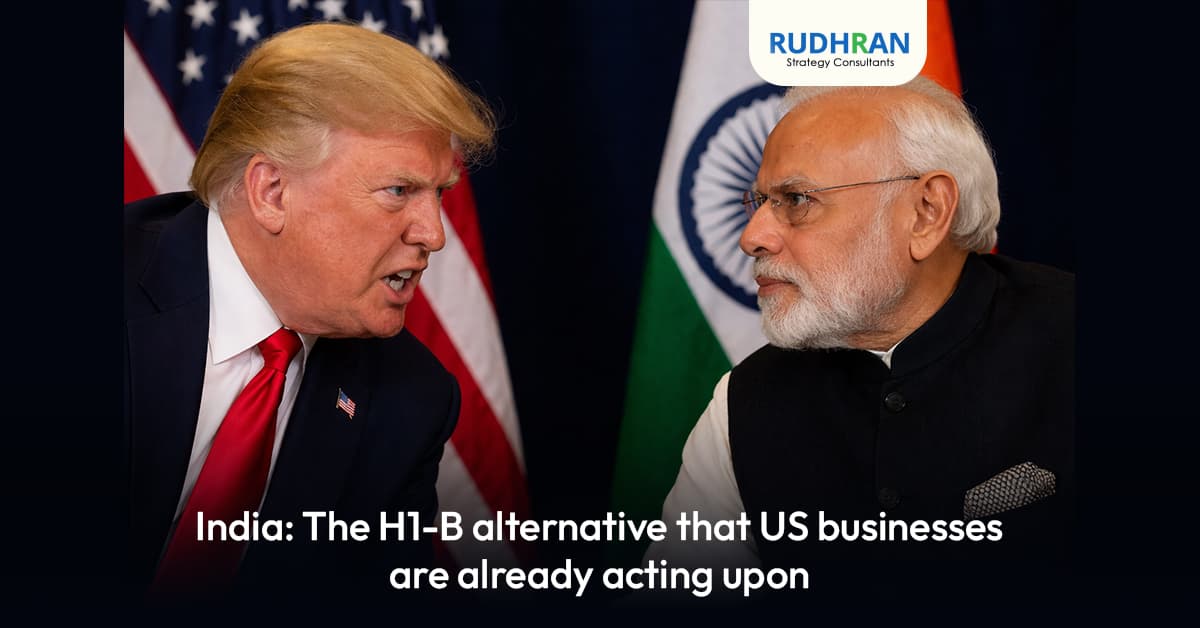
Will India become the talent-hub for US companies? RSC factually deep-dives into talent-supply revolution through relocation.
Important Note:This is an exhaustive 6,000+ words article and the most comprehensive research done by RSC to date. We did not want such a critical article published in phases. For those pressed for time, RSC recommends that you review the tables under each section to capture the depth of content in a fast manner.
Executive Summary
H-1B volatility is no longer a narrow immigration issue for US companies. It has become a strategic talent risk, especially for firms dependent on AI, advanced software, semiconductor engineering, quantitative finance, and other high skill technical functions. In several of these areas, domestic substitution is neither immediate nor easily scalable, making long term workforce continuity a board level concern.
This article argues that India should no longer be viewed only as a cost-efficient scaling base or a resilience hedge. It should increasingly be evaluated as a serious innovation-partner environment. India’s engineering depth, formal AI education pipeline, rise of self-directed technologists, and growing global visibility of talent are changing the competitive landscape. At the same time, the strongest Indian engineers are motivated by more than compensation. They seek ownership, recognition, technical challenge, and meaningful contribution.
For US leadership, the implication is clear. Companies that approach India with an execution only mindset may scale, but they will struggle to attract and retain top tier innovation talent. Companies that treat India as a co-equal innovation engine, supported by disciplined governance and credible recognition, will be better positioned to sustain long term capability in a post H 1B uncertainty environment.
1. The Current H-1B Landscape: Policy Volatility and Executive Influence
For US leadership teams dependent on global technical talent, the H-1B program is no longer a procedural HR function. It is a strategic risk variable. Over the past decade, the H-1B regime has moved through cycles of administrative tightening and judicial intervention. Under President Trump’s prior administration, denial rates for initial H-1B petitions rose sharply — reaching approximately 24% in FY2018 compared to 6% in FY2015 according to the American Immigration Council. Requests for Evidence (RFEs) also increased significantly, introducing operational uncertainty for employers.
While subsequent administrative adjustments under President Biden moderated denial rates, the structural volatility remains embedded in the system. USCIS data confirms that H-1B demand continues to dramatically exceed the annual statutory cap of 85,000 visas, including 20,000 US advanced degree exemptions, with registrations exceeding 750,000 in FY2024 according to USCIS H-1B Employer Data Hub. This mismatch between supply and demand is not cyclical but rather systemic.
1.1 The H-1B Lottery Fiasco
When annual applications exceed up to 8X the available slots, selection becomes probabilistic. For leadership teams running product timelines, AI deployment schedules, or semiconductor design cycles, probabilistic talent access is not a scalable operating model. The Migration Policy Institute notes that the cap has remained largely unchanged since 2004 despite exponential growth in the digital economy according to MPI. From a boardroom perspective, this represents regulatory misalignment with economic evolution.
1.2 Wage Rule Scrutiny and Prevailing Wage Escalation
President Trump’s administration emphasized wage recalibration as a protective mechanism for American workers. The 2020 Interim Final Rule sought to significantly increase prevailing wage requirements for H-1B workers, arguing that companies were undercutting domestic salaries according to Federal Register’s Department of Labor Wage Rule.
Although portions of the rule were later vacated by federal courts, the signal to employers was clear: Immigration policy can shift rapidly under executive authority. President Trump’s influence in reframing the H-1B debate as a national labor protection issue remains politically potent. Whether one agrees with the policy direction or not, presidential positioning directly impacts administrative interpretation and enforcement intensity. For enterprise leadership teams, the lesson is not political but structural because H-1B access is subject to executive interpretation cycles.
NFAP analysis shows denial rates for new H-1B petitions peaked at 24% in FY2018 and dropped to 4% by FY2022. However, the volatility itself introduces three operational costs: Legal overheads, hiring cycle delays, and non-quantifiable strategic uncertainty. Even when denial rates fall, unpredictability remains embedded in executive discretion and judicial review dynamics.
For companies heavily dependent on talents like AI engineers, distributed systems architects, semiconductor designers, or quantitative finance specialists, the H-1B policy volatility is not merely an immigration issue. It is a crisis marked by talent supply chain and continuity issues. President Trump’s framing — that immigration policy must protect American workers — may resonate politically, but for corporations it is an operational nightmare. Enterprise leaders cannot rely on a capped, lottery-based visa regime. It is imperative for leadership to begin scenario planning.
2. Industry Exposure Dashboard: Where H-1B Dependency Is Structurally Concentrated
USCIS data confirms that approximately 70–75% of approved H-1B petitions fall under computer-related occupations. NFAP further confirms that computer occupations consistently dominate approvals. Below is the board-level concentration map.
| Industry Segment | Primary Roles Sponsored | Representative Employers | Citation | H-1B Dependency Level | Operational Risk if Restricted |
| Technology & SaaS | Software Engineers, AI/ML Specialists, Data Engineers, Cloud Architects, Cybersecurity Experts | Amazon, Google, Microsoft, Meta, Apple | USCIS Employer Hub; Brookings Metro | Very High | Immediate product roadmap impact; AI deployment delays |
| Financial Services & FinTech | Quantitative Analysts, Risk Modelers, Trading System Engineers, Data Scientists | JPMorgan Chase, Goldman Sachs | NBER Working Paper 21123 | High | Modeling slowdown; trading system innovation constraints |
| Semiconductor & Advanced Manufacturing | Chip Designers, Fabrication Engineers, Verification Engineers | Intel, Texas Instruments | Semiconductor Industry Association | High & Rising | CHIPS Act capacity expansion bottlenecks |
| Healthcare & Biotech | Medical Researchers, Bioinformatics Scientists, Pharmaceutical R&D Engineers | Large hospital systems & biotech firms | NSF Science & Engineering Indicators | Moderate–High | Clinical research and drug development delays |
| Higher Education & Academic Research | STEM PhD Candidates, Postdoctoral Researchers, Engineering Faculty | US Research Universities | NSF STEM Enrollment Data | Structural | Long-term domestic talent contraction |
Brookings research shows H-1B petitions are heavily concentrated in Silicon Valley, Seattle, Austin, New York and Boston.
This implies that H-1B exposure is clustered in innovation hubs, concentrated in AI-centric sectors and hired by high-margin industries. This is not a labor market distortion in retail or hospitality. The H-1B visa is It is an innovation pipeline variable.
3. The Wage Suppression Debate: Evidence vs Political Narrative
President Donald Trump has consistently argued that the H-1B program has been used by some firms to replace American workers with cheaper foreign labor, positioning reform as a national interest priority. That position has shaped federal scrutiny, wage rule proposals, and administrative enforcement intensity. But does the data really support the wage suppression claim?
Please decipher the facts from the table below:
| Claim | Supporting Evidence | Source & Link | Counter Evidence | Source & Link | Board-Level Interpretation |
| H-1B workers are paid less than US workers in similar roles | Some outsourcing firms cluster filings at Level 1 (entry-level) prevailing wages | Economic Policy Institute (EPI): | Prevailing wage rules legally require employers to pay DOL-determined wage floors | US Dept. of Labor Wage Rules: | Wage arbitrage risk exists in entry-level IT services, not uniformly across sectors |
| Firms prefer H-1B because they are cheaper | High volume filings by IT services firms historically concentrated at lower wage tiers | EPI; USCIS data | NFAP finds median salaries for H-1B tech workers often exceed US median wages | NFAP Analysis: | Sector differentiation is critical — outsourcing ≠ frontier tech |
| H-1B reduces wages of domestic workers | Some studies suggest modest wage suppression effects in localized markets | EPI; select labor studies | NBER finds high-skill immigration increases innovation and productivity without significant wage depression | NBER Working Paper 21123: | Long-term innovation effects may offset short-term wage competition |
| High-skill immigration displaces US workers | Political narrative supported by selective layoff cases | Public hearings & media coverage | Brookings finds high-skill immigrants complement native workers and increase patent output | Brookings Research: | Complementarity appears stronger in advanced STEM roles |
NBER research indicates that high-skill immigration is positively associated with patent production, STEM innovation rates, and firm-level productivity growth. Brookings similarly finds that high-skilled immigrants contribute disproportionately to innovation ecosystems. What President Trump gets right, from a national labor protection standpoint, is that entry-level clustering at lower wage tiers creates perception risk and domestic workforce participation in STEM remains a political priority. These concerns are not baseless. They are partially supported in certain segments. Therefore, the claims that all H-1B hiring is wage suppression, and domestic workers are universally displaced in high-complexity STEM files are not supported by empirical data.
So what does this mean corporate executive leaders and board members? The wage suppression narrative is partially valid in outsourcing-heavy, entry-tier segments, and weak to nearly non-existent in advanced STEM, AI, semiconductor, and quant finance ecosystems.
If you are an enterprise leader reading this and your H-1B dependency is in AI research, distributed systems, chip design or quantitative modeling, then your exposure is likely driven by talent scarcity, not wage arbitrage. This distinction matters strategically because if the issue is wage suppression, domestic substitution is viable. But the core issue is structural scarcity and substitution becomes materially harder.
4. Is There a Structural US STEM Talent Shortage — Or a Substitution Problem?
This section determines whether the India thesis is strategic necessity or optional diversification. If domestic substitution is feasible at scale, offshore expansion is discretionary.
If structural shortages exist in critical segments, offshore capability becomes a hedge against capacity risk.
4.1 STEM Graduation Output vs Market Demand
The US produces a large number of STEM graduates annually. However, distribution across disciplines matters more than aggregate totals. According to the National Science Foundation , international students represent a significant share of graduate enrollments in computer science and engineering — in many research-intensive universities exceeding 50% at the doctoral level.
This creates two structural realities. First, advanced STEM pipelines are already globally integrated. Second, immigration policy affects not only employment but future domestic supply.
If visa uncertainty discourages enrollment, downstream domestic talent supply contracts further. This is a fact and not merely some speculation.
4.2 Labor Market Projections in High-Skill Occupations
The US Bureau of Labor Statistics projects significantly above-average growth in computer and mathematical occupations through the decade BLS Occupational Outlook Handbook,. The projections show that software development roles alone are expected to grow substantially faster than the national employment average.
However, supply elasticity in advanced roles is limited because AI expertise requires advanced mathematical depth and semiconductor design requires specialized engineering training. Cybersecurity for that matter requires layered systems understanding. These are multi-year formation cycles that cannot be empowered with training in short notice period.
4.3 AI Talent Scarcity
The AI labor market is particularly concentrated. McKinsey Global Institute notes that advanced AI roles represent a narrow slice of the technical workforce and that demand significantly exceeds supply in developed markets . AI capability is not evenly distributed. It is rather clustered around elite research institutions, major tech firms, and global engineering ecosystems. When multiple hyperscalers compete for the same PhD-level AI researchers, salary escalation alone does not solve scarcity. It redistributes limited supply. This is a structural tightness problem for enterprise dependent on outlier talents.
4.4 Semiconductor Workforce Gaps
The CHIPS and Science Act accelerated domestic semiconductor manufacturing. However, the Semiconductor Industry Association reports persistent workforce shortages in fabrication engineering, process control, and advanced chip design . Manufacturing expansion without corresponding workforce depth creates ramp-up bottlenecks. If fabrication plants scale faster than engineer supply, project timelines extend. In such environments, global talent mobility becomes critical.
4.5 Cybersecurity Workforce Shortfall
CompTIA’s Cybersecurity Workforce Study indicates ongoing talent gaps in cybersecurity roles across the United States. Cybersecurity is uniquely sensitive because threat velocity increases annually while skilled defenders remain limited. Unlike generic software roles, cybersecurity expertise compounds with experience. Replacing skilled cybersecurity professionals is neither immediate nor trivial.
All these evidences suggest a differentiated reality. For entry-level IT services, US domestic substitution is feasible with policy alignment and workforce development. For advanced AI, semiconductor design, quant modeling, and cybersecurity architecture, substitution is materially constrained by training timelines and talent depth. If the constraint is short-term wage competition, firms can recalibrate domestically within US. If the constraint is multi-year structural scarcity, firms must hedge through geographic diversification of capability. That is where the India discussion becomes strategic rather than opportunistic.
5. From Visa Volatility to Capability Strategy: Why India Becomes a Board-Level Consideration
The preceding sections establish three structural realities: First, H-1B access is cap-constrained and politically sensitive. Second, wage suppression claims are partially valid in narrow segments but weak in technology innovation roles. Third, advanced STEM talent shortages in the United States are not easily reversible within short policy cycles.
When these three variables converge, immigration policy transitions from an HR function to a capacity risk variable for enterprises. At that point, boards must consider geographic diversification of capability. India enters the discussion not as a cost arbitrage play, but as a structural resilience option.
5.1 1. Offshore Capability vs Outsourcing: A Strategic Distinction
Historically US firms engaged India through third-party IT services providers with a primary objective of optimizing costs. The current context demands a different model – in the guise of wholly owned Global Capability Centers (GCCs).
| Dimension | Traditional Outsourcing | Global Capability Center (GCC) |
| Control | Vendor-led | Company-controlled |
| IP Ownership | Shared / Contractual | Direct ownership |
| Strategic Integration | Tactical | Embedded in core roadmap |
| Talent Branding | Vendor brand | Parent company brand |
| Long-Term Capability Build | Limited | Compounding |
India currently hosts more than 1,500 GCCs across sectors including technology, financial services, healthcare, and manufacturing. Industry reports from NASSCOM and Deloitte indicate continued expansion by US firms seeking deeper engineering integration rather than vendor dependency. This signals structural confidence in India’s talent ecosystem.
5.2 India’s Structural Factor Advantage
India’s relevance is driven by five structural advantages. First has to do with the country’s engineering scale. India produces over one million engineering graduates annually. While quality distribution varies, filtering mechanisms through tiered institutions provide access to strong technical talent. Second, the STEM depth in software and applied engineering in India has built dense ecosystems in software development, cloud engineering, cybersecurity, and increasingly AI. It is just a matter of time that American executive leadership will recognize the Indian advantage.
Third, many Indian engineers already work within US, Europe and Asian enterprise architectures, compliance environments, and product frameworks. The familiarity is applicable to both technical and cultural understanding. Fourth, the undeniable cost-to-skill efficiency. This is not to be mistaken as low-cost advantage but rather a high-skill cost efficiency relative to the purchasing power parity of US metropolitan hubs. Fifth, the time-zone complementarity ensures engineering models accelerate deployment cycles. These factors collectively create a structural hedge for American business leaders against H-1B volatility.
Boards must examine whether their innovation architecture is geographically flexible. If AI model training, software engineering, cybersecurity monitoring, and data engineering can be executed in distributed architectures, geographic diversification is viable. If innovation is dependent on highly localized physical labs or regulatory constraints, flexibility narrows. India is particularly strong in:
- Software product engineering
- Enterprise platform development
- AI implementation and model tuning
- Data engineering
- Cloud infrastructure
- FinTech systems – India’s UPI is testimony for this
However, India is comparatively weaker in:
- Deep semiconductor fabrication
- Certain niche biomedical lab research requiring US based clinical compliance
Therefore, the India thesis must align with role-specific portability. Institutional investors increasingly evaluate talent stability, operating leverage, and innovation resilience. If visa volatility introduces uncertainty into product roadmaps, earnings forecasts inherit that uncertainty. A diversified engineering footprint signals risk management discipline. Boards must evaluate whether talent concentration risk is adequately disclosed and mitigated. RSC recommends that India strategy becomes rational when at least three of the following conditions are present:
- More than 20–30% of critical engineering roles depend on H-1B status
- Product roadmaps are AI-intensive or semiconductor-adjacent
- Wage escalation materially affects margin structure
- Hiring cycles exceed planned product deployment windows
- Executive leadership identifies policy volatility as a recurring risk variable
When these thresholds are crossed, geographic diversification becomes imperative. India should not be viewed as a reactive offshoring tactic, but rather a structured extension of core engineering capability designed to stabilize innovation in the face of H-1B visa volatility.
6. India Entry Reality: Compliance Architecture, Structuring Decisions, and Governance Risk
Once US companies determine that geographic diversification into India is strategically rational, the next question becomes operational, in the lines of “Can we execute without introducing regulatory, tax, governance, or talent risk?” India however, is not like the US when it comes to ease of doing business, courtesy of the compliance layers. Execution discipline determines whether an India entry compounds value or creates compliance drag.
6.1 Entry Structure Decision Framework
Before incorporation, US boards must determine structural posture that are ideal for their vision and objectives. The table below discloses the various ramifications for Indian entry.
| Entry Model | Control Level | Capital Requirement | Compliance Complexity | Ideal case | Risk Profile |
| Wholly Owned Subsidiary (WOS) | Full | Moderate–High | Moderate | Long-term capability build | Controlled but requires strong governance |
| Global Capability Center (GCC) | Full Operational Integration | Moderate | Moderate | Engineering & product integration | Strategic resilience |
| Joint Venture (JV) | Shared | Variable | High | Market access plays | Governance misalignment risk |
| Third-Party Outsourcing | Low | Low | Low | Tactical cost optimization | Limited IP control |
One can clearly deduce from the above table that for H-1B risk mitigation, WOS or GCC models are structurally superior, outsourcing does not hedge visa volatility but rather transfers operational control.
6.2 Regulatory & Compliance Landscape
India’s regulatory environment is rule-based and documentation-intensive. The following compliance domains require early-stage structuring:
| Compliance Domain | Governing Authority | Mismanagement Risk |
| Incorporation & Corporate Governance | Ministry of Corporate Affairs (MCA) | Director liability exposure |
| Foreign Direct Investment (FDI) & FEMA Compliance | Reserve Bank of India (RBI) | Capital flow penalties |
| Transfer Pricing | Central Board of Direct Taxes (CBDT) | Tax reassessment & penalties |
| Goods & Services Tax (GST) | GST Council | Input credit disputes |
| Labor Law Compliance | Central & State Authorities | Employment litigation risk |
| Data Protection (DPDP Act) | Ministry of Electronics & IT | Data breach liability |
Improper transfer-pricing modeling is among the most common strategic errors. If the India entity performs high-value engineering, but is structured as a low-margin cost center, tax exposure risk increases. RSC recommends that US companies conduct a thorough feasibility of India’s tax architecture before hiring in India.
6.3 Hiring & Employment Structuring Risk
Hiring in India requires structured employment frameworks. Key risks include: Contractor misclassification, ESOP taxation complexity, payroll statutory contributions, and state-level labor registrations. India mandates statutory benefits such as provident fund (PF) contributions and gratuity obligations. These are manageable but must be embedded into compensation modeling. US Boards must recognize that compensation transparency and compliance discipline in India are increasingly sophisticated. Improvised employment frameworks create reputational and legal risk.
Bottomline, India is not a compliance minefield, but it is a rules-driven jurisdiction requiring architectural planning that US companies may find highly challenging at the incorporation level.
When properly structured regulatory risk is manageable, thereby enabling stable execution based on governance clarity. Taxation will also become predictable if this approach is followed. The execution mistake is rushing incorporation without tax, transfer-pricing and IP modeling. US leadership must remember this mantra – sequence structure before scale.
7. India’s Emerging AI Talent Battlefield
If H-1B volatility pushes US firms to expand in India, they will not be entering a passive labor pool. They will be entering an increasingly competitive AI talent battlefield and it is defined by three converging forces:
- Formal institutional acceleration
- Self-directed elite technologists
- Global contract accessibility
7.1 Institutional Acceleration: AI Is Now Formalized
India’s top institutions — including IITs and leading private universities — have introduced formal AI and data science programs in recent years. This matters for two reasons:
First, AI is no longer a side specialization, and it is being positioned as a primary engineering discipline. Second, the pipeline is widening at both undergraduate and postgraduate levels.
India already produces large numbers of engineering graduates annually. Now, a greater share of the STEM profiles are AI-focused by design, has the propensity to shift the supply curve.
7.2 The Rise of the Self-Directed AI Elite Engineer
There is a growing cohort of Indian engineers who:
- Built careers in control systems, enterprise architecture, automotive telemetry, aviation data, or industrial systems
- Sit on terabytes of domain-specific datasets
- Experiment with AI independently
- Participate in hackathons and AI challenges
- Win awards and attract unsolicited international attention
The shocking part to note here is that these individuals are not entry-level engineers. They are domain-rich technologists layering AI onto years of systems experience. This is a powerful combination of domain depth combined with AI capability. Such individuals do not optimize for salary alone. Instead, their expectations include:
- Intellectual recognition
- Global validation
- Complex problem-solving challenges
- Architectural ownership
- Publication and presentation opportunities
If US firms approach them with execution-only mandates, then they are very unlikely to attract this talent group. Even if they are hired, then attrition becomes predictable.
7.3 Global Discoverability: Geography Is No Longer a Gatekeeper
There is a structural shift happening when it comes to scouting AI talent, mainly discorable through:
- Open competitions
- GitHub repositories
- Kaggle rankings
- LinkedIn technical communities
- Research forums
Geography is becoming less relevant in initial talent identification. If Indian engineers can receive global contracts without relocating, their dependency on US visa pathways declines and that changes the power dynamic.
7.4 Competitive Intensity Matrix
Below is the battlefield map for US companies to understand.
| Competitive Force | Pressure Level | Impact on US Firms Entering India |
| Domestic Indian AI Startups | Rising rapidly | Competes for top-tier engineers |
| Global GCC Expansion | High | Increases compensation pressure |
| Remote Global Contracts | Increasing | Top engineers bypass traditional employment |
| Institutional AI Pipeline Growth | Expanding | Expands base supply but not necessarily elite tier |
| Recognition-Driven Engineers | High influence | Require innovation autonomy to retain |
When it comes to scouting AI talent in the Indian market, it is less about cost-advantage and more about high-aspiration. While financial compensation remains important, it is no longer a sufficient metric to attract talent. Among high-performing young engineers in India, especially Gen-Z, meaningful work ranks above marginal pay differences. Recognition matters to them and they really value exposure to global decision-making. Technical authorship and visibility into product’s long-term impact is highly valued by them. If a US firm treats India as a downstream execution arm, the most ambitious engineers will migrate to startups, international contracts for case-specific AI projects, or research-focused entities.
7.5 Strategic Implication for US Boards
If India is treated as a scaling arm, then US companies will hire average talent and experience predictable churn. On the other hand, if India is positioned as a co-equal innovation contributor, then US companies can hire elite AI talent. But co-equal positioning requires structural commitments that include:
- Architectural decision-making authority
- Patent authorship inclusion
- Global visibility
- Leadership pipeline pathways
- Recognition beyond compensation
India is no longer a passive recipient of outsourced engineering work. It is an increasingly assertive AI innovation environment and US firms entering India must decide if they want labor capacity or innovation partners within their own organization. This will determine if quality talent is attracted, and retained.
8. Attrition Dynamics and Retention Architecture: Winning India’s AI Talent War
If US companies expand into India under the assumption that compensation alone will secure long term loyalty, they will lose the very talent they most need. That assumption may have held in an earlier outsourcing era when India was viewed primarily as a scalable engineering base. It is increasingly outdated in the emerging AI labor market. The most valuable engineers in India, especially those capable of applied AI innovation, do not see themselves merely as delivery resources.
They want intellectual recognition, visible impact, and credible pathways into meaningful product and innovation ownership. In that context, attrition is no longer just an HR metric. It is a signal of whether the operating model itself is strategically misaligned.
For executive leadership, this distinction matters. A company that loses routine software engineers faces replacement cost. A company that loses scarce AI talent loses continuity, experimentation velocity, tacit system knowledge, and in some cases future product direction. The financial cost of attrition is real, but the strategic cost is unquantifiable towards the higher side.
| Talent category | Typical attrition risk | Primary reason for exit | Strategic implication for US firms |
| General software engineering | Moderate | Compensation movement and brand switching | Manageable with strong hiring funnel |
| Cloud and platform engineering | Moderate to high | Demand from global GCCs and product firms | Can disrupt infrastructure continuity |
| Data engineering | High | Rapid market demand and role portability | Creates project delivery instability |
| Applied AI and ML engineers | High | Search for meaningful innovation exposure | High value attrition damages future capability |
| Domain rich AI engineers in sectors such as automotive, aviation, and industrial systems | Very high | Preference for intellectually challenging work and recognition | Loss of rare talent weakens innovation depth |
| Product architecture and advanced systems leadership | High | Limited autonomy and weak influence in decision making | Can stall capability maturity in India |
RSC has strong conviction that this is where many foreign companies entering India make a categorical error. They apply retention playbooks suited for scale hiring to a segment that behaves more like a frontier talent market. That approach underestimates the motivations of top Indian AI engineers. As discussed earlier, a growing number of such professionals are self-directed learners, domain experts, competition participants, and globally discoverable specialists. They are not waiting passively for traditional employment ladders. They are already engaging with international opportunities, often without relocation, and increasingly on the basis of technical credibility rather than employer pedigree. (This paragraph is probably the key takeaway in the entire article for an executive decision-maker reading it).
In such an environment, compensation remains necessary, but it is not decisive. The deciding factor is whether the company can offer a serious intellectual proposition. Executive teams must therefore understand that retention in India’s AI market is not merely about how much they pay. It is about what the company enables the engineer to become.
| Retention lever | Traditional engineering workforce response | Emerging AI talent response |
| Higher fixed compensation | Positive but not always durable | Necessary but insufficient |
| ESOPs and wealth upside | Valuable | Valuable when linked to visible innovation contribution |
| Brand name of employer | Moderately attractive | Useful only if matched by real technical substance |
| International exposure | Attractive | Highly attractive when linked to decision making visibility |
| Technical ownership | Helpful | Critical |
| Recognition and authorship | Limited effect | Very high effect |
| Meaningful problem complexity | Useful | Critical |
| Pathway to innovation leadership | Moderate effect | Very high effect |
The metrics disclosed in Table 8 holds true especially for Gen Z and younger millennial talent in India. Many within this cohort grew up in a highly networked professional environment where technical identity, public proof of capability, and visibility into meaningful work shape career decisions. They do not interpret long tenure as loyalty to hierarchy. They interpret it as loyalty to growth, challenge, and relevance. If the work becomes repetitive, politically constrained, or visibly subordinate to remote leadership without real innovation authority, they disengage.
That does not mean Indian talent is unmanageable. It means it must be engaged at the correct level. Companies that recognize this will build deep and durable teams. Companies that ignore it will hire repeatedly, lose repeatedly, and misread the pattern as a market wide shortage when in fact the issue lies in their own operating model.
| Retention dimension | Weak model | Strong model |
| Role design | Execution only mandates | Roles tied to architecture and innovation ownership |
| Performance recognition | Internal manager ratings only | Visible recognition linked to product and innovation outcomes |
| Decision visibility | India team informed after decisions | India leaders included in key technical and product decisions |
| Patent and authorship treatment | Centralized outside India | Shared authorship and attributable recognition |
| Leadership growth | Limited to team management | Pathways into technical, product, and business leadership |
| Global exposure | Occasional coordination | Structured participation in global reviews and roadmap forums |
| Innovation time | Fully utilization driven | Protected time for experimentation and applied research |
The above table distinguishes between retention theater and retention architecture. High value Indian AI talent stays longer when the organization treats innovation contribution as a visible and rewarded part of the operating model.
At the executive level, this has an important implication. The US. headquarters cannot claim India innovation importance while retaining all meaningful decision rights abroad. Top engineers detect symbolic positioning very quickly. When co-equal language is not matched by structural authority, attrition follows.
This also connects back to the transfer pricing and governance logic disclosed earlier in the article. If US firms genuinely want India to become an innovation contributor rather than a scaling arm, they must be prepared for India to create economically meaningful value. That requires alignment in recognition, role authority, and eventually, where justified, economic treatment. Retention and governance are therefore linked. One cannot be treated as a cultural issue and the other as a tax issue. Together, they define whether the India strategy is credible.
There is also a practical lesson here for boards. Attrition should not be monitored only at aggregate percentage levels. A flat number can hide strategic loss. If a company loses routine software engineers at moderate rates but retains its core AI architects and domain rich innovation talent, the risk is manageable. If the opposite occurs, the company may still appear statistically healthy while strategically weakening from within. Executive dashboards must therefore distinguish between broad workforce churn and critical talent leakage.
RSC strongly advises leadership teams to monitor attrition in India through a capability lens. The board should ask not simply how many people left, but what category of value left. Did the departing talent sit close to core models, specialized datasets, domain heavy product logic, or future product architecture? If yes, the issue is not staffing. It is strategic erosion. The firms that will win India’s AI talent battle are unlikely to be those that merely offer the highest cash package. They will be the ones that combine credible compensation with technical dignity, visible recognition, and genuine long term innovation pathways.
9. The RSC Governance Playbook for Building India as a Co-Equal Innovation Engine
A serious governance model begins with clarity of mandate. Executive teams must decide which layers of value creation will sit in India. This does not require full decentralization. It requires a real answer. If India is expected to support applied AI, product engineering, and experimentation, that scope must be explicit.
| Operating dimension | Symbolic India model | Strategically governed India model |
| India mandate | Delivery support | Innovation and product contribution |
| Leadership status | Site management focus | Business and technical leadership role |
| Product participation | Execution after design | Early role in architecture and roadmap |
| Talent proposition | Compensation led | Ownership, recognition, and growth led |
| Success definition | Utilization and output | Capability depth, innovation contribution, and retention quality |
Leadership design is equally important. India cannot be fronted only by administrative site managers. If the firm wants to attract strong engineers, the local leadership must have technical credibility and visible standing within the global organization.
| Governance layer | Primary responsibility |
| Board and CEO | Define why India matters to enterprise strategy |
| Global product and technology leadership | Define architecture boundaries and decision rights |
| India country and innovation leadership | Build local capability and represent India in core discussions |
| Compliance and finance leadership | Align tax, structure, and risk controls |
| Talent leadership | Translate innovation mandate into employer proposition |
Legend: Table 9.2 shows that India capability building is not a hiring exercise alone. It requires visible alignment across strategy, technology, compliance, and talent leadership. Decision rights are the central issue. Many firms praise India, but fail to define where authority actually sits. That creates friction. RSC’s view is straightforward. Enterprise product vision and capital allocation may remain centrally led. Applied AI implementation, local experimentation, and India hiring strategy should sit in a shared or India led model where appropriate.
| Decision area | US headquarters lead | Shared or India lead |
| Enterprise product vision | Yes | No |
| Global capital allocation | Yes | No |
| Platform architecture principles | Yes | Shared |
| Applied AI implementation | No | Yes |
| Domain specific experimentation | No | Yes |
| India hiring strategy and employer branding | No | Yes |
The above table justifies that co-equal innovation does not mean equal control over everything. It means meaningful authority over the areas that build local capability and technical legitimacy.
Performance metrics must also change. If India is measured only on cost, speed, and utilization, it will behave like a cost center. If it is measured on innovation contribution, critical talent retention, and capability depth, it will evolve into a strategic node.
Recognition architecture is the final piece. As discussed earlier, high-value Indian AI talent increasingly looks for ownership, visibility, and technical dignity. Companies that centralize all recognition outside India will weaken their own talent proposition. Co-equal innovation requires visible contribution, not just compensation.
| Strategic lever | Weak execution pattern | Strong execution pattern |
| Mandate | India framed as important but operationally secondary | India assigned clear innovation scope |
| Leadership | Administrative site leadership | Technically credible and strategically visible leadership |
| Decision rights | Informal and centralized | Documented and selectively delegated |
| Metrics | Cost and output focused | Capability and innovation focused |
| Recognition | Compensation and title oriented | Ownership and contribution oriented |
The above table captures the core RSC view. India becomes a credible innovation engine only when leadership intent, operating authority, and talent economics are aligned. The executive conclusion is clear. If US firms want India to operate as a co-equal innovation engine, they must govern it as one. Talent quality, retention, and long-term innovation value will all follow from that choice.
10. Conclusion: The India Decision Is No Longer Operational. It Is Strategic
For many years, US companies viewed India through the lens of outsourcing, scale, and cost efficiency. That framing is now too narrow. H 1B volatility has exposed a broader strategic issue: critical talent access can no longer be treated as stable simply because demand exists. In several high value sectors, especially AI, advanced software, semiconductors, and data intensive engineering, the challenge is not just hiring volume. It is continuity of innovation.
That is why the India decision now belongs at the board level. It is not merely about opening a new center, reducing payroll cost, or creating offshore redundancy. It is about whether the company is prepared to build a second engine of capability in a market that is becoming increasingly relevant to the future of technical innovation.
India presents a compelling opportunity, but not a passive one. The country offers scale, institutional depth, engineering maturity, and growing AI ambition. At the same time, the best talent is becoming harder to attract through compensation alone. As this article has shown, the strongest Indian engineers increasingly seek challenge, ownership, and recognition. Firms that fail to understand this will hire capacity. Firms that do understand it can build long term capability.
| Strategic posture | Likely outcome |
| India as delivery extension | Scalable execution, moderate retention, limited innovation depth |
| India as resilience hedge | Better continuity, partial strategic value |
| India as co-equal innovation engine | Stronger talent proposition, higher retention potential, deeper long-term advantage |
The core leadership takeaway is simple. If US companies want India to solve a twenty first century talent problem, they cannot use a twentieth century management model. They must enter with clarity, govern with discipline, and retain with credibility. In the years ahead, that difference will separate firms that merely expand in India from firms that truly compound advantage through India.