
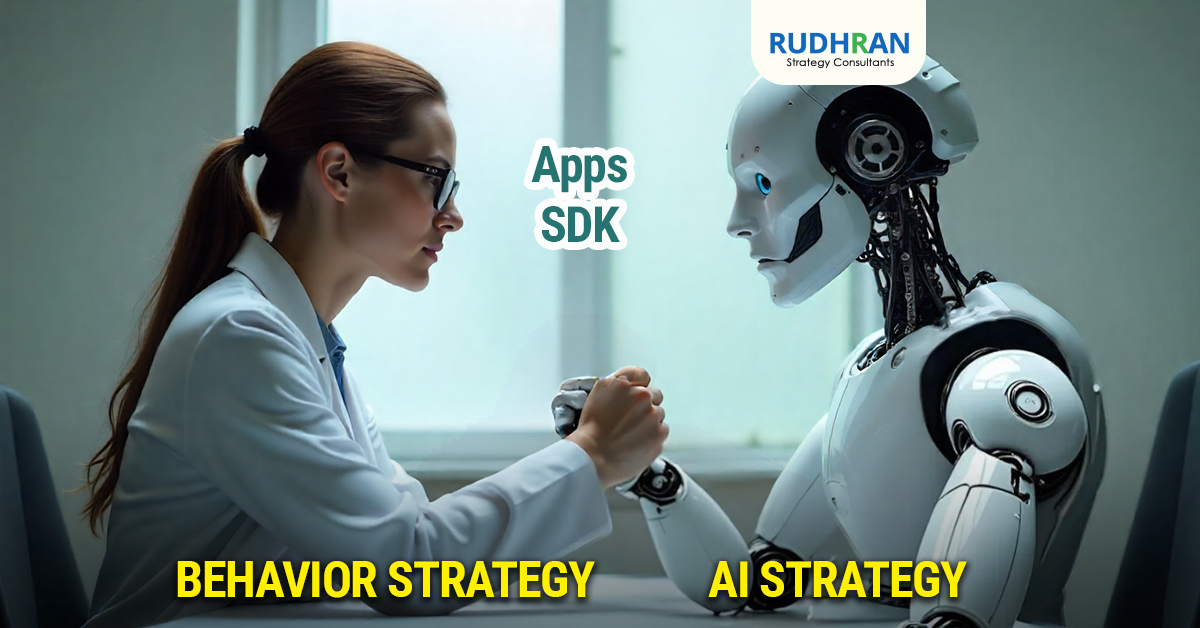
A game-changing operating systems shift where enterprise strategy will be more behavior-centric than AI-centric
1. What is Apps SDK (Software Development Kit) and why it is a game changer
At a high level, Apps SDK is OpenAI’s way of turning ChatGPT from a conversational assistant into a software distribution platform. That sentence alone captures why enterprises should pay attention. Until now, ChatGPT has primarily been perceived as a tool that answers, assists, or suggests. Apps SDK changes that posture fundamentally. It allows organizations to build full-fledged applications that run inside ChatGPT itself, triggered and operated through natural conversation. In other words, Apps SDK allows software to be used inside ChatGPT, not just talkedabout.
It is a game-changer because you go from “software you open” to “software that appears when you need it.” Traditional enterprise software follows a familiar pattern:
- Discover a product
- Install or subscribe
- Train users
- Log in
- Navigate menus
- Execute tasks
Apps SDK compresses this entire journey. With Apps SDK, a user does not “open” software.
They express intent, and the software materializes inside the conversation. It is tempting to see Apps SDK as “just another developer toolkit.” That would be a mistake. What Apps SDK actually introduces is a new distribution logic for software:
- No app store search
- No downloads
- No onboarding flows
- No UI training
- No switching between tools
For enterprises, this matters because adoption friction has always been the silent killer of digital transformation. Most internal tools fail not because they are poorly built, but because:
- Employees don’t remember to use them
- Interfaces feel heavy
- Context switching is painful
- Value appears only after effort
Apps SDK inverts this equation. The tool appears inside the user’s thinking flow, not outside it.
RSC (Rudhran Strategy Consultants) views ChatGPT as positioning itself as the front door to enterprise software usage. Historically, Windows / Linux was the front door to desktop software, browsers became the front door to SaaS, and mobile operating systems became the front door to consumer apps. Apps SDK suggests a new front door – An intent-driven interfaces powered by AI. For a decision-maker, the implication is not technical — it is strategic. This does not mean all software moves into ChatGPT. But it does mean high-frequency, decision-centric, workflow-heavy applications become default choices for access through App SDK.
1.1 Why enterprises should care about it in 2026
Enterprises do not need to deploy Apps SDK immediately to feel its impact. They need to understand what kind of advantage it creates in the guise of reducing training costs, increasing task completion rates, shortening time-to-value, and collapsing software sprawl into a single interaction surface. Executive leadership no longer having to worry about underutilized tools, lags in digital adoption, and teams reverting to email and spreadsheets.
It is human nature to prefer conversations over operating interfaces. Biology always wins, and empathetic leaders know it quite too well. It is in this context that Apps SDK is a game-changer. It is not just about building apps faster. It is about where and how software competes for attention. In enterprise environments especially, attention is the scarcest resource. Apps SDK shifts competition away from UI sophistication, feature depth and dashboard complexity towards faster outcomes, relevance and conversational execution.
2. How Apps SDK fit with MCP
In order to understand Apps SDK properly, it is important to first understand the foundation on which it is built. That foundation is the Model Context Protocol (MCP) (https://blog.rscin.in/the-mcp-disruption-what-it-means-for-traditional-companies-providing-solutions-in-data-integration-storage-transformation-analytics-and-consulting/). It is recommended that readers click on the MCP hyperlink to thoroughly understand MCP’s significance and potential in enterprise AI applications. In simple terms, MCP is a standard introduced by OpenAI to define how AI models interact with external systems in a reliable and structured way. It is the rulebook that governs how an AI system receives information and responds.
Think of MCP as the wiring and protocols behind a modern elevator system. Users don’t see it, but without it, the elevator wouldn’t know:
- Which floor you asked for
- Whether it’s safe to move
- Where to stop
- How to behave under failure
MCP plays the same role for AI systems. It ensures that:
- Context is passed correctly
- Actions are predictable
- Outputs are structured
- Errors are handled consistently
The MCP system is valuable in enterprise environments, where reliability matters more than creativity.
2.1 What MCP does — and what it deliberately does not do
It is important to understand MCP’s boundaries, and these constitute 3 core functionalities:
- Defines how an AI interacts with systems
- Ensures governance, consistency, and safety
- Operates largely behind the scenes
MCP’s also have the following constraints:
- It does not define user experience
- It does not provide a user interface
- It does not address distribution or discovery
- It does not decide where or how users encounter the AI
In other words, MCP is infrastructure and not the product. This distinction is critical because Apps SDK exists precisely to address what MCP intentionally leaves out. As a reader, you will already have a context now on how these two features will complement each other. Apps SDK is built on top of MCP, not alongside it. If MCP is the plumbing, Apps SDK is the room people actually walk into. Apps SDK takes the reliable, governed interaction model that MCP provides and adds a way for:
- Users to invoke functionality conversationally
- Enterprises to present workflows inside ChatGPT
- Applications to render structured responses and actions
2.2 Strictly enterprise-centric: The rationale behind OpenAI to discern MCP and Apps SDK
From an enterprise perspective, this separation is a is ideal to managing third-party or client access to internal systems while ensuring security. MCP can remain stable, conservative, and governance-focused, while Apps SDK can evolve around user experience, distribution, and workflows. This mirrors a familiar enterprise pattern, where databases evolve slowly, while user-applications evolve rapidly. Leaders should view MCP as foundational infrastructure and Apps SDK as a strategic application layer.
3. What Apps SDK is — and What it is not in the context of MCP
As Apps SDK gains attention, it is institutively described as an MCP extension or a UI layer on top of MCP. While these descriptions are not entirely wrong, they are incomplete — and potentially misleading for enterprise leaders. It is imperative therefore to discern Apps SDK and MCP in a manner of how it benefits business.
What Apps SDK is: At its core, Apps SDK is a way for enterprises to package business workflows as conversationally-invoked applications inside ChatGPT, using the reliability that OpenAI has already established through MCP. From the perspective of business enterprises, Apps SDK is a distribution layer and not just a development tool. It determines where software shows up, not merely how it is built. It is also a workflow container that will support decision flows, actions, task completion in a guided manner. It is not designed to replace dashboards or any visualization tools. This is appealing to management teams and leadership because Apps SDK allows for a governable execution environment.
What Apps SDK is not: Simply put, it is not MCP itself, because the latter’s purpose is to strictly handle how AI systems interact with tools and data. Apps SDK handles how humans interact with those interactions. Conflating the two leads to flawed architecture decisions. You cannot expect Apps SDK to solve backend governance or command MCP to handle user experience. They are mutually exclusive and solve different problems by design. Also, Apps SDK is not a replacement for enterprise internal systems such as ERPs or CRMs. It is not suitable when in any application where human interaction adds no value. The UI component is only a part of its equation because Apps SDK is MCP plus distribution, lifecycle control, and user invocation logic. In other words, it is more strategic and tactical for business processes.
Apps SDK is not a replacement for MCP or enterprise systems, but rather a governed, conversational distribution layer that makes selected workflows accessible at the moment of intent through minimalistic software within generative-AI platform.
4. Three Enterprise scenarios where MCP alone is sufficient
Many enterprise AI deployments can benefit from MCP alone, without any need for Apps SDK. Understanding these scenarios is critical for leaders, because it prevents overengineering, capital costs and misplaced expectations. What unites the cases below is a simple principle that
When AI is a decision engine running behind the scenes — not a user-facing workflow — MCP is enough.
| Dimension | Case 1: Internal Decision Intelligence | Case 2: AI embedded in existing enterprise software | Case 3: Background Automation & Event-Driven Systems |
| Typical Enterprise Use Case | Risk assessment, compliance monitoring, vendor scoring, operational or strategic analysis | CRM, ERP, supply chain, or support systems enhanced with AI-driven recommendations | Contract review on upload, fraud detection, invoice anomaly detection, resume parsing |
| Role of AI | Acts as a decision-support engine influencing outcomes | Acts as an embedded capability improving an existing product | Acts as an invisible processor triggered by system events |
| How MCP Is Used | Governs structured data ingestion, reasoning logic, and auditable outputs such as scores or flags | Standardizes AI interactions behind the scenes while the enterprise owns the UI | Enables event-triggered execution, structured outputs, and reliable downstream handoffs |
| User Interaction with AI | Indirect or none; users consume results via dashboards or reports | Fully mediated through existing enterprise applications | None at the point of execution |
| Why Apps SDK Is Not Needed | No conversational interaction required; determinism and auditability are paramount | ChatGPT as a surface would fragment UX and introduce unnecessary context switching | Interaction would slow down systems designed to operate invisibly and continuously |
| Primary Enterprise Priority | Stability, governance, and traceability | UX continuity and system coherence | Speed, reliability, and automation at scale |
| Leadership Analogy | A credit risk engine in a bank — outcomes matter, not the interface | Upgrading the engine of a car, not adding a second steering wheel | Fraud detection in payment rails — if users notice it, the system has failed |
5. Enterprises that will reap maximum benefits from Apps SDK deployment
As per RSC’s analyses, Apps SDK will benefit enterprises where adoption-friction, human judgment, and speed matter more than interface sophistication or feature depth.
It is optimized for fast decision-making or rather execution at the moment of intent, rather than for those who are power users or business analysts.
| Enterprise Characteristic | Why Apps SDK creates disproportionate value | Examples | Leadership interpretation |
| High Human-Driven Workflows | Apps SDK embeds structured execution directly into conversational, judgment-heavy work | Consulting, financial services (non-transactional), legal, compliance, talent & people ops | Reduces meetings, emails, and informal loops by converting intent into guided execution |
| Low Software Adoption Despite High Spend | Eliminates navigation, training, and interface friction by bringing workflows into ChatGPT | Large enterprises with underused CRM, ERP, analytics, or internal tools | Shifts the problem from “tool usage” to “outcome delivery” |
| Service-Oriented Enterprises | Allows expertise and processes to be packaged as repeatable, executable workflows | Professional services, advisory firms, internal centers of excellence | Converts human expertise into scalable, consistent experiences |
| Speed-to-Outcome Critical Environments | Favors rapid decisions and execution over deep feature exploration | Operations teams, managers, frontline decision-makers | Optimizes for “good decisions now” rather than “perfect systems later” |
| Non-Technical or Distributed Workforces | Reduces cognitive load and reliance on training or documentation | Hybrid organizations, global teams, business users | Lowers adoption barriers without lowering governance |
| Enterprises Rethinking Software Distribution | Positions ChatGPT as the primary interaction surface where intent originates | Forward-looking enterprises evaluating AI-first operating models | Recognizes distribution, not features, as the next competitive lever |
6. Apps SDK Value Alignment — Benefits for OpenAI vs Enterprises
| Dimension | Benefits for OpenAI | Benefits for Enterprises | Why this alignment matters |
| Distribution Control | Becomes the primary surface where applications are discovered and used | Reduces reliance on traditional app stores, portals, and internal tool sprawl | Both sides benefit when software meets users at the moment of intent |
| Platform Stickiness | Increased daily engagement as users execute real work inside ChatGPT | Higher adoption without additional training or change management | Usage-driven stickiness replaces license-driven stickiness |
| Ecosystem Expansion | Attracts developers and enterprises to build inside the ChatGPT environment | Gains access to a growing ecosystem of ready-to-use, intent-driven workflows | A larger ecosystem improves choice without increasing complexity |
| Data & Feedback Loops | Learns which workflows deliver value (without owning enterprise data) | Benefits from continuous improvement in interaction quality and outcomes | Feedback improves usability while preserving enterprise data boundaries |
| Monetization Levers | Opens new revenue streams beyond API usage (apps, execution, premium surfaces) | Aligns spend directly with outcomes rather than shelfware licenses | Commercial alignment shifts from access fees to value realization |
| Reduced Adoption Friction | Faster enterprise onboarding into the platform | Faster time-to-value for internal tools and services | Mutual incentive to remove friction rather than add features |
| Strategic Positioning | Positions ChatGPT as an application runtime, not just an assistant | Access to AI-native distribution without building it from scratch | Both sides move up the value chain together |
Any leader who reads the table above will affirm the conclusion that OpenAI optimizes for distribution and engagement, especially for companies that suffer from adoption bottlenecks. Therefore, it is enough if enterprises optimize for faster outcomes – with minimalistic UI – where human-interaction is necessary. It is imperative to again mention that all this process takes place without the need to download and install software.
7. Competitive Analysis — Will an Apps SDK rival emerge from Google, Anthropic, or Perplexity?
RSC has no credible information on whether competitors will release an Apps SDK equivalent. This section is merely points out that the real competitive battlefield is software distribution and not the language model. Our focus is always from an enterprise leader’s perspective. At a leadership level, it is important to separate two things that are often conflated: How smart is AI (Model capability) vs. where users engage the most (Distribution), and Apps SDK clearly competes in the latter case. The strategic advantage is owning the place where intent originates.
7.1 Google: Most capable — but conflicted
From a technical standpoint, Google is the most capable rival as it already has deep AI research capability, strong developer ecosystem and control over Android. However, the structure conflict for Google’s software distribution ‘App-download’ centric. Apps SDK by contrast is intent and conversation-centric. The question that remains for Google now is: Will it deprioritize its own app surfaces and workflows? Maybe they will, and we will have to wait and watch.
7.2 Anthropic: Strong governance, limited surface area
Users prefer Anthropic for is deep research and analysis credibility, especially from an enterprise leadership perspective. However, it lacks a mass user-interface where work already happens. Without a dominant interaction surface, an Apps SDK-like initiative would face an uphill battle in distribution. Enterprises would still need to bring users to the platform, rather than meeting them where they already are. This limits its ability to redefine software distribution, even if its technology is competitive.
7.3 Perplexity: Strong interface vs. weak enterprise utility
Perplexity understands conversational interaction extremely well and has shown strong product intuition around deep search and discovery. However, its enterprise footprint is still nascent. Perplexity may influence how information is retrieved, but Apps SDK is about how work is executed and this gap matters for enterprise adoption. This is a case of finding great answers versus business decision making and execution.
The OpenAI advantage – at least for now – is that Apps SDK leverages its existing ‘mass-user’ behavior rather than trying to create new habits. Building an Apps SDK without ChatGPT’s usage base is like opening a high-volume retail store in a city with no foot-fall. This does not mean OpenAI will be unchallenged forever. But it does mean first-mover advantage here is behavioral, and not model-centric, and hence harder to displace.
8. Security, Risk, and Liability considerations in Apps SDK deployments
When leaders evaluate Apps SDK, security concerns are obvious, but there are two additional considerations that need to be evaluated beyond information security. Apps SDK introduces three distinct categories of risk that leaders must evaluate:
8.1 Information Security
From an information-security standpoint, Apps SDK does not introduce fundamentally new risks beyond what enterprises already manage with cloud platforms and AI APIs. These by default include:
- Enterprise data continuing to reside in enterprise-controlled systems
- Apps SDK not requiring OpenAI to become a system of record
- Access mediation through permissions
- Data exposure risks, comparable to any third-party SaaS or cloud integration
In other words, Apps SDK does not magically bypass enterprise security controls, but rather sits on top of them. The real security question for enterprises is not “Is Apps SDK deployment safe?”, but rather “Are we disciplined about what we expose, when, and to whom?” This is a governance question, not a technology one. To know more about the significance and applications of AI induced governance, please read the Production-Grade LLM article on our blog page. https://blog.rscin.in/attention-pharma-medical-device-enterprise-llm/
8.2 The subtler risk: operational dependency and surface concentration
A more strategic risk emerges when enterprises rely too heavily on a single interaction surface.
Apps SDK concentrates execution into ChatGPT. That creates benefits as well as dependency. Leaders should ask questions in the following lines:
- What happens if the platform is unavailable?
- What happens if terms change?
- What happens if pricing models shift?
- What happens if access policies evolve?
- Should we maintain a dedicated, downloadable software in app stores?
This does not mean enterprises should avoid Apps SDK. It means they should avoid putting mission-critical, time-sensitive workflows exclusively behind ChatGPT while maintaining alternative execution paths.
8.3 The most overlooked issue: Liability when something goes wrong
Here is a pressing question: If ChatGPT makes a recommendation, based on the Apps SDK-powered workflow, and a real-world decision is made based on that recommendation and loss occurs, then who will responsible? Would OpenAI protect its interests by positing itself as a mere platform provider and not liable for decision made by enterprises? The terms and conditions – that OpenAI lays out to enterprises utilizing Apps SDK – was not available for RSC’s review to critique in depth.
However, we can conclude that from a regulatory or legal standpoint, the enterprises will remain the accountable entity, despite the model giving a recommendation. One can infer that Apps SDK behaves more like cloud infrastructure than traditional software in the pretext of liability attribution. Leadership must accept the consensus that Apps SDK is an accelerator and not an authority for making decisions.
9. Apps SDK as an Operating-System Shift for Enterprise Software
To fully appreciate the significance of Apps SDK, enterprises must step back from tools and features and look at how software power has historically shifted, and history is testimony to the fact that it was never about better features. They have always been about control of the primary interaction layer. Apps SDK represents such a shift. Here are some facts:
- Desktop software rose when operating systems became the primary interaction layer
- SaaS rose when browsers became the primary interaction layer
- Mobile apps rose when smartphones became the primary interaction layer
In each case, software that aligned with the dominant surface thrived and distribution mattered more than technical superiority. Apps SDK signals the emergence of a new interaction layer that is conversation based, intent-driven and interface-light. The key differentiator is that it is always available at moment’s notice. This is why Apps SDK should be understood not as a feature, but as an operating-system–level move by OpenAI.
Traditional enterprise software assumes that users understand where functionality lives and navigate its interfaces to achieve outcomes. Apps SDK inverts this assumption, where users begin with intent instead of knowing what features or tools to use. Gen Z users especially expect that systems should surface on moment’s notice. So the questions leaders need to ask, is the awareness of their product or service, in a must-have vs good-to-have basis. Even if the product is a must-have proposition, and leaders decide not to implement Apps SDK, they would still miss out on potential use-cases where employees or customers rely heavily on conversational interfaces.
Apps SDK resets user expectations, irrespective of enterprise leader’s decision to implement it or not. This is how operating-system shifts work. Enterprises that misread Apps SDK as “Just another AI integration” risk repeating mistakes from the past for many companies failed to exploit opportunistic growth. Leaders with foresight should internalize that next generation of enterprise software will be judged by how well it integrates into human intent and not how rich the features are. Whether or not OpenAI ultimately “wins” this layer is secondary. The shift itself is already underway.
10. Enterprise Adoption Readiness Checklist — Should You Deploy Apps SDK Now?
Enterprises should adopt Apps SDK only when it meaningfully improves adoption, speed, or execution, and not because it is available or driven by FOMO insecurity. The table below should serve as a high-level checklist for enterprise leaders whose pressing question now is “Should we deploy Apps SDK?”
| Decision Dimension | Key Question for Leaders | If “Yes” | If “No” |
| User Behavior | Do employees or customers naturally start work by asking questions or seeking guidance? | Apps SDK aligns with existing behavior | Traditional interfaces may still be sufficient |
| Adoption Friction | Do we struggle with low usage of existing internal tools despite high spend? | Apps SDK can materially improve ROI | Focus first on fixing tooling or training gaps |
| Workflow Nature | Are our critical workflows human-driven, judgment-based, or conversational? | Strong candidate for Apps SDK | MCP or backend automation may be better |
| Speed to Outcome | Does faster execution create real business advantage? | Apps SDK amplifies value | Feature depth may matter more than speed |
| Risk Tolerance | Can we tolerate dependency on an external execution surface? | Proceed with guardrails | Defer or limit scope |
| Decision Accountability | Are we clear that AI accelerates execution but does not own decisions? | Create governance-ready protocols | Pause until accountability is clarified |
| Criticality of Workflows | Are the target workflows non-mission-critical or human-reviewed? | Suitable for early adoption | Keep mission-critical flows outside Apps SDK |
| Change Readiness | Is leadership willing to rethink how software is accessed and used? | Cultural fit exists | Adoption will likely stall |
RSC’s disclaimer: The above table is not a scoring exercise for leaders. That is why we did not give a quantitative range scoring. The most common mistake enterprises make is trying to “force-fit” a platform decision. As a leader, unless you answer “Yes” for all question in the table, RSC recommends that you experiment with Apps SDK as a pilot, in a minimalistic approach. Remember that Apps SDK is more behavior-centric than feature superiority.
If half or more of your answers is a resounding “No,” then it is best not to consider an Apps SDK deployment and an MCP implementation – as applicable – will suffice. Here is an analogy that drives the point for leaders: Apps SDK is like adding an express lane, not rebuilding the highway.
If traffic is not your problem, the express lane adds no value. In this context, Apps SDK is more a human-derived strategy for faster adoption and speed than an AI strategy.
11. Caution – Misuse that Leaders must avoid
Enterprise failures with new platforms do not come from technical gaps, but from misapplied expectations and poor governance choices. Apps SDK is not a replacement for core systems
One of the most dangerous misconceptions is assuming Apps SDK can replace existing enterprise platforms such as ERP, CRM, etc. A crude analogy to justify this stance: Apps SDK is a front desk section within the enterprise premises and not the engine room. Leaders should not move their power generators to the reception area.
At the cost of sounding redundant, RSC insists upon leaders that Apps SDK is not substitute for quality decision-making or eliminating human control and supervision. Human review must remain explicit wherever accountability, consequences, and liability are involved. Leaders should also avoid Apps SDK intervention in background automation and deterministic processes that do not need human-input. Under any circumstance, complete dependence on Apps SDK must be avoided.
12. Conclusion – Apps SDK is strictly a behavior-centric opportunity for Enterprises
Apps SDK marks an important moment in the evolution of enterprise software — not because it introduces a new technical capability, but because it reframes how software reaches people. If there is one consistent theme throughout this article, then it is this: Apps SDK is not about making AI more powerful, but rather making software more accessible at the moment intent is formed (Behavioral). It is a software that appears when needed without the need for training or enforcing processes.
RSC’s central argument in this article is that Apps SDK is not universally applicable. Enterprises that succeed with it will be those that deploy it where human need, judgement, and speed matter. This will be the greatest decision to make for all enterprise leader in the next few years. Their years of business experience and maturity should culminate in knowing when to move first and when not to adopt – depending on their vision for the company. Apps SDK does not signal the end of existing systems, but rather the beginning of a new expectation where software should respond to human intent. Enterprises that internalize this insight — whether through Apps SDK or their own designs — will be better positioned for the next decade.